
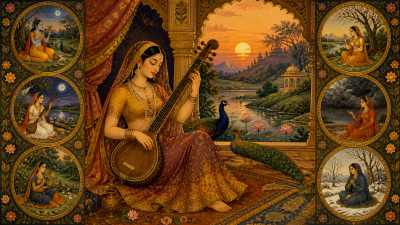
Ragamala (literally “Garland of Ragas”) paintings represent a unique fusion of Indian classical music, poetry, and painting. This genre flourished between the 16th and 19th centuries across various Indian courts, primarily within the Rajasthani, Pahari, Deccan, and Mughal schools. It serves as a visual bridge between the auditory experience of a Raga (musical mode) and the visual expression of the emotion (Rasa) or season it evokes.
The Conceptual Framework: Raga, Ragini, and Putra
Ragamala paintings are based on the personification of musical modes. In the traditional classification system used by artists, Ragas were organized into “families” to reflect their harmonic relationships and gendered characteristics.
- Raga: The male parent mode, usually associated with awe, power, or deep meditation. There are typically 6 principal Ragas.
- Ragini: The female spouse of the Raga, expressing themes of love, longing, or devotion. Each Raga usually has 5 or 6 Raginis.
- Putra: The “son” or derivative mode, representing minor variations or sub-melodies.
- Iconography: Each painting is accompanied by a poetic verse (usually in Braj Bhasha or Sanskrit) inscribed at the top, describing the scene and the specific mood of the musical mode.
Regional Variations and Schools
While the theme of Ragamala remained constant, the stylistic execution varied significantly across different art schools.
| School | Characteristics of Ragamala Paintings | Notable Examples |
| Mewar School | Heavy use of bold reds and yellows; focused on the “Nayaka-Nayika” (hero-heroine) aspect of the Ragas. | The 1605 Chavand Ragamala by Nasiruddin. |
| Bundi School | Distinguished by lush vegetation, detailed water bodies, and a rich, glowing color palette. | The Chunar Ragamala (1591), one of the earliest examples. |
| Malwa School | Characterized by flat, monochromatic backgrounds and large, expressive eyes. | The Amiru Ragamala series. |
| Deccan School | Influenced by Persian aesthetics; features tall figures, distinct flora, and a more somber color palette. | Bijapur Ragamala (late 16th century). |
| Pahari School | Focused on lyrical grace and the landscapes of the Himalayan foothills. | The Basohli Ragamala and Kangra Ragamala. |
Thematic Classification of Ragas
Ragamala paintings categorize musical modes based on time of day, seasons, and emotional states.
- Bhairav Raga: Usually depicted as Lord Shiva or a king being anointed; associated with the early morning and the autumn season.
- Megh Raga: Represented by Krishna dancing in the rain or a king celebrating the monsoon; associated with the rainy season (Varsha Ritu).
- Deepak Raga: Associated with fire and light; often depicted as a lover sitting under a lamp or a figure emitting light; meant to be sung at night.
- Hindol Raga: Depicted as a couple on a swing (Jhoola) during the spring festival; evokes the mood of joy and rejuvenation.
- Malkauns Raga: Often shows a hero listening to music or a couple in a palace setting; associated with late-night winter.
Artistic Motifs and Symbolism
The artists used specific symbols to help the viewer identify the Raga without needing to read the text.
- Animal Imagery: For example, Todi Ragini is almost always depicted as a lonely woman playing a Veena in a forest, surrounded by attracted deer.
- Architectural Elements: Ragini Khambhavati is often shown with a heroine worshipping Brahma or a deity within a palace courtyard.
- Nature and Weather: Lightning and dark clouds signify Megh Raga, while a bright, clear sun might denote a midday Raga like Sarang.
Historical Significance for UPSC Prelims
- Early Origins: The earliest literary mention of the Ragamala concept is found in the Sangeeta Ratnakara by Sharngadeva (13th century), but the visual tradition matured later.
- Integration of Cultures: Ragamala paintings are a prime example of the “Ganga-Jamuni Tehzeeb,” where Hindu musical concepts were patronized by both Rajput kings and Mughal/Deccani Sultans.
- Technique: Most were executed as “Miniatures” on Vasli (layered paper) using natural pigments derived from stones (lapis lazuli), minerals (cinnabar), and plants (indigo).
- The Chunar Series: This 1591 series is critical for historians as it shows the transition where Mughal naturalism began to merge with the traditional Rajput style of Bundi.
Trivia and Key Facts
- The “Healing” Ragas: In some Ragamala traditions, specific paintings were believed to have the same therapeutic effects as listening to the music itself.
- Verses: The poetry inscribed on these paintings is often from the works of Keshav Das (Rasikapriya) or local court poets, providing a dual delight of literature and art.
- The Number 36: The most common Ragamala set consists of 36 paintings (6 Ragas and their 30 Raginis), though some traditions expand this to 42 or 84.