
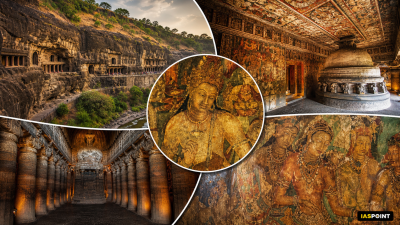
The Ajanta Caves, located in the Aurangabad (Sambhajinagar) district of Maharashtra, represent the pinnacle of ancient Indian mural painting. Carved into the basaltic cliffs of the Sahyadri ranges along the Waghur River, these 29 Buddhist caves were developed in two distinct phases: the Hinayana phase (2nd century BCE to 1st century CE) and the Mahayana phase (5th century CE to 6th century CE). While the caves are celebrated for their architecture and sculpture, it is the murals—covering the walls, ceilings, and pillars—that provide a 360-degree view of the socio-religious and artistic life of ancient India.
Technical Brilliance: The “Indian Fresco” Technique
Contrary to popular belief, Ajanta murals are not “true frescoes” (fresco buono) but a variation of the Fresco Secco technique.
- Preparation of the Ground: The rock surface was first covered with a thick layer of clay mixed with cow dung, rice husks, and vegetable fibers.
- The Second Layer: A thin coat of lime plaster (chunam) was applied over the base to create a smooth surface for the pigments.
- The Painting Process: Colors were applied only after the plaster had dried.
- Pigment Sourcing: Artists used natural minerals.
- Red and Yellow: Ochre (Geru).
- White: Lime or Kaolin.
- Black: Lamp soot/Charcoal.
- Green: Glauconite (Terra Verte).
- Blue: Lapis Lazuli (imported from Afghanistan), used exclusively in later caves like Cave 1 and 2.
- Binding Agent: Animal glue or vegetable glue was used to ensure the pigments adhered to the lime-plastered surface.
Thematic Evolution: Narrative and Symbolism
The paintings at Ajanta primarily focus on the life of the Buddha and the various incarnations of the Bodhisattvas.
- Jataka Tales: These murals depict stories of the Buddha’s previous births, such as the Shibi Jataka (the King who gave his flesh to save a dove) and the Mahajanaka Jataka.
- Life of Gautama Buddha: Scenes include the Birth of Buddha, the Great Departure (Mahabhinishkramana), and the Temptation of Mara.
- Court and Social Life: Despite the religious setting, the murals provide vivid details of contemporary life, including dress, jewelry, hairstyles, musical instruments, and international relations (e.g., the “Persian Embassy” scene).
- Decorative Motifs: Ceilings are adorned with intricate floral patterns, geometric designs, and depictions of mythical creatures like the Makara and Kinnaras.
Artistic Characteristics and Styles
The Ajanta murals are defined by their adherence to the Shadanga (Six Limbs) principles, particularly Bhava (expression) and Lavanya (grace).
- Three-Dimensionality: Artists used a technique of shading and “contouring” (strengthening the outlines) to create a sense of volume and depth on a two-dimensional surface.
- Dynamic Poses: The use of the Tribhanga (triple-bend) pose and graceful mudras gives the figures a sense of fluidity and movement.
- Narrative Continuity: The stories are not always told in linear panels; they often flow into one another, using pillars or architectural elements as subtle boundaries.
- Emotional Depth: The facial expressions are highly nuanced, ranging from the meditative serenity of the Bodhisattvas to the chaotic energy of the crowds.
Key Caves and Masterpieces
| Cave Number | Primary Artistic Feature | Significance |
| Cave 1 | Padmapani and Vajrapani | Represents the peak of Mahayana art; Padmapani holds a blue lotus signifying compassion. |
| Cave 2 | Ceiling and Birth of Buddha | Famous for its exceptionally well-preserved decorative ceiling and “The Thousand Buddhas” painting. |
| Cave 9 & 10 | Earliest Murals | Belongs to the Hinayana phase; characterized by simpler styles and clothing similar to Sanchi/Bharhut. |
| Cave 16 | The Dying Princess | Regarded as one of the most pathetic and expressive scenes in world art; depicts the grief of Nanda’s wife. |
| Cave 17 | The “Zodiac” and Vessantara Jataka | Features a wheel representing the Wheel of Life and numerous well-preserved narrative scenes. |
Patronage and Chronology
The development of the murals was made possible through the patronage of various dynasties and local elites.
- Early Phase: Supported by the Satavahana dynasty.
- Later Phase: Heavily patronized by the Vakataka dynasty, particularly under King Harishena.
- Donative Inscriptions: Many paintings were funded by individual monks, ministers (like Varahadeva), and feudatory princes, indicating that the site was a collective cultural endeavor.
Comparison: Hinayana vs. Mahayana Murals
| Feature | Hinayana Phase (2nd c. BCE – 1st c. CE) | Mahayana Phase (5th c. CE – 6th c. CE) |
| Caves | 9 and 10 | 1, 2, 16, 17, 19, etc. |
| Focus | Symbolic (Stupa, Footprints, Bodhi Tree). | Anthropomorphic (Human form of Buddha). |
| Palette | Limited; mostly ochre, red, and brown. | Vibrant; extensive use of Blue (Lapis Lazuli). |
| Style | Stiff, similar to Shunga art. | Fluid, graceful, and highly sophisticated. |
UPSC Prelims Fact-File and Trivia
- Discovery: The caves were “rediscovered” in 1819 by John Smith, a British cavalry officer, during a tiger hunt.
- UNESCO Status: Ajanta was designated a UNESCO World Heritage Site in 1983.
- Chinese Travelers: While Faxian (Fa-Hien) and Xuanzang (Hiuen Tsang) mentioned Buddhist monasteries in India, their descriptions of Ajanta are relatively brief, suggesting it might have been in decline or remote during their visits.
- The “Lapis Lazuli” Factor: The presence of blue pigment in the 5th-century caves is a crucial indicator of thriving trade routes with Central Asia (Badakhshan region of Afghanistan).
- Preservation Issues: The murals have suffered due to soot from oil lamps, moisture, and early “restoration” attempts using shellac, which darkened the paintings.
- Influence: The Ajanta style traveled via the Silk Road, influencing the art of Sigiriya (Sri Lanka), Bamiyan (Afghanistan), and the Kizil Caves (China).
Artistic Legacy in Indian Tradition
The Ajanta mural tradition is considered the “Mother of all Indian Paintings.” It laid the foundation for the Bagh Caves (Madhya Pradesh), Sittanavasal (Tamil Nadu), and the Badami cave paintings. The emphasis on line, the use of color to define mood, and the mastery of the human form created an aesthetic standard that defined Indian art for over a millennium, eventually influencing the miniature traditions of the medieval period.
Last Modified: May 4, 2026