
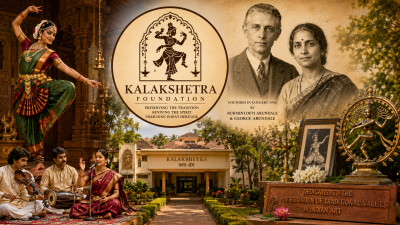
The Kalakshetra Foundation is a premier cultural institution dedicated to the preservation of traditional values in Indian art, particularly in the fields of Bharatanatyam and Carnatic music. It was established in January 1936 by the legendary Rukmini Devi Arundale, along with her husband George Arundale. The foundation was envisioned as an academy to revive the “spirit” of Indian art and to rescue Bharatanatyam (formerly known as Sadir) from social stigma, elevating it to a respected classical art form.
Institutional Transformation and Status
Originally situated within the Theosophical Society’s grounds in Adyar, Chennai, the foundation moved to its current 100-acre campus in Thiruvanmiyur in 1962.
- National Importance: Recognizing its significant contribution to Indian heritage, the Parliament of India passed the Kalakshetra Foundation Act, 1993, declaring it an “Institution of National Importance.”
- Administrative Control: It functions as an Autonomous Body under the Ministry of Culture, Government of India.
- Organizational Structure: The foundation is governed by a Board headed by a Chairman appointed by the Government of India.
The “Kalakshetra Style” of Bharatanatyam
Rukmini Devi Arundale introduced a distinct pedagogy and aesthetic known worldwide as the Kalakshetra Style. This style is characterized by:
- Angular Geometry: Precise, linear movements and sharp, defined lines of the body.
- Restraint and Grace: The removal of unnecessary lascivious elements (sringara) to focus on the spiritual and devotional aspects (bhakti).
- Aesthetic Standardization: Introduction of sophisticated costumes (Kalakshetra saris), specialized jewelry, and refined stage lighting and set designs.
- Theoretical Grounding: Strong emphasis on the study of the Natya Shastra and Abhinaya Darpana.
Key Units of the Kalakshetra Foundation
The foundation operates through several specialized wings that contribute to the holistic development of art and craft:
| Unit Name | Primary Focus and Function |
| Rukmini Devi College of Fine Arts | Offers diploma and post-diploma courses in Bharatanatyam, Carnatic Music, and Visual Arts. |
| Craft Education and Research Centre | Focuses on the revival of traditional textile arts, specifically Kalamkari and natural dyeing. |
| Weaving Centre | Famous for producing the iconic Kalakshetra Saris, known for their unique color palettes and traditional motifs. |
| Besant Theosophical High School | An integrated educational institution following the foundation’s core cultural values. |
| Research and Documentation Center | Digital and physical archives of rare musical notations, dance photographs, and manuscripts. |
Notable Contributions to Indian Heritage
- Dance Dramas: Rukmini Devi choreographed nearly 25 dance dramas, the most famous being the “Ramayana Series” (6 parts), which remains a benchmark in Indian choreography for its costume design and thematic depth.
- Musical Legacy: The foundation has been home to maestros like Tiger Varadachariar, Mysore Vasudevachar, and Budalur Krishnamurthy Sastrigal, ensuring the purity of the Carnatic tradition.
- Natural Dyeing Revival: The Craft Centre is credited with pioneering the revival of vegetable and natural dyes in the handloom sector long before it became a global trend.
Festivals and Outreach Programs
Kalakshetra hosts several prestigious events that serve as a platform for classical artists:
- Annual Art Festival: Usually held in December-January, featuring performances by students, faculty, and invited maestros.
- Remembering Rukmini Devi: A festival organized in February to commemorate the birth anniversary of the founder.
- Dhwani: A dedicated festival for Carnatic music vocal and instrumental performances.
Significance for UPSC Prelims
- Nodal Ministry: Ministry of Culture.
- Statutory Status: Declared an Institution of National Importance via the 1993 Act.
- Founder’s Accolade: Rukmini Devi Arundale was the first woman in Indian history to be nominated as a member of the Rajya Sabha.
- Theosophical Link: The foundation’s philosophy is deeply influenced by the Theosophical Society’s emphasis on universal brotherhood and the spiritual unity of all life.
- Geographical Indication (GI): The foundation plays a role in the promotion of authentic temple jewelry and traditional silk weaving patterns associated with the region.
Trivia and Key Facts
- The campus is designed as a “Gurukul,” where classes are often held under the shade of massive Banyan trees to foster a connection with nature.
- Annie Besant was a major inspiration for the foundation’s educational philosophy.
- Rukmini Devi Arundale famously declined the offer to be considered for the post of President of India in 1977 to continue her work at Kalakshetra.
- The “Kalakshetra Sari” is a staple in the wardrobe of Bharatanatyam dancers, recognized for its heavy silk, distinct borders, and lack of “zari” in certain traditional patterns to maintain elegance.