
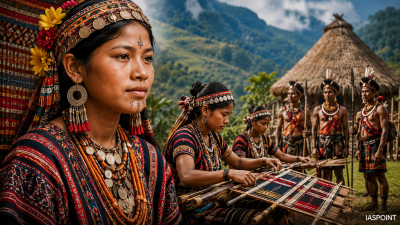
Tribal attire in India represents a sophisticated synthesis of indigenous ecology, spiritual beliefs, and ancestral weaving techniques. Unlike mainstream textiles, tribal clothing often functions as a social semiotic, indicating the wearer’s tribe, marital status, and social hierarchy. These textiles are predominantly hand-woven using back-strap or loin looms, emphasizing the symbiotic relationship between tribal communities and their natural environment.
Distinctive Tribal Attire of North-East India
The “Seven Sister” states represent the most concentrated diversity of tribal weaving, where every pattern carries a specific nomenclature and legendary origin.
Arunachal Pradesh: The Idu Mishmi and Nyishi
- Idu Mishmi: Famous for their black coats with intricate white and red geometric patterns. The craftsmanship is so precise that the designs appear identical on both sides of the fabric.
- Apatani: Notable for the Jig-Jiro, a specialized priest’s robe. Their textiles often use broad stripes and simple geometric borders.
Nagaland: The Language of Shawls
In Naga culture, a shawl is not merely a garment but a “curriculum vitae” of the wearer.
- Tsüngkotepsü (Ao Tribe): A warrior’s shawl featuring a white median band painted with figures of tigers, elephants, and human heads, symbolizing prowess and wealth.
- Angami Shawls: Characterized by the Lohe (dark base with red and yellow borders).
- Chakhesang: Known for using stinging nettle fibers to create durable, eco-friendly textiles.
Manipur and Mizoram
- Phanek (Manipur): A wrap-around skirt worn by Meitei women, often featuring the Moirang Phee design, which incorporates a temple-spire motif (shanko) along the borders.
- Puan (Mizoram): The generic term for Mizo cloth. The Puanchei is the most colorful and prized version, traditionally worn during the Chapchar Kut festival.
Tribal Costumes of Central and Eastern India
Textiles in this belt are characterized by the use of organic cotton, wild silks (Tussar), and motifs inspired by forest flora and fauna.
Odisha: The Dongria Kondh and Santhal
- Kapdaganda (Dongria Kondh): An embroidered shawl gifted by girls to their brothers or suitors. It features geometric triangles representing the “Niyamgiri” hills.
- Santhal Panchee: A two-piece attire (top and bottom) characterized by check patterns and vibrant borders, traditionally woven in thick cotton for durability during agricultural labor.
Chhattisgarh and Madhya Pradesh: The Bastar Region
- Pata (Gond and Maria Tribes): Thick, hand-spun cotton sarees dyed with Aal (Madder) root. The Pangi is a smaller version used as a loincloth by men.
- Baiga Attire: Baiga women traditionally wear a short saree known as Lugra, draped in a way that allows freedom of movement for forest gathering and tattooing.
Tribal Textiles of Western and Southern India
These regions utilize intricate embroidery and unique dyeing processes to distinguish their tribal identities.
Gujarat: The Rabari and Nomadic Tribes
- Kediya: A pleated, frock-like top worn by men, heavily embroidered with mirror work (Abhla) to reflect sunlight and ward off “evil eyes.”
- Ghagra-Choli: Rabari women wear black woollen or cotton skirts with dense chain-stitch embroidery and mirrors, signifying their nomadic heritage.
Southern India: The Todas and Lambadis
- Puthukuli (Toda Tribe, Nilgiris): A distinct white shawl with red and black woollen embroidery. The designs are inspired by the cosmos, buffalo horns, and local flora. It has been granted Geographical Indication (GI) status.
- Phetiya (Lambadi/Banjara): A highly colorful costume characterized by heavy mirror work, cowries, and coins, reflecting the community’s historical role as nomadic traders.
Comparison of Key Tribal Textile Features
| Tribe | Region | Key Textile/Attire | Primary Material | Unique Feature |
|---|---|---|---|---|
| Sikh | Punjab | Dastar | Cotton | Article of faith |
| Toda | Tamil Nadu | Puthukuli | Cotton/Wool | Reversible embroidery; GI Tag |
| Ao Naga | Nagaland | Tsüngkotepsü | Cotton | Hand-painted warrior motifs |
| Meitei | Manipur | Moirang Phee | Fine Cotton/Silk | Temple spire (Shanko) borders |
| Dongria Kondh | Odisha | Kapdaganda | Cotton | Geometric hill motifs |
| Banjara | Pan-India | Phetiya | Cotton | Mirror and cowrie embellishments |
Technological and Raw Material Aspects
Tribal weaving is an exercise in sustainable resource management, utilizing locally available biodiversity.
- Loin Loom (Back-strap Loom): Predominant in the North-East; it allows the weaver to control the tension of the warp using their body weight, producing narrow but dense fabric.
- Natural Dyes:
- Aal (Morinda citrifolia): Used by tribes in Odisha and Chhattisgarh for deep reds and browns.
- Indigo: Widely used across India for blues.
- Strobilanthes cusia: A plant used in the North-East to achieve deep black/blue hues.
- Wild Silks: The use of Eri (Peace silk), Muga (Golden silk), and Tussar (Wild silk) is common among tribes in Assam, Jharkhand, and Chhattisgarh.
Socio-Cultural Trivia for UPSC Prelims
- GI Protection: Several tribal textiles like the Chakhesang Nettle Shawl, Toda Embroidery, and Kotpad Handloom (Odisha) are protected under the Geographical Indications of Goods Act.
- The Concept of “Vantanj”: In many tribal societies, weaving was traditionally a female-exclusive activity, and a woman’s skill at the loom was a prerequisite for marriage.
- Kotpad Textiles: This is the first textile from Odisha to receive a GI tag; it is unique because the dye is extracted from the root of the Indian Mulberry tree.
- Dhabla: A traditional woollen blanket/shawl of the nomadic tribes of Kutch, often featuring extra-weft techniques.
- The “Kavani”: A traditional wrap used by the Kurumba tribes of the Nilgiris, distinct for its minimalist off-white appearance.