
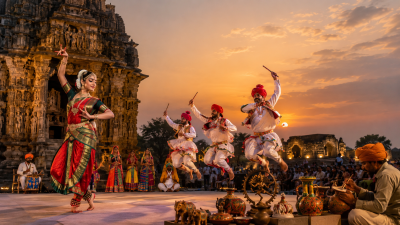
Indian dance festivals serve as a vital link between ancient temple traditions and modern performing arts. Under the patronage of the Ministry of Culture, the Sangeet Natak Akademi, and State Tourism Departments, these festivals are primarily organized at UNESCO World Heritage sites or significant archaeological monuments to promote “Heritage Tourism.” They provide a platform for both Classical and Folk performers while revitalizing the local economy and traditional crafts.
Major Classical Dance Festivals of India
These festivals are usually held during the winter months (October to March) to accommodate the climate and the tourist season. They are often characterized by performances set against the backdrop of historical temples.
| Festival Name | State | Location / Venue | Primary Focus |
| Khajuraho Dance Festival | Madhya Pradesh | Khajuraho Temple Complex | All Indian Classical Dances; held in February. |
| Konark Dance Festival | Odisha | Konark Sun Temple | Odissi and other classical forms; held in December. |
| Mamallapuram Dance Festival | Tamil Nadu | Shore Temple (Mamallapuram) | Focus on Bharatanatyam and South Indian folk arts. |
| Modhera Dance Festival | Gujarat | Sun Temple, Modhera | Also known as Uttarardh Mahotsav; celebrates post-solstice. |
| Nishagandhi Dance Festival | Kerala | Kanakakkunnu Palace, Trivandrum | Diverse classical and folk forms of India. |
| Natyanjali Dance Festival | Tamil Nadu | Chidambaram Nataraja Temple | Dedicated to Lord Shiva; begins on Maha Shivaratri. |
Detailed Analysis of Landmark Festivals
Khajuraho Dance Festival (Madhya Pradesh)
Organized by the Madhya Pradesh Kala Parishad, this is perhaps the most prestigious dance festival in India.
- Archaeological Context: Performances take place in the open-air auditorium against the backdrop of the Chitragupta (Sun God) and Vishwanatha (Lord Shiva) temples.
- Evolution: Started in 1975, it celebrates the “living” aspect of the sculptures carved on the Khajuraho temples.
- The Artistry: It brings together the “Trinity” of Odissi, Kathak, and Bharatanatyam exponents annually.
Konark Dance Festival (Odisha)
Not to be confused with the Konark Music & Dance Festival (a separate private event), the state-organized festival is held at the Natyamandapa of the Sun Temple.
- Architectural Significance: The Konark temple itself is designed as a chariot of the Sun God with its walls covered in intricate dance poses (Karana and Mudra).
- Chandrabhaga Mela: Often coincides with the holy dip at the Chandrabhaga beach.
Natyanjali Festival (Chidambaram)
“Natyanjali” means “offering through dance.” It is a unique spiritual-cultural event.
- Deity Focus: It honors Lord Nataraja, the Cosmic Dancer.
- Duration: It is a five-day festival starting on the auspicious day of Maha Shivaratri.
- Cultural Reach: It serves as a convergence point for thousands of dancers from across the globe who perform as a form of “Arpana” (dedication) rather than mere competition.
Regional and Folk-Centric Dance Festivals
While classical festivals dominate the heritage sites, several festivals specifically celebrate the tribal and folk vibrancy of India.
- Bailay-Kala (Goa): Focuses on the folk dances of the Konkan region like Fugdi and Dhalo.
- Hornbill Festival (Nagaland): Often called the “Festival of Festivals,” it showcases the distinct war dances and tribal steps of the 16 Naga tribes.
- Island Tourism Festival (Andaman & Nicobar): A unique confluence where mainland Indian dances (like Kathak and Bharatnatyam) meet the indigenous Nicobarese tribal dances.
- Hampi Utsav (Karnataka): Also known as Vijaya Utsav; it recreates the grandeur of the Vijayanagara Empire through dance and puppet shows.
Key Institutions and Patronage
The survival and global reach of these festivals are supported by specific governmental and semi-governmental bodies.
- Sangeet Natak Akademi (SNA): The national level academy for performing arts that provides financial grants and recognition.
- Zonal Cultural Centres (ZCCs): Seven centers (like North Zone, South Zone, etc.) that promote regional folk dances through “Octave” (for NE India) and other festivals.
- Indian Council for Cultural Relations (ICCR): Facilitates the participation of international troupes and the promotion of Indian festivals abroad.
- SPIC MACAY: A non-profit organization that brings classical dance festivals to schools and colleges to sensitize the youth to Indian heritage.
Trivia and Facts for UPSC Prelims
- Mukteswar Dance Festival: A boutique festival in Odisha focused exclusively on Odissi, held at the 10th-century Mukteswar Temple.
- Dhauli-Kalinga Mahotsav: Held at the Peace Pagoda (Vishwa Shanti Stupa) in Bhubaneswar, it uniquely combines classical dance with martial arts (like Kalaripayattu and Thang-Ta).
- The Concept of Natyamandapa: Most major festivals are held in the Natyamandapa (dancing hall) of ancient temples, which were scientifically designed for acoustic brilliance and visibility.
- UNESCO Connect: The Khajuraho, Hampi, and Mamallapuram festivals are all held at UNESCO World Heritage Sites, emphasizing the link between Tangible (Architecture) and Intangible (Dance) heritage.
- Elephanta Festival: Held at the Elephanta Caves (Mumbai), it is organized by the Maharashtra Tourism Development Corporation (MTDC) and involves a boat journey to the island, blending maritime heritage with classical arts.