
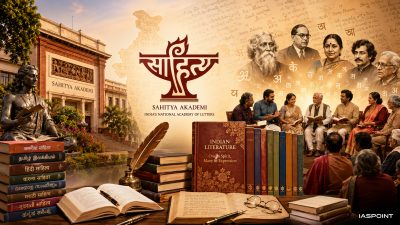
The Sahitya Akademi, India’s National Academy of Letters, is the central institution for literary dialogue, publication, and promotion in the country. Established to preserve and promote the highest standards of Indian literature, it functions as an autonomous organization under the Ministry of Culture. It serves as a unique platform where writers from 24 different languages meet and deliberate, fostering the concept of “Indian Literature is one, though written in many languages.”
Historical Genesis and Institutional Framework
- Establishment: Formally inaugurated by the Government of India on March 12, 1954.
- Registration: Registered as a society in 1956 under the Societies Registration Act, 1860.
- First President: Pandit Jawaharlal Nehru.
- Headquarters: Located at Rabindra Bhavan, New Delhi (shared with Sangeet Natak Akademi and Lalit Kala Akademi).
- Governance: Managed by a General Council, an Executive Board, and Finance and Language Advisory Boards for each recognized language.
Languages Recognized by the Akademi
While the Eighth Schedule of the Indian Constitution recognizes 22 languages, the Sahitya Akademi recognizes a total of 24 languages. This inclusion is vital for UPSC Prelims as it highlights the Akademi’s broader linguistic scope.
| Category | Languages |
| 8th Schedule Languages (22) | Assamese, Bengali, Bodo, Dogri, Gujarati, Hindi, Kannada, Kashmiri, Konkani, Maithili, Malayalam, Manipuri, Marathi, Nepali, Odia, Punjabi, Sanskrit, Santhali, Sindhi, Tamil, Telugu, Urdu. |
| Additional Languages (02) | English and Rajasthani. |
Key Awards and Honours
The Akademi confers several prestigious awards that are benchmarks of literary excellence in India.
Sahitya Akademi Award
- Nature: Annual award given to the most outstanding books of literary merit published in any of the 24 recognized languages.
- Criteria: The work must be an outstanding contribution to the language and literature to which it belongs.
- Casket: Includes a casket containing an engraved copper plaque, a shawl, and a cash prize of ₹1,00,000.
Sahitya Akademi Fellowship
- Significance: The highest honor conferred by the Akademi.
- Selection: Reserved for “Immortals of Literature,” it is limited to a maximum of 21 living fellows at any given time.
Other Specialized Awards
- Bhasha Samman: Given to writers/scholars for significant contribution to classical and medieval literature or to languages not formally recognized by the Akademi.
- Sahitya Akademi Prize for Translation: Recognizes the best translations in the 24 languages to encourage cross-cultural literary exchange.
- Yuva Puraskar: Encourages young writers under the age of 35.
- Bal Sahitya Puraskar: Awarded for outstanding contribution to children’s literature.
Major Projects and Publications
- Encyclopaedia of Indian Literature: A massive project documenting the history and development of Indian literature across centuries.
- National Bibliography of Indian Literature: A comprehensive record of books published in Indian languages.
- Journals: The Akademi publishes two bimonthly literary journals:
- Indian Literature (English)
- Samkalina Bhartiya Sahitya (Hindi)
- Archives of Indian Terminology: A project aimed at preserving oral traditions and tribal literature.
Functional Wings and Regional Presence
To ensure a pan-India reach, the Akademi operates through several regional offices and specialized centers:
- Regional Offices: Located in Kolkata, Mumbai, Bengaluru, and Chennai.
- Library: The Sahitya Akademi Library in New Delhi is one of the most important multi-lingual libraries in India, housing a vast collection of books in the 24 recognized languages.
- Centre for Tribal and Oral Literature: Based in Agartala, it focuses specifically on the promotion of unwritten or oral literary traditions of India.
Trivia and Facts for UPSC
- The Plaque: The Sahitya Akademi award plaque was designed by the renowned Indian filmmaker Satyajit Ray.
- Classical Languages: The Akademi provides specialized support for languages designated as “Classical” by the Government of India (Sanskrit, Tamil, Kannada, Telugu, Malayalam, Odia, Marathi, Pali, Prakrit, Bengali, and Assamese).
- First Women Awardee: Amrita Pritam was the first woman to win the Sahitya Akademi Award in 1956 for her Punjabi poem Sunehade.
- The Motto: The motto of the Akademi is “Indian Literature is one, though written in many languages,” reflecting the civilizational unity of India.