
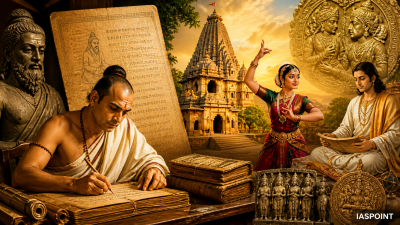
Classical Sanskrit marks a departure from the archaic Vedic Sanskrit, characterized by the formalization of grammar by Panini in his Ashtadhyayi (4th Century BC). This period witnessed the transition from purely religious hymns to sophisticated “Kavya” (poetry), drama, and scientific treatises. It flourished primarily under the patronage of the Guptas, often referred to as the “Golden Age” of Indian culture.
The Foundation: Grammar and Epics
The structural integrity of Classical Sanskrit literature rests on foundational grammatical works and the two “Itihasas” (Epics).
- Grammatical Pillars: Panini’s Ashtadhyayi provided the linguistic framework. This was followed by Patanjali’s Mahabhashya (2nd Century BC), a commentary on Panini, and Bhartrihari’s Vakyapadiya, which explored the philosophy of language.
- The Epics (Itihasa):
- Ramayana: Attributed to Valmiki (the Adi Kavi), it consists of 24,000 verses across seven Kandas. It is the first example of the Kavya style.
- Mahabharata: Attributed to Ved Vyasa, it is the longest epic in the world with 100,000 verses (Sata-sahasri Samhita). It includes the Bhagavad Gita, found in the Bhishma Parva.
Mahakavyas: The Great Court Epics
A Mahakavya is a major epic poem characterized by elaborate descriptions and the use of diverse meters. Tradition recognizes five “Great Epics” (Pancha-mahakavyas):
| Title | Author | Theme/Subject |
| Raghuvamsha | Kalidasa | Genealogy and exploits of the Raghu dynasty (Lord Rama’s lineage) |
| Kumarasambhava | Kalidasa | The birth of Kumara (Kartikeya), son of Shiva and Parvati |
| Kiratarjuniya | Bharavi | The combat between Arjuna and Lord Shiva (in the guise of a Kirata) |
| Shishupala Vadha | Magha | The slaying of Shishupala by Lord Krishna during the Rajasuya Yajna |
| Nishadha Charita | Sri Harsha | The life and romance of King Nala and Princess Damayanti |
Sanskrit Drama (Nataka)
Classical Sanskrit drama is unique for its “Nandimukha” (prologue) and the “Vidushaka” (the fool/clown character who usually speaks Prakrit). Unlike Greek tragedies, Sanskrit plays traditionally end on a happy note.
- Bhasa: The earliest known dramatist. His famous works include Svapnavasavadattam (Vision of Vasavadatta) and Pratigya Yaugandharayana.
- Kalidasa: Often called the “Shakespeare of India.” His masterpiece, Abhijnanashakuntalam, tells the story of King Dushyanta and Shakuntala. Other notable plays include Malavikagnimitram and Vikramorvashiyam.
- Shudraka: Authored Mrichchhakatika (The Little Clay Cart), notable for its realistic portrayal of urban life, featuring a merchant (Charudatta) and a courtesan (Vasantasena).
- Vishakhadatta: Wrote Mudrarakshasa, a rare political thriller detailing Chandragupta Maurya’s ascent and Chanakya’s strategies. He also wrote Devichandraguptam.
- Bhavabhuti: Known for Uttaramacharita (the later life of Rama) and Malatimadhava. He is often ranked alongside Kalidasa for his emotional depth.
- Harshavardhana: The King of Kannauj himself authored three plays: Ratnavali, Priyadarsika, and Nagananda.
Lyric Poetry (Khandakavya) and Anthologies
Sanskrit lyric poetry focuses on themes of love, nature, and ethics.
- Kalidasa’s Lyrics: Meghaduta (The Cloud Messenger), where a Yaksha sends a message to his wife via a cloud, and Ritusamhara, a description of the six Indian seasons.
- Jayadeva: Authored Gita Govinda (12th Century), describing the divine love between Krishna and Radha. This work profoundly influenced the Bhakti movement.
- Bhartrihari: Wrote the Shatakatraya (Three Centuries of Verses): Niti Shataka (Ethics), Shringara Shataka (Love), and Vairagya Shataka (Renunciation).
- Pandita Jagannatha: A later scholar (Mughal era) who wrote Bhamini-vilasa.
Didactic Fables and Narrative Literature
Prose literature often served educational purposes, teaching morals and statecraft through animal fables.
- Panchatantra: Attributed to Vishnu Sharma, it is one of the most translated non-religious books in history. It uses “frame stories” to teach Niti (policy/conduct).
- Hitopadesha: Written by Narayana Pandit, inspired largely by the Panchatantra.
- Kathasaritsagara: Composed by Somadeva, this “Ocean of the Streams of Stories” is a massive collection of legends and fairy tales.
- Dasakumaracharita: Written by Dandin, detailing the adventures of ten princes.
Scientific and Technical Literature (Shastras)
Sanskrit was the primary vehicle for scientific discourse in ancient India.
- Arthashastra: Kautilya’s treatise on statecraft, economic policy, and military strategy.
- Kamasutra: Vatsyayana’s work on the art of living and aesthetics.
- Mathematics & Astronomy:
- Aryabhatiya by Aryabhata (Algebra, Trigonometry, and Astronomy).
- Brahmasphuta-siddhanta by Brahmagupta (introduced the concept of zero as a number).
- Siddhanta Shiromani by Bhaskaracharya.
- Medicine (Ayurveda):
- Charaka Samhita (Internal medicine).
- Sushruta Samhita (Surgery, including plastic surgery).
Important Trivia for UPSC Prelims
- The Bilingualism of Plays: In Sanskrit drama, high-ranking characters (Kings, Brahmins) speak Sanskrit, while women and lower-class characters speak various dialects of Prakrit.
- The Navaratnas: Nine gems (scholars) in the court of Chandragupta II (Vikramaditya) included Kalidasa, Amarasimha (author of the lexicon Amarakosha), and Varahamihira.
- Prashastis: These are courtly inscriptions in Sanskrit, such as the Allahabad Pillar Inscription (Prayag Prashasti) composed by Harisena in praise of Samudragupta.
- Kavya Mimamsa: A practical guide for poets written by Rajashekhara in the 10th Century.
- Influence on South East Asia: Sanskrit literature laid the foundation for the cultural landscape of “Greater India,” influencing the Kakawin literature of Indonesia and the epics of Thailand and Cambodia.