
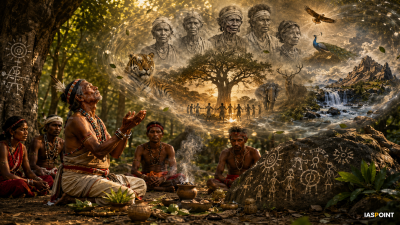
Tribal cosmology in India represents a complex worldview where the boundaries between the physical and spiritual realms are fluid. Unlike institutionalized religions, tribal belief systems are rooted in the immanence of the divine within the natural environment. This perspective views the universe as an interconnected web of humans, ancestors, forest spirits, and natural elements, all maintaining a delicate cosmic balance.
Animism and Totemism: The Spiritual Core
Animism and the Sentient Landscape
Animism is the belief that non-human entities—including animals, plants, mountains, and rivers—possess a spiritual essence or soul. In the Indian tribal context, this manifests as the veneration of specific ecological niches.
- Sarnaism: Followed by tribes like the Santhal, Munda, and Ho in the Chota Nagpur Plateau, it centers on the worship of the Sarna (sacred grove), believed to be the abode of the village deity.
- Donyi-Polo: Practiced by the Tani groups (Adi, Nyishi) in Arunachal Pradesh, focusing on the Sun (Donyi) and the Moon (Polo) as the supreme witnesses of truth and harmony.
- Spiritual Stewardship: For tribes like the Dongria Kondh of Odisha, the Niyamgiri hills are not merely resources but the physical manifestation of their deity, Niyam Raja.
Totemism and Clan Identity
Totemism involves a mystical relationship between a social group (clan) and a specific animal or plant species (totem).
- Social Function: Totems serve as the basis for clan exogamy (marriage rules) and social organization.
- Taboos: Members of a clan are strictly forbidden from killing, eating, or harming their totem. For instance, the Tigga (Monkey) clan among the Oraons will never harm a monkey.
- Examples: Common totems include the Tiger (Baghel), Tortoise (Kachhap), and various species of trees like the Mahua or Sal.
Sacred Spaces and the Cult of Ancestors
Sacred Groves (Natural Temples)
Sacred groves are patches of forest dedicated to local deities and protected by customary laws. They act as gene banks and micro-ecosystems.
- Nomenclature: Known as Kavu in Kerala, Devarakadu in Karnataka, and Jaher Than among the Santhals.
- Conservation: These groves represent the intersection of tribal cosmology and indigenous ecological conservation, often containing rare medicinal plants and water sources.
Ancestor Worship and the Living-Dead
The belief that ancestors continue to influence the lives of the living is central to tribal stability and morality.
- Memorial Stones: The Munda and Ho tribes erect Sasandiri (large stone slabs) over the burial sites of ancestors.
- Gadhok ritual: Among the Garos of Meghalaya, specific rituals are performed to guide the soul to the land of the ancestors (Mangru-Mangram).
- The Saora Idital: The Saora tribe of Odisha creates elaborate wall paintings (Idital) specifically to appease ancestors and spirits to prevent illness or crop failure.
Deities and Supernatural Hierarchy
Tribal pantheons are typically hierarchical, featuring a supreme creator deity followed by territorial and household spirits.
| Tribe | Supreme Deity / Concept | Functional Role |
| Santhal | Marang Buru / Thakur Jiu | The Great Mountain / Supreme Creator |
| Gond | Baradeo (Persa Pen) | The supreme clan deity residing in the Saja tree |
| Munda | Singbonga | Associated with the Sun and the creation of the world |
| Bhil | Raja Pantha | A powerful protector deity of the community |
| Ao Naga | Tsungrem | Spirits that inhabit trees, stones, and water |
Ritualism, Shamanism, and Folklore
The Role of the Shaman
The Shaman (known variously as Pahan, Baiga, or Deori) acts as the intermediary between the human and spirit worlds.
- Divination: Shamans use techniques like grain-sorting or egg-breaking to diagnose the cause of spiritual displeasure.
- Healing: Most tribal medical systems are “ethno-religious,” where herbal cures are accompanied by spirit-appeasing rituals.
Oral Traditions and Cosmogonical Myths
Tribal cosmologies are preserved through oral epics rather than written scriptures.
- Creation Myths: Often involve a “Great Flood” or the emergence of humans from the earth/caves.
- Folklore as Law: Myths dictate the moral code. For example, the Naga folklore regarding the origin of different tribes emphasizes the shared ancestry of man and tiger, fostering a specific ethics of the hunt.
Trivia and Quick Facts for Prelims
- Pehariya Tribe: Believes that their ancestors were the first humans born on earth, emerging from the hills of Rajmahal.
- The Concept of ‘Bonga’: Among the Mundari-speaking tribes, Bonga is a generic term for a spirit or power that can be benevolent or malevolent depending on how it is treated.
- Bastar Dussehra: Unlike the mainstream Ramayana-based Dussehra, this 75-day festival in Chhattisgarh focuses on the tribal goddess Danteshwari and involves complex rituals of the Maria and Muria tribes.
- Cultural Persistence: Despite the influence of Christianity in the North-East and Hinduism in Central India, many tribes practice “syncretism,” maintaining traditional animistic rituals alongside new religious identities.