
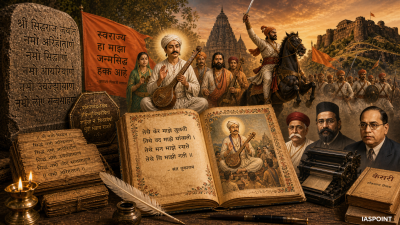
Marathi literature, belonging to the Indo-Aryan family, evolved from Maharashtri Prakrit and Apabhramsa. Its journey is categorized into the early Yadava period, the era of the Bhakti saints, the heroic ballads of the Maratha period, and the modern renaissance.
The Early Period: Yadava Dynasty and Birth of Prose
The earliest written evidence of Marathi is found in the Shravanabelagola inscription (983 AD) in Karnataka. However, the literary foundation was solidified during the Yadava dynasty of Devagiri.
- Mahanubhava Sect: Led by Chakradhar Swami, this sect rejected Sanskrit in favor of Marathi to reach the masses. The Leela Charitra (1270s) by Mhendra Bhat is considered the first biography in Marathi.
- Vivekasindhu: Written by Mukundaraj in the 12th century, it is regarded as one of the earliest philosophical treatises in the Marathi language, dealing with Vedantic philosophy.
The Age of Bhakti: The Varkari Movement
The most significant phase of Marathi literature is the Varkari tradition, which decentralized spiritual knowledge through Abhangas (devotional hymns).
| Saint-Poet | Major Work | Significance |
| Sant Dnyaneshwar | Dnyaneshwari & Amrutanubhav | A commentary on the Bhagavad Gita; he is called the ‘Mauli’ of Marathi literature for laying its foundation. |
| Sant Namdev | Abhangas | A pioneer of the Bhakti movement who traveled to Punjab; his verses are included in the Guru Granth Sahib. |
| Sant Eknath | Eknathi Bhagavata | Known for ‘Bharud’ (folk songs with double meanings) and his efforts to democratize the Sanskrit Puranas. |
| Sant Tukaram | Tukaram Gatha | Represented the pinnacle of the Bhakti movement; his poetry focused on social equality and internal purity. |
| Sant Ramdas | Dasbodh | A contemporary of Shivaji Maharaj, his work blended spiritualism with practical worldly wisdom and organizational skills. |
The Maratha Period: Heroic Ballads and Chronicles
During the 17th and 18th centuries, the literature shifted from purely devotional to administrative and heroic themes under the Maratha Empire.
- Bakhar: A unique form of Marathi historical narrative prose. Famous examples include the Sabhasad Bakhar (biography of Shivaji Maharaj) and the Bhausahebanchi Bakhar (detailing the Battle of Panipat).
- Powada: High-energy heroic ballads composed by Shahirs to narrate the exploits of warriors.
- Lavani: A musical-literary form that flourished under the Peshwas, often focused on Shringara (erotic/romantic) themes.
Modern Marathi Literature: The Renaissance
The 19th-century “Bombay Renaissance” introduced Western literary forms like the novel, essay, and modern drama.
Pioneers of Modernity
- Balshastri Jambhekar: Known as the “Father of Marathi Journalism,” he started the first Marathi newspaper, Darpan, in 1832.
- Baba Padmanji: Authored Yamuna Paryatan (1857), considered the first modern Marathi novel, which focused on the plight of widows.
- Mahatma Jyotiba Phule: Introduced radical social reform literature through works like Gulamgiri and Shetkarayacha Asud.
The Novel and Poetry
- Hari Narayan Apte: The father of the modern Marathi novel, known for historical fiction like Ushakal and social novels like Pan Lakshat Kon Gheto.
- Keshavasut: Known as the “Father of Modern Marathi Poetry,” he broke away from traditional religious themes to write about nature, social revolt, and individualism.
- Vishnu Shastri Chiplunkar: Often called the “Shivaji of Marathi Language,” his journal Nibandhmala was instrumental in reviving cultural pride.
Key Literary Forms and Traditions
- Abhanga: A form of devotional poetry sung in praise of Lord Vitthal.
- Bharud: A satirical and didactic folk song used by Sant Eknath for social education.
- Natyasangeet: A unique blend of classical music and drama that reached its peak with Annasaheb Kirloskar (Shaakuntal) and Bal Gandharva.
- Dalit Literature: A powerful 20th-century movement led by writers like Baburao Bagul (Jevha Mi Jaat Chorli Hoti), focusing on the lived experiences of the oppressed.
Contemporary Achievements and Honors
Marathi literature boasts a robust tradition of excellence recognized at the national level.
- Jnanpith Awardees:
- V.S. Khandekar (1974) – For the novel Yayati.
- V.V. Shirwadkar (Kusumagraj) (1987) – Noted for the play Natsamrat.
- Vinda Karandikar (2003).
- Bhalchandra Nemade (2014) – Known for his magnum opus Hindu: Ek Samruddha अडगळ (A Rich Dump) and the cult classic Kosala.
Important Facts for UPSC Prelims
- Classical Language Demand: Marathi meets the criteria for “Classical Language” status (high antiquity, original literary tradition), which was officially granted in October 2024.
- Marathi Bhasha Din: Celebrated on February 27th, the birthday of the eminent poet Kusumagraj.
- Akhil Bharatiya Marathi Sahitya Sammelan: An annual conference for Marathi writers, first presided over by Justice M.G. Ranade in 1878.
- Modi Script: Historically, Marathi was written in the Modi script (a cursive style) before the Devanagari script (Balbodh) became standardized in the 19th century.