
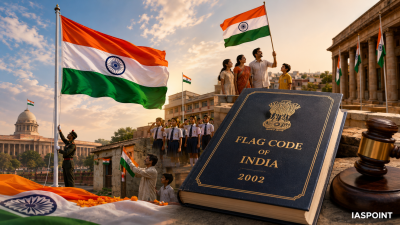
The Flag Code of India, 2002, is a comprehensive set of laws, practices, and conventions that govern the display of the National Flag. It was brought into effect on January 26, 2002, to ensure the dignity of the Tiranga while making it more accessible to the general public.
- Consolidation of Laws: The Code supersedes all earlier executive instructions and consolidates the provisions of the Emblems and Names (Prevention of Improper Use) Act, 1950, and the Prevention of Insults to National Honour Act, 1971.
- Three-Part Structure:
- Part I: General description and specifications of the National Flag.
- Part II: Rules for display of the flag by members of the public, private organizations, and educational institutions.
- Part III: Rules for display of the flag by Central and State Governments and their organizations/agencies.
Key Specifications and Recent Amendments
The Flag Code dictates the physical attributes and material requirements for the National Flag. Significant changes were introduced in 2021 and 2022 to align the code with modern campaigns like ‘Har Ghar Tiranga’.
- Material of the Flag: Originally, the code mandated that the flag must be made of hand-spun and hand-woven wool, cotton, or silk khadi. The 2021 Amendment now permits flags made of polyester or machine-made cotton, wool, silk, and khadi.
- Shape and Ratio: The flag must be rectangular. The ratio of the length to the height (width) of the flag must be 3:2.
- Timing of Display: In a major shift, the July 2022 Amendment allowed the flag to be flown day and night if displayed in the open or on the house of a member of the public. Previously, the flag could only be flown from sunrise to sunset.
Rules for General Display and Proper Conduct
The Code outlines strict protocols to prevent the National Flag from being treated with disrespect.
- Distinctive Placement: When displayed with other flags, the National Flag must be at the highest point or placed to the extreme right of the observer.
- Prohibited Uses:
- The flag shall not be used as a drapery in any form whatsoever, including private funerals.
- It shall not be used as a portion of a costume or uniform, nor shall it be embroidered or printed on cushions, napkins, or undergarments.
- No lettering of any kind shall be placed upon the flag.
- It should not be used as a receptacle for receiving, delivering, or carrying anything.
- Position of Saffron: The saffron band must always be the topmost (in horizontal display) or to the extreme left of the observer (in vertical display).
Protocol for Official and Ceremonial Use
Part III of the Code specifies how the flag is to be used by government dignitaries and during state events.
- Right to Fly on Vehicles: The privilege of flying the National Flag on motor cars is limited to specific high-ranking officials:
- President and Vice-President.
- Governors and Lieutenant Governors.
- Prime Minister and Cabinet Ministers.
- Chief Justice of India and Judges of the Supreme Court/High Courts.
- Speaker of the Lok Sabha and Chairpersons of State Legislative Councils.
- Half-Mast Protocol: The flag is flown at half-mast during periods of national mourning. In the event of the death of a Head of State (President) or Head of Government (Prime Minister), the flag is flown at half-mast throughout India. For a Union Cabinet Minister, it is flown at half-mast in Delhi and the State Capitals.
Disposal and Dignity
The Code provides clear instructions on the handling of damaged or soiled flags to maintain national honor.
- Damaged Flags: A flag that is in a damaged or soiled condition should not be displayed.
- Method of Disposal: Such flags must be destroyed as a whole in private, preferably by burning or any other method consistent with the dignity of the flag.
- Paper Flags: During national, cultural, or sports events, the public may use small paper flags. However, these should not be discarded on the ground after the event and must be disposed of in private with dignity.
Comparative Summary of Recent Changes
| Feature | Pre-2021/2022 Status | Current Status (Post-Amendments) |
| Material | Strictly hand-spun Khadi (Cotton/Silk/Wool) | Includes machine-made and Polyester |
| Timing | Sunrise to Sunset only | Day and Night (for public/private homes) |
| Public Display | Restricted except on special days | Citizens have a fundamental right to fly it daily |
| Legal Status | Guidelines/Executive Instructions | Legally enforceable through referenced Acts |
Fact Sheet for UPSC Aspirants
- Fundamental Right: In the case of Union of India v. Naveen Jindal (2004), the Supreme Court held that flying the flag is a fundamental right under Article 19(1)(a) of the Constitution.
- Constitutional Duty: Article 51A(a) makes it a Fundamental Duty for every citizen to respect the National Flag.
- Size Standards: There are nine standard sizes of the National Flag specified by the Code, ranging from 6300 × 4200 mm (for large buildings) to 150 × 100 mm (for table flags).
- The 24 Spokes: The Ashoka Chakra in the center represents the “Wheel of the Law of Dharma.” The 24 spokes represent 24 hours of the day, symbolizing the constant movement and progress of the nation.