

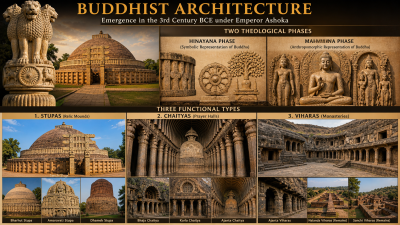
Buddhist architecture emerged as a distinct style in the 3rd century BCE under the patronage of Emperor Ashoka. It evolved through two primary theological phases: the Hinayana phase (symbolic representation of Buddha) and the Mahayana phase (anthropomorphic or physical representation of Buddha). The architecture is fundamentally divided into three functional types: Stupas (relic mounds), Chaityas (prayer halls), and Viharas (monasteries).
The Stupa: Cosmic Symbolism and Structure
The Stupa originated from pre-Buddhist burial mounds (Tumuli). In Buddhism, it became a commemorative monument housing the sacred relics (Dhatu) of the Buddha or his disciples.
Core Components of a Stupa
- Anda: A semi-circular hemispherical mound representing the universe and the infinite.
- Harmika: A square railing on top of the mound, signifying the abode of the gods.
- Chhatra: A triple-umbrella structure representing the Triratna (Buddha, Dhamma, and Sangha).
- Yashti: The central pillar supporting the Chhatra.
- Pradakshina Patha: A circular path for circumambulation, usually enclosed by a railing (Vedica).
- Toranas: Elaborate ceremonial gateways placed at the four cardinal directions, representing the major events of Buddha’s life.
Evolutionary Stages of the Stupa
| Feature | Mauryan Stupa (e.g., Sanchi) | Post-Mauryan Stupa (e.g., Bharhut) | Gupta/Later Stupa (e.g., Dhamekh) |
| Material | Primarily brick and wood. | Stone casing and stone railings. | Use of stone and terracotta with carvings. |
| Decoration | Plain and austere. | Introduction of narrative reliefs (Jatakas). | Geometric and floral patterns; no Jatakas. |
| Buddha | Represented by symbols (Lotus, Wheel). | High-relief symbolic storytelling. | Full-fledged Buddha idols in niches. |
Chaityas: The Centers of Congregational Worship
A Chaitya is a rectangular prayer hall with a rounded rear end (Apse). It typically houses a small stupa at the end of the hall, which serves as the object of devotion.
Architectural Features of Chaityas
- Vaulted Roofs: Large arched roofs, initially supported by wooden ribs and later by stone imitations.
- Gavaksha (Chaitya Window): A horseshoe-shaped window above the entrance that allows light to illuminate the stupa inside.
- Colonnades: Rows of pillars separating the central nave from the side aisles.
- Karle Chaitya (Maharashtra): The largest and most famous rock-cut Chaitya, featuring 15-meter-high pillars with “Mithuna” (couple) sculptures.
Viharas: The Monastic Dwellings
Viharas were residential quarters for monks (Bhikkus). Initially, they were simple rock-cut cells, but they evolved into massive structural universities.
Layout and Function
- Central Courtyard: A square or rectangular open space used for collective gatherings.
- Cells: Small, austere rooms surrounding the courtyard for individual monks.
- Sanctum: In later Mahayana Viharas (like Ajanta Cave 1), a shrine containing a Buddha image was added to the back wall.
- Nalanda University: A prime example of structural Viharas made of brick, featuring multiple stories, libraries (Dharmaganja), and lecture halls.
Schools of Buddhist Art and Iconography
The transition from Hinayana to Mahayana led to the development of three distinct schools of sculpture, each contributing to Buddhist architectural aesthetics.
- Gandhara School: Influenced by Greco-Roman styles. Characterized by “Apollo-like” Buddhas with curly hair, muscular physiques, and heavy pleated robes.
- Mathura School: A purely indigenous style using spotted red sandstone. The Buddha is depicted with a smiling face, shaven head, and thin, clingy muslin drapery.
- Amaravati School: Focused on “Narrative Art.” It used white marble-like limestone to depict complex scenes from the Jataka tales in deep relief.
Key Buddhist Architectural Sites in India
- Sanchi (Madhya Pradesh): Home to the Great Stupa, famous for its Ashokan inscriptions and Satavahana-era Toranas.
- Sarnath (Uttar Pradesh): The site of Dhamekh Stupa and the Lion Capital. It marks the spot of Buddha’s first sermon.
- Ajanta Caves (Maharashtra): 29 rock-cut caves famous for fresco-secco paintings and the transition from Hinayana to Mahayana architecture.
- Ellora Caves (Maharashtra): Features 12 Buddhist caves (Caves 1-12), including the Vishwakarma Cave (a multi-storied Chaitya).
- Dholavira/Lothal (Gujarat): While Harappan, these sites show early circular platforms that some archaeologists link to proto-stupa structures.
- Tabo Monastery (Himachal Pradesh): Known as the “Ajanta of the Himalayas,” it is one of the oldest functional Buddhist monasteries.
Important Facts and Trivia for Prelims
- The Triratna Symbol: Frequently carved on Toranas, it represents the three jewels: Buddha (The Teacher), Dhamma (The Teaching), and Sangha (The Community).
- The Jatakas: These are stories of the previous births of the Buddha, depicted extensively on the railings of Bharhut and the gateways of Sanchi.
- Circumambulation: The Pradakshina is always performed in a clockwise direction, symbolizing the sun’s path across the sky.
- Sultanganj Buddha: A massive 7.5-foot copper statue found in Bihar, representing the peak of Gupta-era Buddhist metallurgy and sculpture.
- Piprahwa Stupa: Located in Uttar Pradesh, it is considered one of the oldest stupas, containing urns that reportedly hold the actual bone fragments of the Buddha.
- Aniconic Phase: In early Buddhist architecture, Buddha was never shown in human form but represented by symbols: an empty throne, a Bodhi tree, a pair of footprints, or the Wheel of Law (Dharmachakra).