
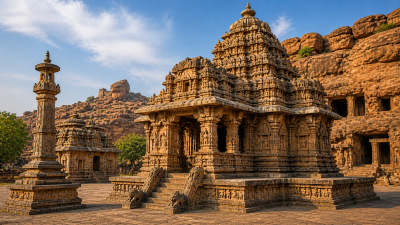
The Badami Chalukyas, also known as the Early Chalukyas, ruled from Vatapi (modern-day Badami) between the 6th and 8th centuries CE. Their reign marks a watershed moment in Indian temple architecture, as it served as a “cradle” for experimentation, blending styles from both North and South India. This synthesis gave birth to the Vesara style (or the Karnataka Dravida style).
Core Architectural Styles
The Chalukyan architects pioneered two distinct structural forms:
Rock-Cut Cave Temples
Primarily located at Badami, these caves represent the transition from Buddhist rock-cut traditions to Hindu structural forms.
- Caves 1-3: Dedicated to Vedic deities (Shiva and Vishnu). Cave 3 is the largest and most ornate, dated to 578 CE during the reign of Mangalesha.
- Cave 4: Dedicated to Jain Tirthankaras, notably Mahavira and Parshvanatha.
- Features: Decorative pillars, bracket figures (Vyalas), and elaborate ceiling carvings depicting the Matsya Chakra and Vidyadharas.
Structural Temples
These are freestanding buildings found predominantly at Aihole, Pattadakal, and Mahakuta.
- Nagara Influence: Seen in the curvilinear shikhara (tower) and square plans (e.g., Papanatha Temple).
- Dravida Influence: Characterized by tiered pyramids (vimanas) and storied arrangements (e.g., Virupaksha Temple).
The Three Main Centers of Architecture
Aihole: The Cradle of Indian Architecture
Aihole houses over 120 temples and was the initial experimental site.
- Lad Khan Temple: Originally a panchayat-style hall, it features a flat roof and a small shrine built into the rear wall.
- Durga Temple: Unique for its Apsidal (semi-circular) plan, mimicking Buddhist Chaitya halls. It features a perambulatory path and an early Nagara shikhara.
- Huchimalli Gudi: Notable for introducing the vestibule (antarala), a transitional space between the sanctum and the hall.
- Meguti Jain Temple: Built by Ravikirti (court poet of Pulakeshin II) in 634 CE. It is the only dated temple in Aihole and sits atop a hill.
Badami: The Capital Stronghold
Apart from the four famous caves, Badami is home to the Bhutanatha Group of Temples.
- Bhutanatha Temple: Situated on the edge of the Agastya Lake, it showcases early Chalukyan masonry with heavy, massive proportions and wide-pillared porches.
- Malegitti Shivalaya: Perched on a hill, it is one of the oldest surviving structural temples, characterized by its lack of an antarala and its sturdy, primitive Dravidian style.
Pattadakal: The UNESCO World Heritage Site
Reaching the pinnacle of Chalukyan art, Pattadakal was the site for royal coronations. It represents a 50-50 split between Nagara and Dravida styles.
| Temple Name | Style | Notable Facts |
| Virupaksha Temple | Dravida | Built by Queen Lokamahadevi to commemorate Vikramaditya II’s victory over the Pallavas. Modeled after the Kailasanathar Temple of Kanchipuram. |
| Sangameshwara Temple | Dravida | The oldest temple at Pattadakal, commissioned by King Vijayaditya. |
| Papanatha Temple | Nagara | Features a short, stunted shikhara and elaborate carvings from the Ramayana and Mahabharata. |
| Galaganatha Temple | Nagara | Contains a curvilinear shikhara with a clear Amalaka and Kalasha at the top. |
| Jain Narayana Temple | Rashtrakuta | Though located here, it was built later (9th century) by the Rashtrakutas, showing continued architectural patronage. |
Key Architectural Features and Innovations
- Sandstone Usage: The primary material was locally available reddish-golden sandstone, which allowed for intricate deep-relief carving.
- Suvarnamukhi River: Most major sites are located on the banks of the Malaprabha River, a tributary of the Krishna.
- Iconography: Introduction of specific motifs such as the Ganga and Yamuna at temple entrances, the Nandi Pavilion, and the Varaha (Boar) avatar of Vishnu, which was the royal emblem of the Chalukyas.
- No Mortar: The temples were constructed using the dry masonry technique, where stones were dressed to fit perfectly without binding materials.
Trivia for Prelims
- UNESCO Status: Pattadakal was inscribed as a World Heritage Site in 1987.
- The Pallava Connection: The capture of Kanchipuram by Vikramaditya II led to the migration of Pallava architects to the Chalukyan kingdom, significantly influencing the Dravida elements in Pattadakal.
- Cave 3 Inscription: Provides the earliest evidence of the use of the Saka Era in inscriptions (Saka 500 = 578 CE).
- First Apsidal Hindu Temple: The Durga Temple at Aihole is often cited as the first major adaptation of the Buddhist Chaitya shape for Hindu worship.