
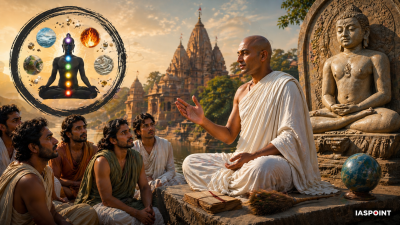
Jain philosophy is one of the oldest heterodox (Nastika) schools of Indian thought, rejecting the authority of the Vedas while emphasizing an independent, soul-centric universe. The core of Jain metaphysics is characterized by realism and pluralism, asserting that the universe is composed of infinite independent entities.
The Doctrine of Reality: Anekantavada and Syadvada
Jainism introduces a unique epistemological framework to understand truth and reality, moving away from absolute assertions.
- Anekantavada (The Theory of Many-Sidedness): This is the metaphysical belief that ultimate truth and reality are complex and have multiple aspects. No single statement can capture the entire nature of an object.
- Syadvada (The Theory of Conditioned Predication): This is the logical expression of Anekantavada. It suggests that all judgments are relative and conditional. Every proposition should be prefaced with Syat (meaning “perhaps” or “in some ways”).
- Nayavada (The Theory of Partial Viewpoints): This refers to the different perspectives through which one perceives a thing. A partial truth is called a Naya.
Jain Metaphysics: The Dravyas (Substances)
Jainism classifies the universe into two main categories: Jiva (Conscious) and Ajiva (Non-conscious). These are further divided into six eternal substances (Dravyas) that constitute the world.
| Substance (Dravya) | Nature | Characteristics |
| Jiva | Soul/Spirit | Infinite in number; possesses consciousness (Chaitanya), bliss, and energy. |
| Pudgala | Matter | The only substance that is perceptible; consists of atoms (Anu). |
| Dharma | Principle of Motion | The medium that helps Jivas and Matter to move (like water for fish). |
| Adharma | Principle of Rest | The medium that helps Jivas and Matter to rest (like shade for a traveler). |
| Akasha | Space | Provides accommodation to all other substances. Divided into Lokakasha and Alokakasha. |
| Kala | Time | Responsible for the change, continuity, and modification of substances. |
The Nine Tattvas (Fundamentals)
The Jain path to liberation is explained through the interaction between the soul and matter via nine fundamental truths.
- Jiva: The living being or soul.
- Ajiva: Non-living matter.
- Punya: Meritorious karma acquired through virtuous acts.
- Papa: Demeritorious karma acquired through harmful acts.
- Asrava (Inflow): The process through which karmic matter flows into the soul due to passions.
- Bandha (Bondage): The sticking of karmic particles to the soul, obscuring its natural qualities.
- Samvara (Stoppage): The obstruction of the inflow of new karmic matter.
- Nirjara (Shedding): The wearing out or destruction of accumulated karma through penance.
- Moksha (Liberation): The total freedom from the cycle of birth and death; the soul attains Siddhashila.
Ethics and the Ratnatraya (Three Jewels)
To achieve the goal of Moksha, Jainism prescribes a threefold path known as the Ratnatraya. These three jewels must be practiced simultaneously.
- Samyak Darshana (Right Faith): True belief in the substances and the teachings of the Tirthankaras.
- Samyak Jnana (Right Knowledge): Precise and thorough knowledge of the universe, free from doubt or error.
- Samyak Charitra (Right Conduct): Living a life based on ethical principles to stop the accumulation of karma.
The Five Main Vows (Pancha Mahavratas)
The ethical code for Jain monks (Mahavratas) and laypeople (Anuvratas) is built upon five pillars.
- Ahimsa (Non-violence): The highest ethical duty. It includes non-injury in thought, word, and deed to all living beings.
- Satya (Truthfulness): Abstaining from falsehood and harmful speech.
- Asteya (Non-stealing): Not taking anything that is not given.
- Brahmacharya (Chastity): Total celibacy for monks; fidelity for householders.
- Aparigraha (Non-possession): Detachment from material possessions and psychological attachments.
Schools of Jainism: Digambara and Svetambara
Following the Great Famine in Magadha (c. 3rd Century BCE), the Jain community split into two major sects based on different interpretations of the code of conduct.
Digambara (Sky-clad)
- Monks do not wear clothes, signifying total detachment.
- Believe that women cannot attain liberation in the same body.
- Follow the original teachings as preserved in the Pro-Canon works like Satkhandagama.
- Major sub-sects: Terapanthi, Bisapanthi.
Svetambara (White-clad)
- Monks wear white seamless robes.
- Believe that women can attain liberation (e.g., the 19th Tirthankara, Mallinath, is considered female by this sect).
- Follow the Agamas (canonical literature) compiled at the Council of Valabhi.
- Major sub-sects: Murtipujaka, Sthanakvasi, Terapanthi.
Important Facts and Trivia for Prelims
- The Tirthankaras: Jainism recognizes 24 Tirthankaras (Ford-makers). Rishabhanatha was the first, and Vardhamana Mahavira was the 24th.
- Concept of God: Jainism is atheistic in the sense that it denies a creator God. However, every liberated soul (Siddha) is considered divine.
- Kaivalya: This is the highest form of knowledge (Omniscience) attained by a soul after destroying all obstructive karmas.
- Sallekhana (Santhara): The philosophical practice of voluntary fasting to death to purge karma at the end of life. Chandragupta Maurya famously performed this at Shravanabelagola.
- Loka: The Jain universe is often depicted in the shape of a man standing with arms akimbo, known as the Purushakara Loka.
- Agamas: The primary scriptures of Jainism, written in Ardhamagadhi Prakrit.