
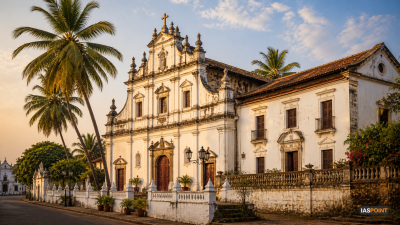
Indo-Portuguese architecture is a distinct colonial style that emerged following the arrival of Vasco da Gama in 1498 and the subsequent establishment of the Portuguese State of India (Estado da Índia). Primarily concentrated in Goa, Daman, Diu, and parts of Kerala and Mumbai, this style is a synthesis of European Gothic, Renaissance, and Baroque aesthetics with Indian materials, climate adaptations, and craftsmanship. It represents the first successful transplantation of European architectural sensibilities onto the Indian subcontinent.
Religious Architecture: The “Rome of the East”
The Portuguese used architecture as a tool for religious proselytization, leading to the construction of grand churches and cathedrals, particularly in Old Goa.
- Baroque and Manueline Influence: Early structures featured the Manueline style (Portuguese late Gothic), which evolved into the grand, theatrical Baroque style characterized by massive facades and ornate altars.
- Use of Local Material: Due to the absence of marble, most churches were built using Laterite (a reddish volcanic rock found in the Konkan). These were then covered with a thick layer of lime plaster to protect them from the harsh Indian monsoons.
- Basílica of Bom Jesus: A UNESCO World Heritage site, it is famous for its non-plastered laterite exterior and for housing the mortal remains of St. Francis Xavier. It reflects the Jesuit architectural tradition.
- Sé Cathedral: Dedicated to St. Catherine, it is one of the largest churches in Asia. It was built in the Portuguese-Gothic style with a Tuscan exterior and a Corinthian interior. It is home to the famous “Golden Bell.”
- Church of St. Anne (Talaulim): Notable for its “Hollow Wall” construction, which allowed for secret passages and better structural stability.
Secular and Domestic Architecture: The Goan House
The Indo-Portuguese house is a unique typology that modified European residential layouts to suit the tropical Indian climate.
- The Balcão: A distinct covered porch or gallery at the entrance. It served as an interface between the private home and the public street, reflecting a shift in social dynamics where homeowners engaged with the community.
- Oyster Shell Windows: Instead of expensive glass, the Portuguese used thin, polished translucent oyster shells (Mother of Pearl) set in wooden lattices. These filtered the harsh sunlight while maintaining privacy.
- Vibrant Color Palette: Unlike the white-washed churches (a color reserved for religious buildings by law during the colonial era), private houses were painted in vivid blues, yellows, and ochres using vegetable and mineral dyes.
- Internal Courtyards (Rajangan): Derived from the traditional Indian Chowk, these provided cross-ventilation and a central space for family activities.
Military Architecture: The Coastal Forts
Portuguese forts were designed as maritime strongholds to control Indian Ocean trade routes.
- Fort Aguada (Goa): Built in 1612, it features a four-story lighthouse (the first of its kind in Asia) and a massive vaulted cistern capable of storing 20,00,000 gallons of water.
- Reis Magos Fort: Notable for its prominent location on the Mandovi River, using steep slopes as natural defenses.
- Diu Fort: A massive structure surrounded by the sea on three sides, showcasing the integration of heavy bastions and intricate stone carvings.
Comparative Analysis: Indo-Portuguese vs. Mughal Style
| Feature | Indo-Portuguese Architecture | Mughal Architecture |
| Primary Influence | European Baroque/Renaissance | Persian/Central Asian |
| Material | Laterite and Lime Plaster | Red Sandstone and Marble |
| Windows | Oyster shells and wooden shutters | Jali (stone lattice) work |
| Social Space | Balcão (Front Porch) | Courtyard and Diwan-e-Aam |
| Religious Focus | Large congregational halls (Naves) | Open courtyards and prayer halls |
| Roofing | Sloping Mangalore tiles | Massive Domes |
Key Structural Elements and Innovations
- False Ceilings: Often made of wood and painted with floral or religious motifs, used to reduce the heat from the high roofs.
- The Cornice: Elaborate mouldings at the junction of walls and roofs, often used to hide the ends of rafters.
- Pilasters: Decorative wall carvings that mimic columns, common on church facades to provide a sense of verticality.
- Gilded Altars (Reredos): Massive, intricate wooden carvings covered in gold leaf, representing the height of Baroque interior decoration in India.
Facts and Trivia for UPSC Prelims
- The Golden Bell: Located in the Sé Cathedral, it is known for its rich tone and is considered one of the best bells in the world.
- Prohibition of White: Until the late 19th century, private houses in Goa were legally prohibited from being painted pure white; that color was strictly reserved for churches.
- Cast-iron Railings: Introduced later in the 19th century, these replaced wooden balustrades and became a hallmark of the Goan urban landscape.
- The Chapel of St. Catherine: It was the first Christian ecclesiastical structure built in Goa (1510) to commemorate the conquest of the city by Afonso de Albuquerque.
- Azulejos: Hand-painted, tin-glazed ceramic tilework. While originally Portuguese, it became a staple of Goan interior and exterior decoration, often depicting local flora, fauna, or religious scenes.