
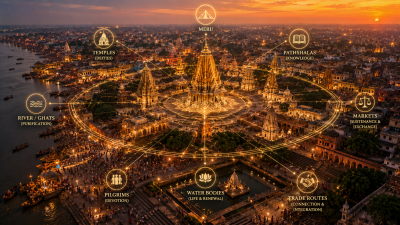
In the framework of Indian sacred geography, certain urban centers are designated as Tirtha-Nagaris—cities that serve as permanent “crossing places” between the mundane and the divine. These cities are not merely historical settlements but are viewed as living mandalas, where the layout of streets, temples, and water bodies mirrors cosmic orders. They have historically functioned as centers of “Great Traditions,” facilitating pan-Indian cultural integration through pilgrimage, scholarship, and trade.
The Sapta-Puri: The Seven Cities of Liberation
The most prominent classification of sacred cities in India is the Sapta-Puri, a group of seven holy sites believed to bestow Moksha (liberation) upon the devotee. These cities represent the diverse sectarian and geographical fabric of the subcontinent.
| City Name | Modern Location | Primary Association | Key Landmark |
| Ayodhya | Uttar Pradesh | Birthplace of Lord Rama (Ikshvaku Dynasty) | Ram Janmabhoomi, Sarayu River |
| Mathura | Uttar Pradesh | Birthplace of Lord Krishna (Braj region) | Krishna Janmasthan, Yamuna Ghats |
| Maya (Haridwar) | Uttarakhand | Gateway to the Gods; the source of the Ganga | Har Ki Pauri, Chandi Devi Temple |
| Kashi (Varanasi) | Uttar Pradesh | Abode of Lord Shiva; oldest living city | Kashi Vishwanath, Manikarnika Ghat |
| Kanchi (Kanchipuram) | Tamil Nadu | Center of Shakti and Vedanta | Kamakshi Amman, Varadharaja Perumal |
| Avantika (Ujjain) | Madhya Pradesh | Center of Time (Kal) and Astronomy | Mahakaleshwar Jyotirlinga, Kshipra River |
| Dvaravati (Dwarka) | Gujarat | Capital of Krishna’s Kingdom | Dwarkadhish Temple, Gomti Sangam |
The Cultural Landscape of Varanasi (Kashi)
Often cited as the spiritual capital of India, Varanasi exemplifies the “Sacred Geography” unit through its unique spatial organization.
- Pancha-kroshi Yatra: A 50-mile (80 km) sacred circuit around the city that pilgrims walk, visiting 108 shrines along the boundary.
- The Crescent Waterfront: The 84 ghats along the Ganga represent the “stairway to heaven.” Dashashwamedh and Manikarnika are the most ritually significant.
- City of Light: Named Kashi (derived from the root kash, meaning “to shine”), it is mythologically believed to stand on the tip of Shiva’s trident, independent of the earth’s geography.
Kanchipuram: The Confluence of Sects
Kanchipuram represents the “Cultural Landscape” of South India, bridging the gap between Shaivism, Vaishnavism, and Buddhism/Jainism.
- City of Temples: Divided into Shiva Kanchi (centered around the Ekambareswarar Temple) and Vishnu Kanchi (centered around the Varadharaja Perumal Temple).
- Educational Hub: Historically known as a Ghatika (place of higher learning), it was a center for Vedic studies and the headquarters of the Kanchi Kamakoti Peetham established by Adi Shankara.
- Silk Heritage: The sacred landscape is inextricably linked to the Kanjeevaram silk industry, where motifs found in temple sculptures are woven into the textiles.
Mathura and the Braj Mandala
The sacred city of Mathura extends into a broader “cultural landscape” known as Braj Bhoomi, covering 84 kos (a traditional unit of distance).
- Vana-Yatra: The pilgrimage involves visiting 12 sacred forests (vanas) and 24 groves (upavanas) associated with the life of Krishna.
- Sanjhi Art: A unique ritual art form using stencils to create floor patterns of Krishna’s exploits, practiced during the Pitru Paksha period.
- Ghat Culture: The Vishram Ghat is the central point where the ritual circumambulation of the city begins and ends.
Ujjain (Avantika): The Center of the World
Ujjain holds a unique position due to its historical role as the prime meridian for ancient Indian astronomers.
- Mahakaleshwar: The presiding deity is Shiva as the Lord of Time (Mahakala). It is the only Jyotirlinga where the Bhasma Aarti (ash ritual) is a daily feature.
- Simhastha Kumbh: Held once every 12 years when Jupiter enters Leo; it is one of the four sites of the mass pilgrimage.
- Jantar Mantar: One of the five observatories built by Maharaja Jai Singh II, highlighting the intersection of sacred belief and scientific inquiry.
Factors Contributing to the Sanctity of Cities
- Riverine Proximity: Almost all sacred cities are situated on the banks of perennial rivers (Ganga, Yamuna, Sarayu, Kshipra, Kaveri).
- Cosmological Mapping: The temple architecture (Vastu Shastra) and city layout often align with celestial bodies or geometric patterns (Mandala).
- Historical Layering: These cities show a continuity of worship from the Vedic era through the Puranic, Medieval, and Modern periods.
- Literary References: Mention in the Itihasa (Ramayana/Mahabharata) and Puranas provides the scriptural “Sanand” (authority) for their sanctity.
Fact File for UPSC Prelims
- The Eternal City: Mark Twain famously remarked that Varanasi is “older than history, older than tradition, older even than legend.”
- Adi Shankara’s Integration: He is credited with reinforcing the status of these cities by establishing monasteries (Mathas) or temples in Kanchi, Dwarka, and Haridwar.
- UNESCO Tentative List: Several of these cities, including Varanasi and Kanchipuram, are on the tentative list for UNESCO World Heritage Sites under the category of “Cultural Landscapes.”
- The ‘Puri’ Suffix: In ancient Sanskrit, ‘Puri’ means a fortress or a city; in the sacred context, it refers specifically to the seven cities of liberation.
Trivia: The Invisible Connection
In traditional belief, all seven sacred cities are connected by a subtle energy grid. It is said that if one cannot visit Kashi, visiting Kanchipuram provides half the merit, as Kanchipuram is considered the “Kashi of the South.” Similarly, Dwarka and Puri are often viewed as the “Western” and “Eastern” anchors of this spiritual network.
Last Modified: May 7, 2026