
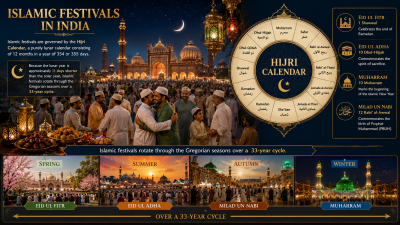
Islamic festivals in India are governed by the Hijri Calendar, a purely lunar calendar consisting of 12 months in a year of 354 or 355 days. Because the lunar year is approximately 11 days shorter than the solar year, Islamic festivals rotate through the Gregorian seasons over a 33-year cycle.
Key Festivals and Their Significance
- Eid-ul-Fitr (Meethi Eid): Celebrated on the first day of the month of Shawwal, marking the end of Ramadan (the holy month of fasting). It emphasizes charity, known as Zakat-al-Fitr, and the communal prayer at the Eidgah.
- Eid-ul-Adha (Bakra-Eid): Celebrated on the 10th day of Dhu al-Hijjah. It commemorates the willingness of Prophet Ibrahim (Abraham) to sacrifice his son as an act of obedience to God. It also marks the culmination of the Hajj pilgrimage to Mecca.
- Milad-un-Nabi (Barawafat): Observed in the month of Rabi’ al-awwal to commemorate the birth anniversary of Prophet Muhammad. In India, particularly in Kashmir (at the Hazratbal Shrine), relics are displayed to the public.
- Muharram: The first month of the Islamic calendar. The 10th day, Ashura, is significant for Shia Muslims as a day of mourning for the martyrdom of Imam Hussain (grandson of the Prophet) at the Battle of Karbala. In India, this is marked by the procession of Tajiyas (miniature replicas of the tomb of Hussain).
- Shab-e-Barat: Known as the “Night of Records” or “Night of Fortune,” observed on the night between the 14th and 15th of the month of Sha’ban. It is a night of prayer and seeking forgiveness for the deceased.
The Sufi Tradition: Urs and Dargahs
A unique facet of Indian Islamic culture is the Urs, which marks the death anniversary of a Sufi saint. In Sufism, death is viewed as Wisaal (union with the Divine).
- Ajmer Sharif Urs: Dedicated to Khwaja Moinuddin Chishti. It attracts millions irrespective of religion, showcasing India’s composite culture (Ganga-Jamuni Tehzeeb).
- Nizamuddin Auliya Urs: Held in Delhi, famous for the Qawwali performances that originated from the teachings of Amir Khusrau.
Christian Festivals: Liturgical Traditions and Indian Localization
Christianity in India dates back to the 1st century CE with the arrival of St. Thomas. Christian festivals follow the Gregorian Calendar (Solar), though some dates for Easter vary between Orthodox and Western churches based on the vernal equinox and lunar phases.
Primary Christian Observances
- Christmas (December 25): Commemorates the birth of Jesus Christ. In India, it is characterized by “Crib-making,” midnight mass, and regional culinary traditions like the Goan Bebinca or Kerala’s plum cakes.
- Easter: Celebrates the Resurrection of Jesus. It is a “moveable feast,” falling on the first Sunday after the full moon following the March equinox.
- Good Friday: A day of mourning and penance commemorating the crucifixion of Jesus. It is the Friday preceding Easter Sunday.
- Pentecost: Observed 50 days after Easter, celebrating the descent of the Holy Spirit upon the Apostles.
- Epiphany (Three Kings Day): Celebrated on January 6, particularly in Goa (Festa dos Reis), marking the visit of the Biblical Magi to the infant Jesus.
Unique Indian Christian Festivals
- Feast of St. Francis Xavier (Goa): Celebrated on December 3 at the Basilica of Bom Jesus. The exposition of the saint’s remains occurs every ten years, drawing global pilgrims.
- Velankanni Festival (Tamil Nadu): The Feast of Our Lady of Good Health in Nagapattinam. It exhibits significant Hindu-Christian syncretism, such as the shaving of heads (tonsuring) and the offering of metal replicas of organs for healing.
- St. Thomas Feast: Celebrated by the Syrian Christians of Kerala (Malayala Nazranis) to honor the Apostle who brought Christianity to India.
Comparative Overview of Socio-Religious Practices
| Feature | Islamic Festivals | Christian Festivals |
| Calendar System | Purely Lunar (Hijri) | Purely Solar (Gregorian) |
| Common Rituals | Salat (Prayer), Sawm (Fasting), Zakat (Alms) | Mass (Liturgy), Carols, Feasting |
| Major Pilgrimage | Hajj (Mecca), Ziyarat (Local Shrines) | Holy Land (Jerusalem), Local Shrines (Velankanni, Goa) |
| Indian Folk Art | Qawwali, Tajiya making, Calligraphy | Carol singing, Pookalam-style church decor, Crib making |
Fact-File for UPSC Aspirants
- Hazratbal Shrine: Located in Srinagar, it houses the Moi-e-Muqqadas (sacred hair) of Prophet Muhammad.
- St. Thomas Christians: Also known as Nasrani Mappila, they are among the oldest Christian communities in the world, concentrated in Kerala.
- Id-e-Milad-un-Nabi History: While widely celebrated, some conservative schools of thought within Islam do not observe birth anniversaries, making its celebration a distinct cultural marker in the Indian subcontinent.
- Lent and Ramadan: Both religions observe a period of fasting and austerity—Lent (40 days) for Christians leading to Easter, and Ramadan (29-30 days) for Muslims leading to Eid-ul-Fitr.
- Syncretic Shrines: Shrines like Nagore Dargah in Tamil Nadu and Mount Mary Church in Mumbai are frequented by devotees of all faiths, embodying the “Fairs” aspect of Indian heritage where religious boundaries blur.