
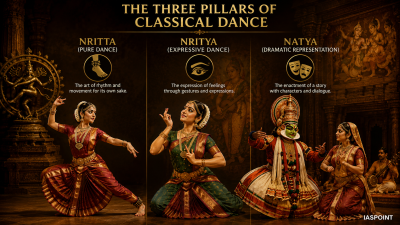
In the study of Indian Art and Culture, the technical structure of classical dance is categorized into three distinct elements: Nritta, Nritya, and Natya. This tripartite classification originates from the Natya Shastra and was further refined in Nandikeshwara’s Abhinaya Darpana. These components work in tandem to create a holistic performance that transitions from physical rhythm to emotional storytelling and finally to dramatic narrative.
Detailed Analysis of the Three Components
Nritta (Pure Dance)
Nritta refers to abstract, rhythmic dance movements that do not convey any specific message, story, or emotion. It is the “technical” aspect of the performance.
- Purpose: To showcase the dancer’s mastery over rhythm (Tala), speed (Laya), and physical form.
- Focus: It emphasizes footwork (Pada Bheda), body postures (Karanas and Angaharas), and arm movements.
- Aesthetic Goal: It aims at creating visual beauty through symmetry and precise geometric patterns.
- Example: The Tillana in Bharatanatyam, the Tarana in Kathak, or the Jatiswaram in Mohiniyattam are primary examples of Nritta.
Nritya (Expressive Dance)
Nritya is the interpretative element of dance that fuses rhythm with sentiment and meaning. It is the “mimetic” aspect of the performance.
- Purpose: To convey the meaning of the song lyrics (Sahitya) or a specific theme through stylized gestures.
- Methodology: It utilizes Abhinaya (expression) and Hastas (hand gestures/mudras) to translate emotions (Bhavas) into an aesthetic experience (Rasa) for the audience.
- Focus: Facial expressions and hand movements are paramount here.
- Example: The Padams and Varnams in Bharatanatyam or the Abhinaya sequences in Odissi where the dancer portrays the longing of the soul for the divine.
Natya (Dramatic Element)
Natya represents the dramatic aspect of the performance, essentially meaning “Drama” or “Theatre.”
- Purpose: To present a full narrative or play through a combination of dance and speech.
- Methodology: It involves multiple characters, a plot, and dialogue (Vachika Abhinaya). It is often a collective performance rather than a solo one.
- Focus: Characterization and the progression of a storyline.
- Example: Traditional dance-dramas like Kathakali, Yakshagana, and Kuchipudi (in its traditional Bhagavata Mela format) are quintessential examples of Natya.
Comparative Summary of Nritta, Nritya, and Natya
| Feature | Nritta | Nritya | Natya |
| Translation | Pure Dance | Expressive Dance | Dramatic Art/Drama |
| Meaning | No specific meaning; abstract. | Conveys meaning/theme. | Narrates a story/plot. |
| Expression | Absence of Abhinaya/Bhavas. | Extensive use of Abhinaya. | Combines dance with speech. |
| Key Element | Rhythm and Movement (Tala). | Emotion and Gestures (Rasa). | Character and Narrative. |
| Audience Impact | Visual delight in geometry. | Emotional connection/empathy. | Intellectual and dramatic engagement. |
The Four-Fold Abhinaya in Nritya and Natya
The Natya Shastra specifies that for Nritya and Natya to be effective, the dancer must master four types of Abhinaya (communication):
- Angika Abhinaya: Communication through physical body parts (head, hands, waist, etc.).
- Vachika Abhinaya: Communication through speech, song, and music.
- Aharya Abhinaya: Communication through external aids like costumes, jewelry, and make-up.
- Sattvika Abhinaya: Communication of internal emotional states (e.g., tears, trembling, or change of color).
Technical Terminology for UPSC Prelims
- Hastas/Mudras: Hand gestures used in Nritya to act as a visual vocabulary. There are two types: Asamyuta (single hand) and Samyuta (both hands).
- Karanas: The 108 basic units of dance movements described in Natya Shastra, combining a posture, a leg movement, and a hand gesture.
- Angaharas: A sequence of several Karanas linked together.
- Rasa-Bhava: The core of Nritya. Bhava is the emotion portrayed by the dancer, while Rasa is the “aesthetic flavor” experienced by the spectator.
- Tandava and Lasya: Nritta and Nritya can be performed in either the Tandava style (vigorous, masculine, associated with Shiva) or the Lasya style (graceful, feminine, associated with Parvati).
Fact Check and Trivia
- Interdependence: In a standard Indian classical dance recital, these three elements are not always mutually exclusive. A single performance usually starts with Nritta (invoking rhythm) and graduates into Nritya (invoking emotion).
- Kuchipudi Evolution: While Kuchipudi is now performed as a solo dance (mostly Nritya), it originated as a Natya (dance-drama) performed by groups of men known as Brahmana Bhagavathulu.
- Kathakali: It is perhaps the most prominent example where Natya dominates, as it is a complete theatrical reenactment of epics like the Ramayana and Mahabharata.
- Nandikeshwara’s Definition: In Abhinaya Darpana, Nritta is defined as “that which does not express any mood (Bhava) by means of Abhinaya.”