
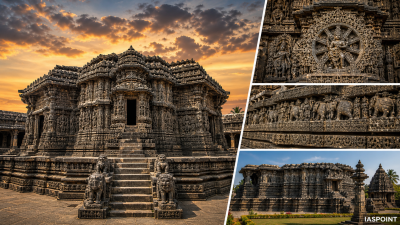
The Hoysala Empire (10th–14th century CE) ruled the region of Gangavadi in modern-day Karnataka. Emerging as subordinates to the Western Chalukyas, they eventually established an independent identity, peaking under rulers like Vishnuvardhana and Ballala II. Their architecture represents the most refined and ornate phase of the Vesara style (a hybrid of Nagara and Dravida), often termed the Karnataka Dravida tradition. The concentration of these temples is primarily in the Malnad region, specifically in Belur, Halebidu, and Somanathapura.
Structural Characteristics and Innovations
Hoysala temples are distinct for their departure from the massive proportions of the Cholas toward miniature, jewelry-like precision.
Stellated (Star-Shaped) Plan
The most defining feature of Hoysala architecture is the Stellated Plan. The temple stands on a high platform (Jagati) that follows the jagged, star-shaped layout of the main shrine. This design increases the surface area of the exterior walls, providing more space for elaborate sculptural friezes.
Construction Material: Chloritic Schist
The architects shifted from sandstone to Soapstone (Chloritic Schist). Soapstone is soft when quarried, allowing for intricate, minute carvings akin to ivory or sandalwood work, but hardens over time when exposed to the atmosphere.
Horizontal Friezes (The Decorative Base)
The exterior walls are not plain but divided into horizontal layers or bands (Pagas). Starting from the bottom, these usually include:
- Elephants: Symbolizing strength and stability.
- Lions/Simhas: Representing courage.
- Floral Motifs: Vines and creepers.
- Horsemen: Representing speed and military might.
- Puranic Scenes: Narrative friezes from the Ramayana, Mahabharata, and Bhagavata Purana.
- Makaras and Hamsas: Mythical beasts and celestial swans.
Major Components of a Hoysala Temple
- Mantapa: A pillared hall where devotees gather. Hoysala mantapas are known for their circular, lathe-turned pillars that appear to have been polished on a machine.
- Vimana: The tower over the sanctum. Unlike the steep Chola pyramids, these are shorter and follow the star-shaped plan, appearing as a series of points and flutes.
- Salabhanjika (Madanika): Exquisite bracket figures of feminine forms in various dance poses or performing daily chores, usually placed under the eaves of the temple.
- Intricate Ceilings: The interior ceilings are deeply carved with circular or square floral patterns and mythological themes.
Comparison of Major Hoysala Centers
| Temple Name | Location | Builder / Patron | Unique Fact |
| Chennakesava Temple | Belur | King Vishnuvardhana | Built to commemorate victory over the Cholas (Battle of Talakad); known for the Darpana Sundari (Lady with the Mirror) bracket figure. |
| Hoysaleswara Temple | Halebidu | Ketamalla (Officer of Vishnuvardhana) | A Dvikuta (double temple) dedicated to Shiva; it is the largest Hoysala temple but its Shikharas were never completed. |
| Kesava Temple | Somanathapura | Somanatha (General of Narasimha III) | A perfect Trikuta (triple shrine) temple; it remains the most well-preserved and symmetrical example of the style. |
Architectural Classification by Shrines
Hoysala temples are often classified by the number of sanctums (garbhagrihas) they possess:
- Ekakuta: Single shrine (e.g., Chennakesava Temple, Belur).
- Dvikuta: Two shrines (e.g., Hoysaleswara Temple, Halebidu).
- Trikuta: Three shrines (e.g., Chennakesava Temple, Somanathapura).
- Panchakuta: Five shrines (e.g., Panchalingeshwara Temple, Govindanhalli).
Key Differences: Hoysala vs. Other Styles
| Feature | Hoysala Style | Chola (Dravidian) Style |
| Plan | Stellated (Star-shaped) | Square or Rectangular |
| Platform | High Jagati (Platform) | Direct ground or low Adhisthana |
| Pillars | Lathe-turned, highly polished | Square or fluted, massive |
| Sculpture | Intricate, crowded, deep relief | Elegant, balanced, shallow relief |
| Tower | Moderate height, decorative | Massive, pyramidal (Vimana) |
Trivia and Facts for Prelims
- UNESCO Recognition: In 2023, the “Sacred Ensembles of the Hoysalas” (Belur, Halebidu, and Somanathapura) were officially inscribed as a UNESCO World Heritage Site.
- Artist Signatures: Uniquely in Indian history, Hoysala architects and sculptors often signed their works. Famous names include Dasoja, Chavana, and Mallitamma.
- The Ritual Pillar: The Chennakesava temple at Belur features a “Gravity Pillar” (Lamp post) which stands on its own weight without a deep foundation.
- Vesara Synthesis: While the Vimana structure is Dravidian in origin, the ornamentation and the curvilinear tendency of the staggered projections show Nagara influence.
- Gandaberunda: The mythical two-headed bird, which later became the state emblem of Mysore and Karnataka, is a frequent motif in Hoysala art.