
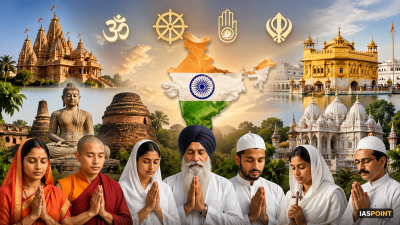
India is the birthplace of four major world religions: Hinduism, Buddhism, Jainism, and Sikhism. The religious diversity of the country is not merely a demographic statistic but is deeply integrated into its constitutional framework and cultural heritage. According to the 2011 Census, Hindus constitute the majority (79.8%), followed by Muslims (14.2%), Christians (2.3%), Sikhs (1.7%), Buddhists (0.7%), and Jains (0.4%). Other minority groups include Parsis (Zoroastrians) and various indigenous tribal faiths (Sarnas, Animism).
Hinduism: The Sanatana Dharma
Hinduism is characterized by its diversity of beliefs, rituals, and philosophies, lacking a single founder or a central ecclesiastical organization. It is categorized by several core philosophical and sectarian divisions.
- Core Concepts: Belief in Dharma (duty/righteousness), Karma (action and consequence), Samsara (cycle of rebirth), and Moksha (liberation).
- Major Sects:
- Vaishnavism: Focus on Vishnu and his incarnations (Dashavatara).
- Shaivism: Focus on Shiva as the Supreme Being.
- Shaktism: Worship of the female divine (Devi/Shakti).
- Smartism: Based on the Panchayatana puja, treating five deities (Ganesha, Shiva, Shakti, Vishnu, and Surya) as equal.
- The Six Schools of Philosophy (Shad-darshanas):
- Nyaya: Logic and epistemology.
- Vaisheshika: Atomic theory and metaphysics.
- Samkhya: Dualism between Purusha (consciousness) and Prakriti (matter).
- Yoga: Physical and mental discipline for liberation.
- Purva Mimamsa: Emphasis on Vedic rituals.
- Vedanta (Uttara Mimamsa): Focus on the Upanishadic knowledge of Brahman.
Islam: Arrival and Integration
Islam entered India through various channels, including trade in the 7th century (Malabar Coast) and subsequent military conquests and Sufi movements in the North.
- Major Traditions: Divided primarily into Sunni and Shia denominations.
- Sufism: Played a critical role in the indigenization of Islam in India. It emphasized personal devotion (Ishq) and mysticism. Major Silsilas (orders) include Chisti, Suhrawardi, Qadiri, and Naqshbandi.
- Key Pillars: Shahada (Faith), Salat (Prayer), Zakat (Alms), Sawm (Fasting), and Hajj (Pilgrimage).
Buddhism: The Path of Enlightenment
Founded by Siddhartha Gautama in the 6th century BCE, Buddhism emerged as a heterodox (Nastic) school challenging Vedic ritualism.
- Four Noble Truths (Arya Satyani): Suffering (Dukkha), Cause of suffering (Samudaya), Cessation of suffering (Nirodha), and the Path to cessation (Magga).
- Major Sects:
- Hinayana/Theravada: Original teachings; uses Pali; treats Buddha as a guide.
- Mahayana: Uses Sanskrit; treats Buddha as a deity; introduces the concept of Bodhisattvas.
- Vajrayana: Tantric Buddhism prevalent in Tibet and Himalayan regions.
- Important Councils:
- First Council: Rajgir (presided by Mahakasyapa).
- Second Council: Vaishali (under Kalasoka).
- Third Council: Pataliputra (under Ashoka).
- Fourth Council: Kashmir (under Kanishka; split into Hinayana and Mahayana).
Jainism: The Philosophy of Non-Violence
Jainism emphasizes Ahimsa (non-violence) and the spiritual independence of the soul. It recognizes 24 Tirthankaras, with Rishabhadeva being the first and Vardhamana Mahavira the last.
- The Three Jewels (Triratna): Right Faith (Samyak Darshana), Right Knowledge (Samyak Gyana), and Right Conduct (Samyak Charitra).
- Five Vows (Pancha Mahavrata): Ahimsa (Non-violence), Satya (Truth), Asteya (Non-stealing), Aparigraha (Non-attachment), and Brahmacharya (Chastity).
- Major Sects:
- Digambara: “Sky-clad” (monks do not wear clothes); believe women cannot achieve liberation in that form.
- Svetambara: “White-clad” (monks wear white); believe women can attain liberation.
Sikhism: The Panth of the Gurus
Sikhism was founded by Guru Nanak Dev in the 15th century in the Punjab region, emphasizing monotheism and social equality.
- Ten Gurus: Starting from Guru Nanak Dev to Guru Gobind Singh. The lineage ended with the installation of the Guru Granth Sahib as the eternal Guru.
- Khalsa Identity (The 5 Ks): Kesh (uncut hair), Kangha (wooden comb), Kara (iron bracelet), Kachera (cotton undergarments), and Kirpan (steel sword).
- Philosophy: Nam Japna (Meditation on God’s name), Kirat Karni (Honest living), and Vand Chakna (Sharing with others).
Christianity and Zoroastrianism
- Christianity: Believed to have arrived with St. Thomas the Apostle in 52 CE. It expanded during the Portuguese, Dutch, and British colonial eras. Major denominations include Roman Catholic, Protestant, and Syrian Christians.
- Zoroastrianism (Parsis): Followers of Prophet Zarathustra who fled Persia in the 8th century to avoid persecution. They worship Ahura Mazda and consider Fire as a sacred symbol of purity. Their central text is the Zend Avesta.
Comparison of Religious Philosophies and Origins
| Religion | Founder | Key Text | Major Goal |
| Hinduism | Traditional/Ancient | Vedas, Upanishads, Gita | Dharma, Artha, Kama, Moksha |
| Islam | Prophet Muhammad | Quran, Hadith | Submission to Allah |
| Buddhism | Siddhartha Gautama | Tripitakas | Nirvana (Cessation of Desire) |
| Jainism | Tirthankaras (Mahavira) | Agamas | Kaivalya (Liberation of Soul) |
| Sikhism | Guru Nanak Dev | Guru Granth Sahib | Union with God through Service |
| Zoroastrianism | Zarathustra | Zend Avesta | Good Thoughts, Words, Deeds |
Constitutional and Legal Framework for Religious Diversity
India is a secular state as per the Preamble (added by the 42nd Amendment Act, 1976). The Constitution ensures religious freedom through several articles:
- Article 25: Freedom of conscience and free profession, practice, and propagation of religion.
- Article 26: Freedom to manage religious affairs.
- Article 27: Freedom as to payment of taxes for promotion of any particular religion.
- Article 28: Freedom as to attendance at religious instruction or religious worship in certain educational institutions.
- Articles 29 & 30: Protection of interests of minorities and their right to establish and administer educational institutions.
Religious Trivia and Facts for Prelims
- Navrez and Navroz: Navroz is the Parsi New Year, while Navreh is the Kashmiri Hindu New Year.
- Sangam Era: Early Tamil literature (Silappadikaram and Manimekalai) provides evidence of the co-existence of Buddhism, Jainism, and Vedic Hinduism in South India.
- The Kumbh Mela: Recognized by UNESCO as an Intangible Cultural Heritage of Humanity; it is held at four locations: Prayagraj, Haridwar, Ujjain, and Nashik.
- Abrahamic vs. Dharmic: Islam, Christianity, and Judaism are Abrahamic religions (monotheistic, linear time), whereas Hinduism, Buddhism, Jainism, and Sikhism are Dharmic religions (cyclical time, karma-based).
- Minority Status: In India, Muslims, Christians, Sikhs, Buddhists, Jains, and Parsis are notified as “minority communities” under the National Commission for Minorities Act, 1992.