
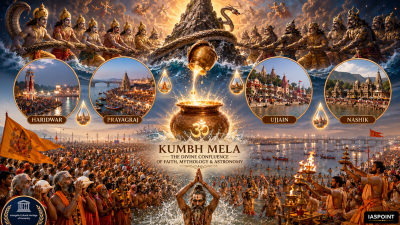
The Kumbh Mela is recognized by UNESCO as an Intangible Cultural Heritage of Humanity, representing the largest peaceful gathering of pilgrims on Earth. The festival’s origins are rooted in the Samudra Manthan (Churning of the Ocean) from Hindu mythology. According to the Puranas, as the Devas and Asuras fought over the Kumbh (pot) containing Amrit (nectar of immortality), four drops fell at four specific locations: Prayagraj, Haridwar, Ujjain, and Nashik. These spots became the sanctified venues for the Mela, where the water is believed to turn into nectar during specific celestial alignments.
The Luni-Solar Astronomy of Kumbh Locations
The timing of the Kumbh Mela is not fixed on the Gregorian calendar but is determined by the positions of the Sun, Moon, and Jupiter (Brihaspati). The astronomical configurations for the four sites are as follows:
| Venue | River | Astronomical Requirement |
| Haridwar | Ganga | Jupiter in Aquarius (Kumbha) and Sun in Aries (Mesha). |
| Prayagraj | Triveni Sangam (Ganga, Yamuna, Saraswati) | Jupiter in Taurus (Vrishabha) and Sun in Capricorn (Makara). |
| Nashik | Godavari | Jupiter in Leo (Simha) or Jupiter, Sun, and Moon in Cancer (Karka). |
| Ujjain | Shipra | Jupiter in Leo (Simha) and Sun in Aries (Mesha). |
Classification and Frequency of the Mela
The Kumbh is categorized based on its periodicity and the intensity of the gathering. It is important to distinguish between these for competitive examinations.
- Maha Kumbh Mela: Held only at Prayagraj once every 144 years (after 12 Purna Kumbh cycles).
- Purna Kumbh Mela: Occurs every 12 years at each of the four locations.
- Ardh Kumbh Mela: Held every 6 years, but exclusively at Haridwar and Prayagraj, marking the halfway point between two Purna Kumbh Melas.
- Magh Mela: An annual fair held at Prayagraj in the month of Magh (January/February), which takes the form of a Kumbh or Ardh Kumbh in their respective years.
Rituals and Social Structure: The Akharas
The central ritual of the Kumbh is the Shahi Snan (Royal Bath) or Rajyogi Snan. This is the first bath taken by the members of various Akharas (monastic orders) before the general public enters the water.
- The Akharas: These are organized groups of Sadhus (ascetics) established primarily by Adi Shankaracharya in the 8th century to protect the Sanatana Dharma.
- Categories of Sadhus:
- Naga Sadhus: Known for being sky-clad (naked) and smearing ash on their bodies. They are traditionally the first to take the Shahi Snan.
- Urdhwavahurs: Ascetics who practice extreme austerities, such as keeping an arm raised for years.
- Kalpavasis: Pilgrims who stay on the banks of the river for the entire month of Magh, lead a minimalist life, and perform rituals thrice a day.
Socio-Cultural and Administrative Significance
Beyond its religious identity, the Kumbh Mela serves as a massive platform for cultural exchange and temporary urbanization.
- Cultural Synthesis: The Mela sees a confluence of diverse schools of Indian philosophy, ranging from Vedantins to practitioners of Tantra, and includes massive discourses (Pravachans) and devotional singing (Bhajans).
- Temporary Cities: For each Kumbh, a temporary city is erected with its own police force, hospitals, and sanitation systems, often cited as a marvel of “Pop-up Mega-city” management.
- Economic Impact: The festival provides seasonal employment to thousands and significantly boosts the local tourism and transport sectors of the host states (Uttar Pradesh, Uttarakhand, Madhya Pradesh, and Maharashtra).
Key Facts and Trivia for Aspirants
- First Historical Reference: The Chinese traveler Hiuen Tsang (Xuanzang) provided the first written eyewitness account of a Kumbh-like gathering at Prayag during the reign of King Harshavardhana in the 7th century CE.
- UNESCO Recognition: It was inscribed on the Representative List of the Intangible Cultural Heritage of Humanity in 2017.
- Panchayati Akhara: The Maha Nirvani Akhara is one of the oldest and most prominent among the 13 recognized Akharas.
- Simhastha: The Kumbh at Ujjain and Nashik is specifically called Simhastha because Jupiter is located in the zodiac sign of Leo (Simha).
- Paush Purnima: Traditionally, the bathing rituals begin on Paush Purnima and conclude on Maha Shivratri, with the most auspicious days being Mauni Amavasya and Basant Panchami.