
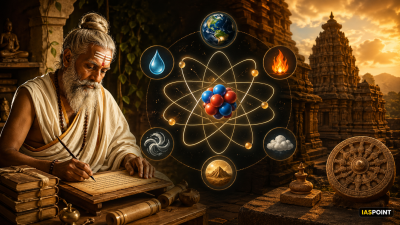
The Vaisheshika school is one of the six orthodox (Astika) systems of Indian philosophy. It is best known for its metaphysical realism and its pioneering atomic theory. The name is derived from the word Vishesha, which means “particularity” or “distinction,” reflecting the school’s focus on identifying the specific characteristics that distinguish one object from another. It is considered a “sister school” to Nyaya; while Nyaya focuses on logic and epistemology, Vaisheshika provides the physical and ontological description of the universe.
Authorship and Foundational Texts
The system was founded by Sage Kanada, also known as Uluka or Kashyapa, around the 2nd century BCE.
- Vaisheshika Sutra: The primary text authored by Kanada, which systematically classifies all objects of experience.
- Padartha-Dharma-Sangraha: A famous commentary by Prashastapada (c. 4th century CE) that expanded and refined the original sutras, serving as the standard reference for the school.
The Seven Padarthas (Categories of Reality)
Vaisheshika philosophy categorizes everything that exists in the universe into seven categories or Padarthas. These represent the objects of knowledge and experience.
| Category (Padartha) | Meaning | Description |
| Dravya | Substance | The substratum of qualities and actions. There are nine substances. |
| Guna | Quality | Inherent properties that exist in substances (e.g., color, taste, number). |
| Karma | Action/Movement | Physical motion inherent in a substance. |
| Samanya | Generality | The common nature shared by a class of objects (e.g., “gotva” or “cowness”). |
| Vishesha | Particularity | The unique individuality of eternal substances (atoms, souls). |
| Samavaya | Inherence | The inseparable relationship between a substance and its qualities. |
| Abhava | Non-existence | Added later; the reality of the absence of an object. |
The Nine Dravyas (Substances)
The school identifies nine fundamental substances that constitute the universe. These are divided into those that are atomic and those that are all-pervading.
- Prithvi (Earth): Atomic.
- Ap (Water): Atomic.
- Tejas (Fire): Atomic.
- Vayu (Air): Atomic.
- Akasha (Ether): Non-atomic; the substratum of sound.
- Kala (Time): Infinite and eternal.
- Dik (Space): Infinite and eternal.
- Atman (Soul): Infinite and eternal; the substratum of consciousness.
- Manas (Mind): Atomic; the internal organ of perception.
Paramanuvada: The Atomic Theory
Vaisheshika is credited with the earliest systematic formulation of atomism in human history.
Characteristics of Paramanu (Atoms)
- Indivisibility: An atom (Paramanu) is the smallest possible unit of matter that cannot be further divided.
- Eternity: Atoms are eternal and indestructible. While the objects made of atoms are temporary, the atoms themselves persist.
- Qualitative Difference: Unlike Greek atomism, Vaisheshika posits that atoms have specific qualities. For example, earth atoms possess smell, while water atoms possess taste.
- Structure of Matter: Atoms combine into Dyads (Dyanuka) and then into Triads (Tryanuka). A triad is the smallest visible particle (like a mote of dust in a sunbeam).
Theory of Creation and God
- Asatkaryavada: Like Nyaya, Vaisheshika follows the theory that the effect is a new creation. The world is produced through the combination of atoms.
- Adrishta (The Unseen Force): Since atoms are unconscious, they cannot move on their own. The school posits a moral force called Adrishta—the collective merit and demerit of souls—which guides the atoms to form the world.
- Theism: In later Vaisheshika, Ishwara (God) is recognized as the efficient cause who directs the atoms according to the laws of Adrishta. God does not create atoms from nothing but fashions the world from pre-existing eternal atoms.
Concept of Liberation
Liberation (Moksha) is viewed as the cessation of all pain and consciousness.
- Cause of Bondage: Ignorance of the true nature of things and the confusion between the soul and the material body.
- Path to Release: By attaining a correct understanding of the Padarthas (categories), the soul realizes its distinctness from atoms and the mind.
- State of Liberation: In the liberated state, the Atman exists in its pure, substance-like form, free from all qualities including knowledge, pleasure, and pain.
Facts and Trivia for UPSC Prelims
- Kanada’s Name: Legend says he was called “Kanada” (Kana-ada or “atom-eater”) because he used to collect grains from the fields to eat while contemplating the smallest particles of matter.
- Scientific Temperament: Vaisheshika is often cited as evidence of the scientific and analytical bent of ancient Indian thought, particularly in the fields of physics and chemistry.
- Relationship with Buddhism: Buddhist thinkers like Dignaga and Dharmakirti frequently engaged in debates with Vaisheshika scholars, particularly regarding the nature of perception and the reality of universals (Samanya).
- Pramanas accepted: Vaisheshika recognizes only two valid means of knowledge: Pratyaksha (Perception) and Anumana (Inference). It considers Verbal Testimony (Shabda) and Comparison (Upamana) as forms of inference.
- Vaisheshika and Naturalism: The school is highly naturalistic; it explains the universe through mechanical laws of atoms and the moral law of Karma, with God as the supervisor rather than a whimsical creator.