
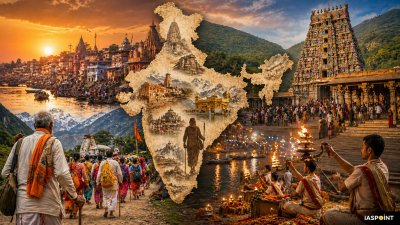
Pilgrimage or Tirtha-Yatra is an integral part of the Indian religious landscape, representing a journey to a “crossing place” (Tirtha) between the mundane and the divine. These traditions have historically fostered national integration, influenced temple architecture, and stimulated the growth of local economies.
Hindu Pilgrimage Circuits and Sacred Geographies
Hinduism features several overlapping circuits, often organized around cardinal directions or specific sectarian philosophies.
The Chardham (The Four Abodes)
Established by Adi Shankara in the 8th century to unify the subcontinent, these four sites represent the cardinal directions of India:
- Badrinath (North, Uttarakhand): Dedicated to Lord Vishnu; located on the banks of the Alaknanda River.
- Dwarka (West, Gujarat): Associated with Lord Krishna; situated where the Gomti River meets the Arabian Sea.
- Puri (East, Odisha): Famous for the Jagannath Temple and the Rath Yatra; located on the Bay of Bengal.
- Rameswaram (South, Tamil Nadu): Dedicated to Lord Shiva; features the longest temple corridor in India.
The Chota Chardham (Uttarakhand)
A localized circuit in the Himalayas, significant for its association with the sources of sacred rivers:
- Yamunotri: Source of the Yamuna River.
- Gangotri: Source of the Ganga River (Goumukh).
- Kedarnath: One of the 12 Jyotirlingas, dedicated to Lord Shiva.
- Badrinath: Dedicated to Lord Vishnu.
The 12 Jyotirlingas
These represent sites where Lord Shiva is said to have appeared as a fiery column of light.
| Region | Site Name | State |
| North | Somnath | Gujarat |
| North | Nageshwar | Gujarat |
| North | Kedarnath | Uttarakhand |
| North | Kashi Vishwanath | Uttar Pradesh |
| Central | Mahakaleshwar | Madhya Pradesh |
| Central | Omkareshwar | Madhya Pradesh |
| West | Trimbakeshwar | Maharashtra |
| West | Grishneshwar | Maharashtra |
| West | Bhimashankar | Maharashtra |
| South | Mallikarjuna | Andhra Pradesh |
| South | Vaidyanath | Jharkhand (traditionally debated) |
| South | Rameswaram | Tamil Nadu |
Shakti Peethas
Associated with the legend of Sati’s body parts falling across the subcontinent. There are traditionally 51 Shakti Peethas, with the Kamakhya Temple (Assam) and Kalighat (West Bengal) being the most prominent.
Buddhist and Jain Circuits
The Buddhist Circuit (Holy Footsteps of Buddha)
The Ministry of Tourism promotes this circuit covering the four most sacred sites:
- Lumbini (Nepal): Birthplace of Siddhartha Gautama.
- Bodh Gaya (Bihar): Site of Enlightenment under the Bodhi Tree.
- Sarnath (Uttar Pradesh): Site of the first sermon (Dharmachakrapravartana).
- Kushinagar (Uttar Pradesh): Site of death (Mahaparinirvana).
- Extended Circuit: Includes Nalanda, Rajgir, and Sravasti.
The Jain Tirtha Traditions
Jain pilgrimage sites are often located on hilltops to provide a serene environment for meditation.
- Shravanabelagola (Karnataka): Home to the 57-foot Gomateshwara (Bahubali) statue.
- Palitana (Gujarat): Located on Shatrunjaya Hill; it is the world’s only mountain with over 900 temples.
- Mount Abu (Rajasthan): Location of the Dilwara Temples, known for intricate marble carvings.
- Shikharji (Jharkhand): Located on Parasnath Hill, where 20 out of 24 Tirthankaras attained Moksha.
Sikh and Sufi Pilgrimage Traditions
The Five Takhts of Sikhism
These are the seats of temporal authority in the Sikh faith.
- Akal Takht: Located within the Golden Temple complex, Amritsar.
- Takht Sri Damdama Sahib: Talwandi Sabo, Punjab.
- Takht Sri Keshgarh Sahib: Anandpur Sahib, Punjab.
- Takht Sri Hazur Sahib: Nanded, Maharashtra.
- Takht Sri Patna Sahib: Patna, Bihar.
Sufi Dargahs (Ziyarat)
The practice of visiting the tombs of Sufi saints transcends religious boundaries in India.
- Ajmer Sharif (Rajasthan): Dargah of Khwaja Moinuddin Chisti.
- Nizamuddin Dargah (Delhi): Dargah of Hazrat Nizamuddin Auliya.
- Haji Ali Dargah (Mumbai): Situated on an islet off the coast of Worli.
Islamic and Christian Pilgrimage Sites
- Cheraman Juma Mosque (Kerala): The oldest mosque in India, significant for its Kerala-style architecture.
- Basilica of Bom Jesus (Goa): Holds the relics of St. Francis Xavier; a UNESCO World Heritage site.
- Vailankanni (Tamil Nadu): Known as the “Lourdes of the East,” dedicated to Our Lady of Good Health.
The Kumbh Mela: UNESCO Intangible Heritage
The Kumbh Mela is the largest peaceful gathering of pilgrims in the world, occurring in a cycle of 12 years across four river sites determined by astrological positions of the Sun, Moon, and Jupiter.
| Location | River | State |
| Haridwar | Ganga | Uttarakhand |
| Prayagraj | Confluence of Ganga, Yamuna, Saraswati | Uttar Pradesh |
| Nashik | Godavari | Maharashtra |
| Ujjain | Shipra | Madhya Pradesh |
Sacred Rivers and Their Significance
Rivers are often personified as goddesses and act as Tirthas themselves.
- Sapta Sindhu: The seven sacred rivers (Ganga, Yamuna, Saraswati, Narmada, Indus, Kaveri, and Godavari).
- Pushkaram: A festival dedicated to worshipping the 12 sacred rivers, celebrated every 12 years for each river.
Cultural Facts and Trivia for UPSC
- Prasad and Bhog: The Mahaprasad at Jagannath Temple, Puri, is cooked in seven earthen pots placed one on top of the other, where the top-most pot always cooks first.
- Architecture and Pilgrimage: The Kandariya Mahadeva Temple at Khajuraho and the Sun Temple at Konark serve as “pilgrimage destinations” that reflect the pinnacle of Nagara architecture.
- PRASHAD Scheme: The Government of India’s “Pilgrimage Rejuvenation and Spiritual, Heritage Augmentation Drive” aims at the integrated development of identified pilgrimage destinations.
- UNESCO Inscription: The Kumbh Mela was inscribed on the UNESCO Representative List of Intangible Cultural Heritage of Humanity in 2017.
- Eco-Pilgrimage: The concept of “Ecological Tirthas” is emerging to protect the fragile Himalayan ecosystem around sites like Amarnath and Mansarovar.