
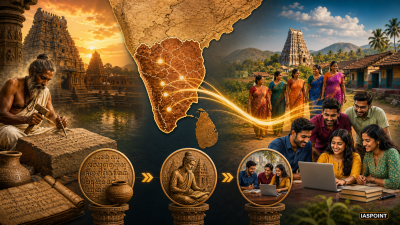
The Dravidian language family is one of the world’s largest and most ancient linguistic groups, indigenous to the Indian subcontinent. It accounts for approximately 24% of India’s population. Unlike the Indo-Aryan family, which has roots in the Indo-European migration, the Dravidian family is considered autochthonous to South Asia, with a history spanning over 4,500 years.
Geographical and Linguistic Classification
The Dravidian languages are not confined solely to South India; they are distributed across the subcontinent into three distinct geographical groups.
South Dravidian Group
This group contains the most numerically and culturally dominant languages.
- Tamil: The oldest recorded Dravidian language with a rich “Sangam” literary tradition.
- Kannada: Boasts an extensive epigraphic record starting from the 5th Century CE.
- Malayalam: Developed as a distinct branch from Tamil around the 9th Century CE.
- Tulu and Kodagu: Spoken primarily in Karnataka; Tulu has a strong oral tradition and its own script (Tigalari).
Central Dravidian Group
These languages are primarily spoken by tribal communities in Central India.
- Telugu: The most widely spoken Dravidian language, showing significant Sanskrit influence in its vocabulary.
- Gondi: Spoken by the Gond tribes across Madhya Pradesh, Chhattisgarh, and Maharashtra.
- Kui, Khond, and Kolami: Minority languages spoken in the belt extending from Odisha to Maharashtra.
North Dravidian Group
This group is linguistically significant as it demonstrates the historical spread of Dravidian speakers far beyond the Deccan plateau.
- Brahui: Spoken in the Balochistan region of Pakistan; it is geographically isolated from other Dravidian languages.
- Kurukh (Oraon) and Malto: Spoken in parts of Jharkhand, West Bengal, and Bihar.
Comparison of Major Dravidian Languages
| Language | Primary State | Earliest Epigraphic Evidence | Classical Status Year |
| Tamil | Tamil Nadu | Mangulam Inscription (2nd Century BCE) | 2004 |
| Kannada | Karnataka | Halmidi Inscription (450 CE) | 2008 |
| Telugu | Andhra Pradesh/Telangana | Erragudipadu Inscription (575 CE) | 2008 |
| Malayalam | Kerala | Vazhappally Inscription (830 CE) | 2013 |
Salient Linguistic Features
Dravidian languages possess unique structural characteristics that distinguish them from the Indo-Aryan family.
- Agglutinative Nature: Grammatical relations are expressed by adding suffixes to a root word. Unlike inflectional languages, the root remains unchanged and clearly identifiable.
- Inclusive and Exclusive “We”: Many Dravidian languages distinguish between a “we” that includes the listener and a “we” that excludes them.
- Retroflex Consonants: The use of sounds produced by curling the tongue back (e.g., ṭ, ḍ, ṇ, ḷ) is a hallmark of this family, which later influenced the Indo-Aryan languages through linguistic convergence.
- Gender System: Often categorized into “rational” (humans/gods) and “irrational” (animals/objects) rather than purely masculine/feminine.
Evolution of Scripts
Most Dravidian languages utilize scripts derived from the Southern branch of the Brahmi script.
- Vatteluttu: An ancient “round script” used in South India for Tamil and Malayalam before being replaced by modern variants.
- Grantha Script: Developed by the Pallavas to write Sanskrit in the Tamil-speaking region; it influenced the modern Malayalam and Tigalari scripts.
- Kadamba Script: The precursor to the modern Kannada and Telugu scripts, which were nearly identical until the medieval period.
- Rounded Morphology: The scripts are notably rounded because they were historically etched onto palm leaves; straight lines would have split the leaf along the grain.
The Classical Language Designation
The Government of India recognizes languages with high antiquity and an original literary tradition as “Classical Languages.” All four major Dravidian languages hold this status.
- Criteria for Status: A high antiquity of early texts (1500–2000 years), a body of ancient literature considered a valuable heritage, and an original literary tradition not borrowed from another speech community.
- Cultural Impact: This status grants international awards for scholars and the establishment of dedicated research centers, such as the Central Institute of Classical Tamil (CICT).
Important Facts and Trivia for Aspirants
- Robert Caldwell: The 19th-century missionary who first proved that Dravidian languages were a distinct family independent of Sanskrit in his work, A Comparative Grammar of the Dravidian or South-Indian Family of Languages.
- Indus Valley Connection: Many linguists, including Iravatham Mahadevan and Asko Parpola, hypothesize that the undeciphered Indus Valley script may represent a “Proto-Dravidian” language.
- Sangam Literature: The earliest period of Tamil literature (c. 300 BCE – 300 CE), organized into assemblies (Sangams) under the patronage of Pandya kings.
- The Brahui Isolation: Brahui’s presence in Pakistan serves as a key piece of evidence for the theory that Dravidian speakers were once spread across Northern India before the arrival of Indo-Aryans.
- Eighth Schedule: All four major Dravidian languages (Tamil, Telugu, Kannada, Malayalam) are included in the Eighth Schedule of the Indian Constitution.