
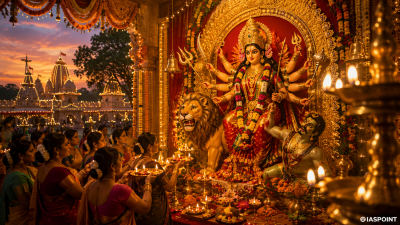
Navaratri, meaning “Nine Nights,” is a major Hindu festival celebrated four times a year, though the most significant is the Sharada Navaratri. It is governed by the Luni-Solar calendar, falling in the Shukla Paksha (bright fortnight) of the month of Ashvin (September–October). This period coincides with the transition from the Monsoon to Autumn (Sharad Ritu), symbolizing a period of purification and the resurgence of energy (Shakti).
The Four Navaratris of the Hindu Calendar
While public festivities are common in autumn, the Indian tradition recognizes four distinct Navaratris throughout the lunar year:
- Sharada Navaratri: The most celebrated, occurring in Ashvin; it culminates in Dussehra.
- Vasanta Navaratri: Observed in the month of Chaitra (March–April), marking the start of the Vedic New Year and culminating in Rama Navami.
- Magha Navaratri: A “Gupt” (secret) Navaratri observed by practitioners of Shaktism in January–February.
- Ashadha Navaratri: Another “Gupt” Navaratri observed in June–July.
Navaratri: Symbolism of the Nine Forms of Durga (Navadurga)
Each of the nine nights is dedicated to a specific manifestation of Goddess Durga, representing various stages of spiritual evolution and cosmic power:
- Shailaputri: Daughter of the Mountains; represents the root chakra.
- Brahmacharini: The ascetic form; represents penance and resolve.
- Chandraghanta: The wearer of the bell-shaped moon; represents bravery.
- Kushmanda: The creator of the universe; represents cosmic energy.
- Skandamata: Mother of Kartikeya; represents maternal strength.
- Katyayani: The warrior form; the slayer of Mahishasura.
- Kalaratri: The fierce form; destroyer of ignorance and darkness.
- Mahagauri: The serene and radiant form; represents purity.
- Siddhidhatri: The granter of perfections (Siddhis) and divine wisdom.
Durga Puja: The Socio-Cultural Pillar of Eastern India
While Navaratri is celebrated across India, Durga Puja is a specific socio-religious event concentrated in West Bengal, Odisha, Assam, and Bihar. In 2021, UNESCO inscribed Durga Puja in Kolkata on the Representative List of the Intangible Cultural Heritage of Humanity.
Key Rituals and Days of Durga Puja
Durga Puja officially begins on Mahalaya, the day the Goddess is invited to earth, but the core rituals span from the sixth to the tenth day:
- Maha Shashti: The ritual of Bodhon (awakening the Goddess) takes place.
- Maha Saptami: The Nabapatrika (nine plants tied together) is bathed in a river, representing nature’s fertility.
- Maha Ashtami: The most auspicious day, featuring the Sandhi Puja, performed at the junction where Ashtami ends and Navami begins.
- Maha Navami: Marks the final day of the battle between Durga and Mahishasura.
- Vijayadashami: The immersion (Visarjan) of the idol, symbolizing the Goddess’s return to Mount Kailash.
Regional Artistic and Ritualistic Variations
The diversity of India is reflected in how different states observe these nine nights:
| Region | Style of Celebration | Unique Feature |
| Gujarat | Garba and Dandiya Raas | Circular folk dances representing the cycle of life; Garba is also a UNESCO Intangible Cultural Heritage. |
| West Bengal | Pandal Hopping | Temporary architectural marvels (Pandals) and clay idols crafted by artisans in Kumartuli. |
| Tamil Nadu | Bommai Golu | A tiered display of dolls depicting mythological stories and social themes. |
| Kerala | Vidyarambham | On the day of Vijayadashami, children are initiated into education and the arts. |
| Karnataka | Mysuru Dasara | A state festival (Nada Habba) featuring the worship of the Goddess Chamundeshwari. |
| Telangana | Bathukamma | A floral festival where women build beautiful flower stacks to worship the goddess of nature. |
Art and Material Culture in Durga Puja
- Dhak: Traditional large drums played during the puja, creating a distinct rhythmic atmosphere.
- Dhunuchi Naach: A devotional dance performed with earthen incense burners filled with coconut husk and dhuno (resin).
- Patuas and Scroll Painting: In rural Bengal, the victory of Durga is often narrated through the Patachitra tradition.
- Sholapith Craft: Intricate white ornaments and backdrops for idols made from the milky-white sponge-wood of the Shola plant.
Important Facts for UPSC Prelims
- UNESCO Status: Durga Puja in Kolkata was the first festival in Asia to receive the UNESCO Intangible Cultural Heritage tag (2021).
- Akal Bodhon: The autumn celebration is called Akal Bodhon (“untimely awakening”) because according to the Puranas, the Goddess was traditionally worshipped in spring. Lord Rama is credited with performing this autumn puja to seek her blessings before his battle with Ravana.
- Nabapatrika (Kola Bou): The nine plants used represent nine forms of the Goddess: Banana, Pomegranate, Turmeric, Jayanti, Bel, Arum, Rice, Ashoka, and Paddy.
- Chakhushmadaan: The ritual of painting the eyes of the Durga idol, traditionally performed by the lead artisan on the day of Mahalaya.
- Dakshinayan vs. Uttarayan: Sharada Navaratri falls during the Dakshinayan period (the “night” of the gods), necessitating the ritual “awakening” of the Goddess.