
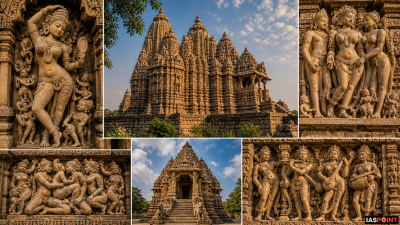
The Chandela dynasty (9th to 13th century CE) ruled the Jejakabhukti region (modern-day Bundelkhand). Their greatest contribution to Indian heritage is the temple complex at Khajuraho, constructed primarily between 950 and 1050 CE. Chandela sculpture represents the pinnacle of the Central Indian Nagara style, distinguished by its intense emotional expression, sophisticated anatomical detailing, and the seamless integration of the divine with the mundane.
Fundamental Characteristics of Chandela Statuary
Chandela sculptures are renowned for their “plasticity” and the ability of the craftsmen to make hard sandstone appear as supple as human flesh.
- Three-Dimensionality: Unlike the flat reliefs of earlier periods, Khajuraho sculptures are carved in high relief, often appearing almost free-standing from the temple walls.
- The Sinuous “S” Curve: Figures are characterized by the Tribhanga (triple-bend) or extreme Atibhanga postures, providing a sense of rhythmic movement.
- Anatomical Perfection: Artists displayed a profound understanding of human anatomy, emphasizing slender waists, rounded limbs, and intricate hairstyles.
- Secular-Religious Synthesis: The sculptures bridge the gap between spiritual aspirations and earthly life, depicting gods, goddesses, celestial nymphs, and ordinary humans with equal fervor.
Major Categories of Sculptural Themes
The exterior and interior walls of Chandela temples are organized into distinct horizontal bands (Pattikas) featuring specific thematic groups.
- Cult Deities (Panchayatan): These are the primary icons found in the Garbhagriha (sanctum) and the main niches, including Shiva, Vishnu, Shakti, and Surya.
- Surasundaris and Apsaras: These are the most celebrated motifs of Khajuraho. They depict celestial beauties in secular acts such as applying makeup, removing a thorn from a foot, writing a letter, or dancing.
- Mithuna and Maithuna (Erotic Art): Constituting about 10% of the total carvings, these depictions reflect the influence of Tantric cults and the four goals of human life (Purusharthas), where Kama (desire) is a path to Moksha (liberation).
- Vyala and Sardula: Mythical creatures, often a lion-hybrid, symbolizing power and the untamed forces of nature.
- Social Life: Friezes depicting royal processions, hunting scenes, musical performances, and the daily labor of masons and sculptors.
Significant Chandela Temples and Sculptural Highlights
| Temple Name | Primary Deity | Key Sculptural Features |
| Kandariya Mahadeva | Shiva | The largest temple; features nearly 900 sculptures; famous for its elaborate celestial nymph panels. |
| Lakshmana Temple | Vishnu (Vaikuntha) | Houses the unique three-headed Vishnu (Lion, Man, Boar); features a famous frieze of the Chandela army. |
| Visvanatha Temple | Shiva | Noted for the sculpture of a woman playing a flute and another fondling a child. |
| Parshvanatha Temple | Jain Tirthankara | Famous for the “Woman applying Collyrium” (eye makeup) and the “Woman tying an anklet” sculptures. |
| Chausath Yogini | 64 Yoginis | The only circular, granite temple at the site; houses fierce, tantric female deity sculptures. |
Evolution of Material and Technique
- Sandstone: Most Khajuraho temples were built using buff, pink, or pale yellow sandstone sourced from the Panna quarries. This fine-grained stone allowed for the “filigree-like” detailing of jewelry and drapery.
- Granite: The earliest Chandela structures (like the Chausath Yogini) were made of granite. The transition to sandstone enabled the transition from blocky, primitive forms to the fluid grace seen in later temples.
- Joinery: The sculptures are part of a dry-masonry system where stones were held together by gravity and mortise-and-tenon joints rather than mortar.
Technical Facts for UPSC Prelims
- UNESCO World Heritage Site: The Khajuraho Group of Monuments was inscribed in 1986.
- Regional Variation: While the Nagara style is common in the North, Chandela architecture is unique for its lack of a boundary wall (Prakara) and its elevated plinth (Jagati).
- Iconographic Rarity: The Lakshmana temple contains one of the few surviving depictions of the Vaikuntha Vishnu (a form with three or four heads representing various avatars).
- Tantric Influence: The prominence of erotic sculpture is often attributed to the Kaula-Kapalika sects, which believed in the sublimation of sexual energy for spiritual gain.
Notable Masterpieces and Trivia
- The Vaman Temple: Unique for its “Orgy” panels and highly decorative Surasundaris that occupy two rows of niches on the exterior.
- The Matangeshvara Temple: The only temple in the complex that is still an active place of worship, housing a massive 8-foot tall polished rock-cut Lingam.
- The “Thorn Remover”: One of the most famous individual sculptures at Khajuraho, demonstrating the artist’s ability to capture a fleeting, mundane moment with divine grace.
- The Shardula Legend: The Chandela royal emblem features a warrior fighting a lion (Sardula), which according to legend, represents the dynasty’s founder, Chandravarman, protecting his mother.