
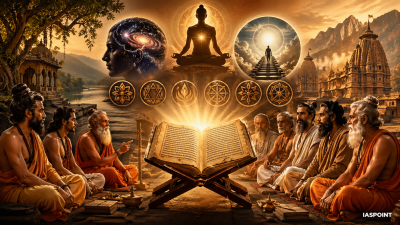
In Indian philosophy, schools are classified as Astika (Orthodox) if they accept the authority of the Vedas. These schools represent a systematic attempt to explain the nature of existence, the self, and the path to liberation (Moksha). While they differ in their metaphysical and epistemological approaches, they share common goals: the removal of suffering and the realization of ultimate truth.
Evolution of the Shad-Darshanas
The six orthodox schools, known as the Shad-Darshanas, evolved through centuries of debate and commentary. They are often grouped into three pairs based on their shared philosophical affinities: Nyaya-Vaisheshika, Samkhya-Yoga, and Mimamsa-Vedanta.
| School | Major Proponent | Primary Text | Key Focus |
| Samkhya | Kapila | Samkhya Sutra | Dualism: Purusha (Spirit) and Prakriti (Matter). |
| Yoga | Patanjali | Yoga Sutra | Physical and mental discipline for liberation. |
| Nyaya | Gautama | Nyaya Sutra | Logical reasoning and Epistemology. |
| Vaisheshika | Kanada | Vaisheshika Sutra | Atomic theory and classification of reality. |
| Purva Mimamsa | Jaimini | Mimamsa Sutra | Interpretation of Vedic rituals and Dharma. |
| Vedanta | Badarayana | Brahmasutra | Philosophical essence of the Upanishads. |
Samkhya: The Dualistic Foundation
Samkhya is considered one of the oldest schools and provides the metaphysical basis for many other systems.
Metaphysics of Purusha and Prakriti
- Dualism: It posits that the universe is composed of two independent realities: Purusha (pure consciousness, male principle) and Prakriti (primordial matter, female principle).
- The Three Gunas: Prakriti consists of three inherent qualities: Sattva (purity/light), Rajas (activity/passion), and Tamas (darkness/inertia). Imbalance in these Gunas leads to the evolution of the material world.
- Satkaryavada: This is the Samkhya theory of causation, which asserts that the effect pre-exists in the cause (e.g., oil exists in the seed).
Liberation through Discernment
- Salvation is achieved through Viveka-Jnana (discriminative knowledge), where the Purusha realizes its complete independence from the entanglements of Prakriti.
Yoga: The Science of Meditation
Yoga is the practical counterpart to Samkhya. While Samkhya provides the theory, Yoga provides the methodology to achieve liberation.
The Ashtanga Yoga Path
Patanjali’s “Eight-Fold Path” is designed to still the mind (Chitta-Vritti-Nirodha):
- External Discipline: Yama (restraints) and Niyama (observances).
- Physical Preparation: Asana (posture) and Pranayama (breath control).
- Internalization: Pratyahara (withdrawal of senses).
- Mental Focus: Dharana (concentration), Dhyana (meditation), and Samadhi (absorption/liberation).
Concept of Ishwara
Unlike early Samkhya, which was largely silent on God, Yoga introduces Ishwara—not as a creator, but as a perfect soul that serves as a model for practitioners to concentrate upon.
Nyaya: The School of Logic
Nyaya focuses on the conditions of correct thinking and the means of acquiring valid knowledge (Pramana).
The Four Pramanas
Nyaya recognizes four valid sources of knowledge:
- Pratyaksha (Perception): Knowledge gained through the five senses.
- Anumana (Inference): Reaching a conclusion from a known premise (e.g., seeing smoke and inferring fire).
- Upamana (Comparison): Learning the meaning of a word by comparing it to known objects.
- Shabda (Testimony): Knowledge derived from reliable authorities or scriptures.
Five-Membered Syllogism
Nyaya developed a sophisticated five-step logical process (Avayava) to prove a point: Pratijna (Hypothesis), Hetu (Reason), Udaharana (Example), Upanaya (Application), and Nigamana (Conclusion).
Vaisheshika: Atomic Pluralism
Founded by Sage Kanada, this school is regarded as the precursor to Indian physics and chemistry.
Atomic Theory (Paramanuvada)
- It posits that the universe is made of indivisible, eternal atoms (Anu).
- There are four types of atoms: Earth, Water, Fire, and Air. Space (Akasha) is considered eternal but not atomic.
- The combination of these atoms into molecules is governed by the “Unseen Force” (Adrishta).
The Seven Padarthas (Categories)
Vaisheshika classifies everything that exists into seven categories: Dravya (Substance), Guna (Quality), Karma (Action), Samanya (Generality), Vishesha (Particularity), Samavaya (Inherence), and Abhava (Non-existence).
Purva Mimamsa: The Path of Rituals
Mimamsa focuses on the earlier (Purva) part of the Vedas, specifically the Brahmanas, which deal with rituals.
- Dharma as Action: It defines Dharma as the performance of Vedic sacrifices.
- Eternity of the Vedas: It holds that the Vedas are Apaurusheya (not created by man or God) and Nitya (eternal).
- Prabhakara and Kumarila Schools: These are the two main sub-sects of Mimamsa that differ slightly on epistemology and the nature of error.
Vedanta: The Ultimate Reality
Vedanta (Uttara Mimamsa) focuses on the philosophical portion of the Vedas—the Upanishads. It is the most dominant school in modern Hindu thought.
Major Sub-schools of Vedanta
The different interpretations of the relationship between the individual soul (Jiva), the world (Jagat), and God (Brahman) led to various sub-schools:
| School | Founder | Core Philosophy |
| Advaita | Shankaracharya | Radical Monism: Only Brahman is real; the world is Maya (illusion). |
| Vishishtadvaita | Ramanujacharya | Qualified Non-dualism: The soul and world are real but inseparable parts of God. |
| Dvaita | Madhvacharya | Strict Dualism: God, Soul, and Matter are eternally distinct. |
| Dvaitadvaita | Nimbarkacharya | Dualistic Non-dualism: Relationship is like the sun and its rays. |
| Shuddhadvaita | Vallabhacharya | Pure Non-dualism: The world is a real manifestation of Krishna, not an illusion. |
Comparative Factsheet for UPSC Aspirants
- Theistic vs. Atheistic: While all Astika schools accept the Vedas, Samkhya and Mimamsa were originally atheistic (denying a creator god), whereas Yoga, Nyaya, Vaisheshika, and Vedanta are theistic.
- Theory of Causation: Samkhya follows Satkaryavada (effect in cause), while Nyaya-Vaisheshika follows Asatkaryavada (effect is a new creation).
- Historical Context: These schools reached their peak during the Gupta period, often called the “Golden Age” of Indian culture.
- Prasthanatrayi: The three foundational texts of Vedanta are the Upanishads, the Bhagavad Gita, and the Brahma Sutras.