
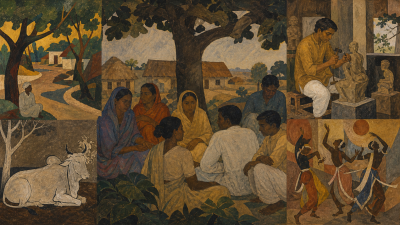
Contextual Modernism is a term coined by art historian R. Siva Kumar to describe the distinct brand of modern art that emerged from Santiniketan, West Bengal, particularly between the 1920s and 1940s. Unlike the Bengal School’s “Revivalism” or the Progressive Artists’ Group’s “Internationalism,” Contextual Modernism sought a path where international modernism was filtered through local, indigenous, and environmental contexts. It was a shift from nationalist sentimentality to a robust engagement with nature, the rural landscape, and the common man.
The Role of Kala Bhavana and Santiniketan
Kala Bhavana, the fine arts faculty of Visva-Bharati University, served as the laboratory for this movement. Founded by Rabindranath Tagore, the institution moved away from the rigid academic structures of colonial art schools.
- Education in Nature: Classes were held under trees, encouraging artists to observe the organic rhythms of life rather than copying Greco-Roman casts.
- Integration of Crafts: The hierarchy between “Fine Arts” and “Crafts” was dissolved, integrating leatherwork, batik, and pottery into the artistic curriculum.
- Murals as Public Art: The tradition of large-scale outdoor murals was revived to make art accessible to the community, rather than confining it to private galleries.
Key Pioneers and Their Stylistic Contributions
Four major figures, often referred to as the “Santiniketan Triumvirate” plus Rabindranath Tagore, defined the trajectory of Contextual Modernism.
Rabindranath Tagore: The Intuitive Expressionist
Tagore turned to painting in his 60s, evolving his doodles into haunting, expressive figures.
- Style: Spontaneous, rhythmic, and often somber. He used fountain pen ink, crayons, and vegetable dyes.
- Themes: Strange animals, melancholic women, and dramatic landscapes that moved away from the “pretty” aesthetic of the earlier Bengal School.
Nandalal Bose: The Architect of National Imagery
As the principal of Kala Bhavana, Bose transitioned from his early mythological themes to a “grounded” modernism.
- Haripura Posters: Created for the 1938 Congress session, these depicted ordinary professionals like musicians and hunters using bold lines and local pigments.
- Environmental Art: He emphasized the “life-rhythm” of nature, heavily influenced by Far-Eastern brushwork.
Benode Behari Mukherjee: The Visual Poet of the Earth
Despite severe visual impairment (and later total blindness), Mukherjee focused on the “architectonics” of the landscape.
- Mediaeval Saints Mural: Located in the Hindi Bhavana, this 100-foot mural is considered a masterpiece of 20th-century Indian art, depicting the history of the Bhakti movement through the lives of common people.
- Localism: His subjects were the local foliage of Santiniketan and the simple daily lives of the people around the university.
Ramkinkar Baij: The Father of Modern Indian Sculpture
Baij was the first to use modern materials like cement and concrete to create monumental outdoor sculptures.
- Santhal Family: A landmark sculpture depicting the migration of tribal people, capturing motion and raw energy.
- Indigenous Modernism: He fused the structural principles of Western modernism with the vitality of the local Santhal tribes.
Comparison: Contextual Modernism vs. Bengal School
| Feature | Bengal School (Early Phase) | Contextual Modernism (Santiniketan) |
| Philosophy | Revivalism (Reclaiming the past) | Engagement with the present and environment |
| Subject Matter | Mythological and Historical tales | Rural life, Santhal tribes, Local landscape |
| Technique | Soft Wash technique (Misty look) | Bold lines, heavy textures, and murals |
| Material | Delicate watercolours and tempera | Oil, cement, terracotta, and local inks |
| Approach | Romantic and Idealistic | Observational and Structural |
Technological and Material Innovations
The artists at Santiniketan were pioneers in material experimentation, often driven by the lack of resources and a desire for “Swadeshi” materials.
- Fresco Buono: Nandalal Bose and his students studied Italian fresco techniques but adapted them to the local climate and materials.
- Terracotta and Brick: Utilizing the traditional craft heritage of Birbhum (the district where Santiniketan is located).
- Calligraphic Lines: Integrating the linear economy of Japanese and Chinese ink-wash traditions with Indian figurative forms.
Fact Sheet for UPSC Prelims: Critical Trivia
- The Constitution of India: Nandalal Bose and his team from Santiniketan were tasked with decorating the original manuscript of the Indian Constitution, illustrating it with scenes ranging from the Vedic period to the freedom struggle.
- The 1934 Earthquake: This event triggered a shift in Nandalal Bose’s work, leading to a more somber and realistic portrayal of human suffering and resilience.
- Satyajit Ray: The legendary filmmaker was a student of Benode Behari Mukherjee at Santiniketan and later made the documentary The Inner Eye as a tribute to his blind teacher.
- Kopai River: A frequent motif in Santiniketan art, symbolizing the local landscape’s flow and the integration of nature into the artistic consciousness.
- Poush Mela: The annual fair at Santiniketan served as a major source of inspiration for depictions of folk life and tribal culture.
- UNESCO World Heritage Status: In 2023, Santiniketan was inscribed on the UNESCO World Heritage List, specifically citing its unique model of “Contextual Modernism” and its departure from colonial architectural and artistic norms.