
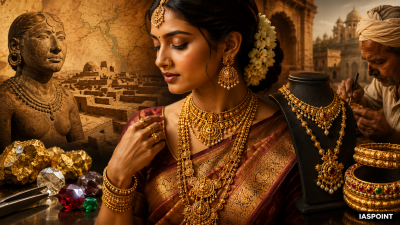
Indian jewellery is not merely an accessory but a visual record of the country’s aesthetic, social, and economic history. Since the Indus Valley Civilization, Indian artisans have mastered the art of transforming metals and minerals into symbolic ornaments. The tradition is characterized by a “360-degree” approach where every part of the human anatomy has a dedicated ornament, reflecting a deep understanding of both aesthetics and acupressure points.
Principal Jewellery Crafting Techniques
The diversity of Indian jewellery arises from specialized regional techniques that have been preserved through hereditary guilds (Srenis).
Kundan and Polki Work
- Definition: Kundan is the oldest method of stone-setting in India, involving the use of highly refined 24k gold foil to secure stones.
- Polki: This refers to the use of raw, uncut diamonds in their natural form without professional polishing.
- Process: The artisan creates a gold framework, places the stone, and then inserts “Kundan” (pure gold) between the stone and the frame at room temperature.
- Geographic Hub: Primarily Rajasthan (Bikaner and Jaipur) and Gujarat.
Meenakari (Enameling)
- Origins: Introduced to India by the Mughals; perfected in the courts of Raja Man Singh of Amber.
- Technique: The art of coloring metal surfaces by fusing mineral powders. The metal is engraved with intricate designs, filled with colors, and fired in a kiln.
- Reverse Meenakari: High-end Kundan-Polki jewellery often features Meenakari on the reverse side, ensuring the ornament is a work of art from both angles.
Jadau
- Craftsmanship: A collaborative technique involving the Chitariya (designer), Ghaaria (engraver), and Enameller.
- Distinctive Feature: It is a process of “embedding” rather than just setting, typically involving gold that is softened to hold the stones in place.
Regional Art Traditions of Indian Jewellery
| Tradition | State of Origin | Key Characteristics |
| Thewa | Rajasthan (Pratapgarh) | Embossing intricately worked gold foil onto molten colored glass. |
| Tarakasi | Odisha (Cuttack) | Silver Filigree work involving thin wires drawn from silver blocks to create lace-like patterns. |
| Temple Jewellery | Tamil Nadu | Inspired by Chola and Pandya temple architecture; features motifs of deities, bells, and lotus flowers. |
| Bidriware | Karnataka (Bidar) | Silver inlay on an alloy of zinc and copper, blackened with soil from Bidar Fort. |
| Pachchikam | Gujarat (Kutch) | A folk version of Kundan using silver instead of gold, giving it a rustic, antique look. |
| Nazzar | Hyderabad | Traditional Hyderabadi pearl jewellery, often combined with “Basra” pearls and emeralds. |
Classification of Traditional Ornaments by Anatomy
Indian ornamentation follows a systemic approach to the human body, with specific items assigned to various parts.
Head and Forehead Ornaments
- Maang Tikka: A pendant worn on the parting of the hair, symbolizing the third eye or the union of male and female energies.
- Shringar Patti: A fringe-like ornament that borders the hairline.
- Jhumar/Passa: A fan-shaped ornament worn on the left side of the head, a signature of the Awadhi and Mughal styles.
Ear and Nose Ornaments
- Jhumka: Bell-shaped earrings that gained prominence during the Mughal era.
- Karnaphula: “Ear-flower” studs, often seen in ancient Shunga and Kushan sculptures.
- Nath: The nose ring, which varies significantly by region (e.g., the Maharashtrian Nath is cashew-shaped and pearl-studded).
Neck and Torso Ornaments
- Guluband: A tight-fitting choker.
- Haar: Long necklaces; the Chandrahaar (moon-garland) consists of multiple gold chains.
- Kamarband: A waist belt or girdle used to hold garments in place and accentuate the waistline.
Hand and Foot Ornaments
- Hathphul: Five rings connected by chains to a central medallion and a bracelet.
- Kangan/Kara: Thick bangles or bracelets, often featuring animal head motifs like lions or elephants (Gajra).
- Pajeb/Payal: Anklets, traditionally made of silver as gold was considered the “metal of the gods” and not worn on the feet in many communities.
Materials and Symbolism in Indian Jewellery
- Gold: Symbolizes the sun and purity; considered the most auspicious metal in Hindu tradition (Hiranyagarbha).
- Silver: Associated with the moon and used extensively by tribal communities (e.g., Rabari, Toda) for its cooling properties.
- Pearls (Moti): Sourced historically from the Gulf of Mannar; Hyderabad remains a global processing hub.
- Navaratna: A combination of nine gems representing the nine planets (Grahas), believed to balance the wearer’s cosmic energy.
Factful Trivia for UPSC Aspirants
- First Evidence: The earliest evidence of Indian jewellery dates back to the Mehrgarh site (Pre-Indus Valley), where beads of shell and lapis lazuli were found.
- GI Tags: Several Indian jewellery forms hold Geographical Indication tags, including Cuttack Silver Filigree and Pratapgarh Thewa Work.
- The Sreni System: In ancient India, jewellery manufacture was regulated by guilds called Srenis, which had their own laws and judicial powers.
- Tavernier’s Account: 17th-century traveller Jean-Baptiste Tavernier recorded that Indian diamond cutters were far superior to European ones in preserving the weight of the stone.
- Spiritual Connection: In South India, the Thali or Mangalsutra is not just jewellery but a sacred thread representing the marital status, with designs varying according to caste and sect.