
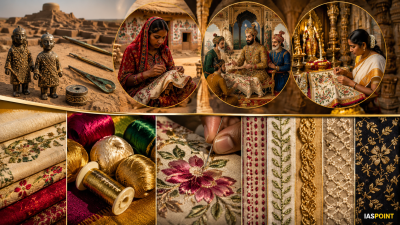
Embroidery in India, known as Shilpashastra or Kashida, dates back to the Indus Valley Civilization, where bronze needles and figurines wearing patterned shawls were discovered. Over millennia, the art evolved through three distinct influences: the indigenous folk traditions (rural), the courtly/imperial patronage (Mughal and Sultanate), and the religious/temple traditions (ritualistic). It is categorized by the base fabric used, the type of thread (silk, cotton, or metallic), and the specific stitch employed.
Classification of Indian Embroidery Traditions
Indian embroidery is broadly classified into three categories based on the nature of the craft and its socio-economic origin.
| Category | Characteristics | Primary Examples |
| Court Embroidery | Highly sophisticated, uses expensive materials like gold and silver threads; patronized by royalty. | Zardosi, Chikankari (Imperial style). |
| Folk Embroidery | Practiced by rural and tribal women for personal use; often features geometric patterns and local motifs. | Phulkari, Kantha, Toda, Lambadi. |
| Religious Embroidery | Created for temple hangings, deity vestments, or ritualistic offerings. | Pichwai (painted/embroidered), Pipli work. |
Major Regional Embroidery Traditions
Chikankari (Uttar Pradesh)
- Origin: Popularized by Empress Nur Jahan in the 17th century; Lucknow is the primary hub.
- Technique: Traditionally a “White-on-White” embroidery (white thread on white muslin/mulmul). It now uses various fabrics like georgette and chiffon.
- Unique Features: It involves 36 different stitches. The most important are Tepchi (running stitch), Bakhiya (shadow work where the thread is on the reverse to create a shadow on the front), and Phanda (millet-shaped knots).
Zardosi (Delhi, Agra, and Varanasi)
- Origin: A Persian craft (Zar meaning gold, Dosi meaning embroidery) that reached its zenith under the Mughals.
- Materials: Uses Zari (metallic threads), Salma (coils), Sitara (spangles), and Badla (flattened wire).
- Application: Historically used for royal tents, scabbards, and courtly robes. Today, it is a staple of Indian bridal couture.
Phulkari (Punjab)
- Definition: Literally means “Flower Work.” It was traditionally done by women for their own use or for dowries.
- Fabric and Thread: Uses coarse, hand-spun cotton (Khaddar) as the base and untwisted silk thread (Pat) for embroidery.
- Stitch: The Darning Stitch is used from the reverse side of the fabric to create a velvety effect on the front.
- Variants: Bagh (Garden) is a type where the embroidery is so dense that the base fabric is completely invisible.
Kantha (West Bengal and Odisha)
- Philosophy: Based on the concept of recycling; traditionally made by stitching together layers of old saris using a simple Running Stitch.
- Motifs: Depicts scenes from daily life, folk tales, animals, and the “Lotus” or “Sun” at the center.
- Modern Form: Now used on new silk and cotton saris to create intricate narrative patterns.
Kasuti (Karnataka)
- Technique: A highly intricate style that requires counting the warp and weft threads of the fabric. No knots are used, so both sides of the fabric look identical.
- Stitches: Features four types—Gavanti (double running), Murgi (zigzag), Neygi (running), and Menthi (cross-stitch).
- Motifs: Influenced by temple architecture, featuring Gopurams, chariots, lamps, and peacocks.
Toda Embroidery (Tamil Nadu)
- Identity: Practiced by the Toda pastoral tribe of the Nilgiris; locally called Pukhoor.
- Technique: Done on white unbleached cotton with red and black woollen threads. The patterns are strictly geometric, resembling the weave of the fabric.
- Status: It has been granted a Geographical Indication (GI) tag.
Tribal and Nomadic Traditions
- Lambadi/Banjara Embroidery (Telangana/Andhra Pradesh): Characterized by vibrant colors, cowrie shells, mirrors (Abhla), and beads. It uses a mix of cross-stitches and chain stitches on thick fabric.
- Kutch Embroidery (Gujarat): A collective term for various styles like Ahir, Rabari, and Mochi Bharat. The Aari (hook) work is a specialty, producing fine, chain-stitch patterns that look like paintings.
- Chamba Rumal (Himachal Pradesh): Known as “Needle Painting.” It is a double-sided embroidery (Do-rukha) where the design appears identical on both sides. It usually depicts scenes from the Raas-Leela of Krishna.
Technical Glossary for Prelims
- Aari Work: Embroidery done with a long hooked needle, similar to a crochet needle.
- Abhla: The use of small mirrors stitched onto the fabric, common in Rajasthani and Gujarati crafts.
- Gota Patti: An appliqué technique from Rajasthan using small pieces of gold/silver ribbon (Gota) to create floral patterns.
- Kashida: The general term for embroidery in Kashmir, often featuring the Chinarpatti (leaf) and Ambi (paisley) motifs using fine wool.
- Suini: A traditional embroidery of Bihar (often compared to Kantha) which involves fine running stitches to create geometric and floral patterns.
Current Institutional Framework
- Geographical Indication (GI) Tags: Several embroideries like Lucknow Chikankari, Chamba Rumal, Kasuti, and Toda Embroidery are protected under the GI Act, 1999.
- National Handicrafts Development Programme (NHDP): A government initiative to provide marketing and technical support to traditional embroiderers.
- Vocal for Local: This initiative has boosted the export of handcrafted Indian embroidery, especially to European luxury fashion houses.