
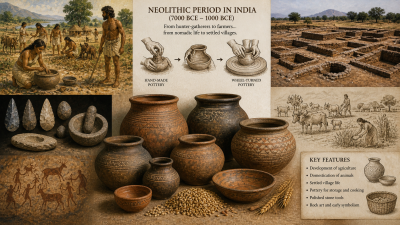
The Neolithic Period in India, spanning roughly from 7000 BCE to 1000 BCE, marked a revolutionary transition from a nomadic hunter-gatherer lifestyle to settled agriculture and animal husbandry. This transition, often termed the Neolithic Revolution, necessitated the creation of storage vessels for surplus grain and cooking utensils. Consequently, pottery emerged as a primary craft, evolving from crude hand-made forms to sophisticated wheel-turned vessels.
Evolution and Manufacturing Techniques
The transition in pottery techniques reflects the technological advancement of Neolithic settlements.
- Hand-made Pottery: The earliest phase involved the coiling technique, where ropes of clay were wound and smoothed, or the pinch-pot method. These vessels were often irregular in shape.
- Turn-table/Slow Wheel: In later stages, the introduction of the wooden turntable allowed for better symmetry and thinner walls.
- Firing Methods: Pottery was initially dried in the sun and later fired in open pits or primitive kilns. The control over oxygen during firing led to distinct color variations like Grey Ware, Red Ware, and Black-and-Burnished Ware.
Regional Variations and Key Neolithic Sites
Neolithic pottery in India is not uniform; it varies significantly across geographical clusters based on clay availability and cultural influences.
| Regional Cluster | Key Sites | Dominant Pottery Types |
| North-Western | Mehrgarh (Pakistan), Kili Gul Muhammad | Crude handmade ware, later transitioning to painted wheel-made pottery with geometric motifs. |
| Northern (Kashmir) | Burzahom, Gufkral | Coarse Grey Ware, often with mat-impressed bases (indicating pots were kept on mats while wet). |
| Vindhyan / Central | Koldihwa, Mahagara | Cord-impressed ware (distinctive rope patterns), Micaceous Red Ware. |
| Mid-Gangetic | Chirand (Bihar), Senuwar | Red Ware, Black and Red Ware (BRW), and Grey Ware with burnished surfaces. |
| Southern | Brahmagiri, Maski, Piklihal, Hallur | Burnished Grey Ware, Blotchy Grey Ware, and occasionally painted Red Ware. |
| North-Eastern | Daojali Hading, Sarutaru | Shouldered Celts and Cord-marked pottery showing links to East Asian traditions. |
Distinctive Features and Decorative Motifs
The Neolithic potters utilized various methods to enhance the functional and aesthetic value of their craft.
Surface Treatment and Finish
- Burnishing: Rubbing the leather-hard surface with a smooth pebble to create a glossy, non-porous finish.
- Slipping: Applying a thin layer of liquid clay (slip) before firing to provide a uniform color (Red or Ochre).
- Cord-Marking: A hallmark of the Vindhyan and North-Eastern Neolithic, where the wet clay was impressed with corded paddles, leaving a textured design.
Decorative Patterns
- Incision: Using sharp tools to create geometric patterns, zig-zags, or oblique slashes.
- Appliqué Work: Attaching additional strips of clay to the neck or body of the pot for decoration.
- Graffiti: Post-firing marks found on some Southern Neolithic pots, possibly representing ownership or ritualistic symbols.
Socio-Economic Significance of Pottery
Pottery serves as a vital tool for archaeologists to reconstruct the socio-economic life of Neolithic humans.
- Functional Diversification: The variety of shapes—including storage jars, bowls, basins, and lipped spouts—indicates specialized usage for cooking, storage, and serving.
- Food Habits: Residue analysis of Neolithic pots has revealed traces of cultivated crops like barley, wheat, and ragi, as well as evidence of boiling milk and meat.
- Social Stratification: The presence of finely burnished or painted pottery in certain dwellings compared to coarse ware in others suggests emerging social hierarchies.
- Trade and Interaction: The similarity between cord-marked pottery in Assam and the Yangshao culture of China points toward early trans-border cultural exchanges.
Technical Trivia for UPSC Prelims
- Earliest Evidence: Koldihwa (Uttar Pradesh) provides some of the earliest evidence of cord-impressed pottery along with rice cultivation in the Indian subcontinent.
- Mat-Impressions: The “Mat-impressed” base is a unique feature of Burzahom (Kashmir), suggesting that the pots were placed on woven mats during the drying process.
- Mehrgarh Transition: Mehrgarh is the only site showing a clear stratigraphic transition from Aceramic (pottery-less) Neolithic to Ceramic Neolithic.
- The Spouted Vessel: The appearance of spouted vessels in the Southern Neolithic (Piklihal) indicates an advanced understanding of liquid pouring mechanisms, likely used in rituals.
- Technological Shift: The shift from handmade to wheel-made pottery is generally used as a marker for the transition from the Early Neolithic to the Chalcolithic period in several regions.