
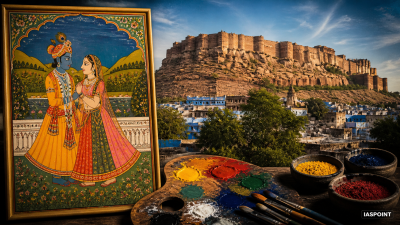
The Marwar School of Painting represents the artistic traditions of the erstwhile Jodhpur State and its surrounding principalities like Pali and Nagaur. It is characterized by its bold execution, vibrant colors, and a distinct departure from the extreme naturalism of the Mughal school, favoring instead a more robust and indigenous folk-inspired aesthetic.
Historical Evolution and Patronage
The school evolved from the early 16th-century Jain manuscript traditions of Western India.
- Early Phase: The earliest dated work is the Ragamala painted at Pali in 1623 by artist Virji. This phase shows minimal Mughal influence and focuses on flat perspectives.
- Mughal Integration: During the reigns of Maharaja Jaswant Singh and Maharaja Ajit Singh, the school adopted certain Mughal elements such as refined linework and courtly etiquette, yet retained its “desert” color palette.
- The Golden Age: Under Maharaja Man Singh (1803–1843), the school reached its peak, heavily influenced by the Nath Sampradaya (a religious sect). This period saw the production of massive series based on Shiva and the Nath yogis.
Distinctive Features of Marwar Art
The Marwar style is easily recognizable through specific physiognomic and environmental markers.
- Color Palette: Extensive use of brilliant yellow, flame red, and ochre, reflecting the desert landscape.
- Physical Traits: Figures are often tall with “sideways” almond-shaped eyes, pointed noses, and elongated limbs. Male figures are depicted with high turbans and voluminous whiskers.
- Costumes: Men wear the characteristic Jodhpuri pagri (turban) and long jamahs, while women are shown in traditional lehenga-choli with transparent odhis.
- Stylized Nature: Clouds are often depicted as spiral, rolling masses, and the vegetation usually includes the Khejri tree and desert shrubs.
Major Themes and Manuscripts
The Marwar School prioritized heroic and romantic narratives.
- Dhola-Maru: The most popular folk theme, depicting the romantic tale of Prince Dhola and Princess Maru riding a camel.
- Ragamala and Barahmasa: Visual representations of musical modes and the twelve months.
- Religious Series: Shiva Purana, Durga Sapthashati, and Nath Charitra (dedicated to the Nath sect).
- Court and Hunting: Detailed scenes of the Maharaja in procession or hunting wild boar in the desert.
The Kishangarh School: A Sub-set of Excellence
Kishangarh, a small state founded by Kishan Singh in 1609, developed one of the most sophisticated and poetic styles of Indian painting during the 18th century, primarily under the patronage of Raja Savant Singh.
The Legend of Bani Thani
The defining feature of Kishangarh art is the idealized depiction of Radha and Krishna, modeled after Raja Savant Singh (who wrote poetry under the pen name Nagari Das) and his beloved singer, Bani Thani.
- Stylized Features: The “Kishangarh Face” is unique—elongated faces, high sloping foreheads, sharply arched eyebrows, and half-closed, lotus-shaped eyes (Khonjan-Netra).
- Artist Nihal Chand: The master artist responsible for the Kishangarh idiom. He successfully translated Nagari Das’s mystical poetry into visual masterpieces.
- The “Mona Lisa of India”: This title is often attributed to the portrait of Bani Thani due to its enigmatic smile and refined elegance.
Comparative Analysis: Marwar vs. Kishangarh
| Feature | Marwar (Jodhpur) Style | Kishangarh Style |
| Primary Theme | Folk legends (Dhola-Maru), Nath Sect | Divine Love (Radha-Krishna), Courtly Romance |
| Human Figure | Robust, tall, large almond eyes | Slender, ethereal, lotus-shaped eyes |
| Landscape | Desert flora, spiral clouds | Lush gardens, marble pavilions, lakes (Gundelao Lake) |
| Patronage | Maharaja Man Singh (Nath influence) | Raja Savant Singh (Nagari Das) |
| Atmosphere | Bold and Heroic | Lyrical and Mystical |
Notable Sub-centers of Marwar School
Beyond Jodhpur and Kishangarh, the Marwar tradition extended to several other regions:
- Bikaner: Known for the ‘Usta’ and ‘Matheerna’ artists. It shows the highest degree of Mughal sophistication, featuring delicate lines and soft colors.
- Ajmer: Characterized by a mix of Rajput and Mughal styles, often featuring portraits of local chieftains and Sufi saints.
- Nagaur: Renowned for its unique murals and use of muted, earthy tones, focusing on court life and women’s activities.
Key Facts for Competitive Examinations
- Nihal Chand: The most celebrated artist of Kishangarh; his works are known for their “lyrical naturalism.”
- Dhola-Maru on Camel: This remains the iconic motif of the Jodhpur school, symbolizing the folk heritage of the Marwar region.
- Pali Ragamala: Created in 1623, it serves as the foundational document for the stylistic study of early Marwar painting.
- Gundelao Lake: Frequently appears in Kishangarh paintings, serving as a scenic backdrop for the dalliances of Radha and Krishna.
- Yellow and Red: These colors in Marwar paintings are traditionally derived from minerals like orpiment and cinnabar.