

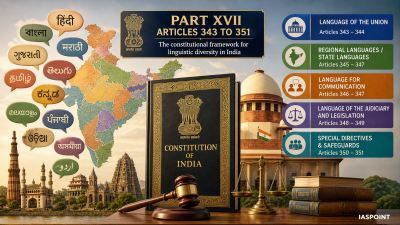
The linguistic diversity of India is governed by Part XVII of the Constitution, spanning Articles 343 to 351. The constitutional provisions distinguish between the language of the Union, regional languages, and the language of the judiciary.
Language of the Union (Article 343 & 344)
- Official Language: Article 343(1) designates Hindi in Devanagari script as the official language of the Union.
- Numerals: The form of numerals to be used for official purposes is the international form of Indian numerals.
- English Language: Initially, the Constitution provided for the use of English for a period of 15 years (until 1965). However, the Official Languages Act, 1963 permitted the continued use of English indefinitely for official Union purposes and Parliamentary business.
- Official Language Commission: Under Article 344, the President constitutes a commission at the expiration of five years (and then ten years) from the commencement of the Constitution to make recommendations for the progressive use of Hindi.
Regional Languages and the Eighth Schedule (Articles 345–347)
The Eighth Schedule originally contained 14 languages. Through various constitutional amendments, the number has increased to 22 languages.
| Amendment Act | Languages Added |
|---|---|
| 21st Amendment Act, 1967 | Sindhi |
| 71st Amendment Act, 1992 | Konkani, Manipuri, and Nepali |
| 92nd Amendment Act, 2003 | Bodo, Dogri, Maithili, and Santhali |
Complete List of 22 Scheduled Languages
- Assamese
- Bengali
- Bodo
- Dogri
- Gujarati
- Hindi
- Kannada
- Kashmiri
- Konkani
- Maithili
- Malayalam
- Manipuri
- Marathi
- Nepali
- Odia (Renamed from Oriya by 96th Amendment, 2011)
- Punjabi
- Sanskrit
- Santhali
- Sindhi
- Tamil
- Telugu
- Urdu
Language of the Judiciary and Legislation (Articles 348–349)
- Supreme Court and High Courts: Article 348 stipulates that all proceedings in the Supreme Court and every High Court shall be in English until Parliament provides otherwise.
- Authoritative Texts: The text of all Bills, Acts, Ordinances, orders, rules, and bye-laws at the Central and State levels must be in English.
- State Exceptions: With the previous consent of the President, the Governor of a State may authorize the use of Hindi or any other official language of the State in proceedings of the High Court, but this does not apply to judgments, decrees, or orders.
Classical Languages of India
To preserve the ancient heritage of Indian linguistics, the Government of India created a category for “Classical Languages.” As of current records, six languages have been granted this status based on high antiquity, a body of ancient literature, and original literary tradition.
| Language | Year of Notification |
|---|---|
| Tamil | 2004 |
| Sanskrit | 2005 |
| Telugu | 2008 |
| Kannada | 2008 |
| Malayalam | 2013 |
| Odia | 2014 |
Criteria for Classical Status
- High antiquity of its early texts/recorded history over a period of 1500–2000 years.
- A body of ancient literature/texts considered a valuable heritage by generations of speakers.
- The literary tradition must be original and not borrowed from another speech community.
- The classical language and literature being distinct from modern, there may also be a discontinuity between the classical language and its later forms or its offshoots.
Special Directives for Language Development
- Article 350: Every person is entitled to submit a representation for the redress of any grievance to any officer of the Union or a State in any of the languages used in the Union or the State.
- Article 350A: Mandates every State to provide adequate facilities for instruction in the mother-tongue at the primary stage of education to children belonging to linguistic minority groups.
- Article 350B: Provides for the appointment of a Special Officer for Linguistic Minorities by the President to investigate matters relating to safeguards provided for linguistic minorities.
- Article 351: Places a duty on the Union to promote the spread of the Hindi language and to develop it so that it may serve as a medium of expression for all elements of the composite culture of India.
Historical Trivia and Facts for Prelims
- Linguistic Provinces Commission: Also known as the Dhar Commission (1948), it recommended against the reorganization of states on a purely linguistic basis.
- JVP Committee: Consisting of Jawaharlal Nehru, Vallabhbhai Patel, and Pattabhi Sitaramayya, it also formally rejected language as the basis for reorganization in 1949.
- First Linguistic State: Andhra State was the first state created on a linguistic basis in 1953, following the death of Potti Sreeramulu.
- States Reorganisation Act, 1956: Based on the Fazl Ali Commission report, it led to the creation of 14 states and 6 union territories.
- English as Official Language: Note that English is not one of the 22 languages listed in the Eighth Schedule of the Constitution, despite being an official language for Union administration.