

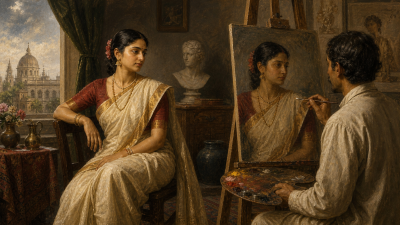
Modern Indian Academic Realism emerged during the mid-19th century as a direct result of British colonial influence and the establishment of formal art schools in major presidency towns. Unlike traditional Indian art, which prioritized symbolism, two-dimensionality, and spiritual themes, Academic Realism introduced European techniques focused on anatomical accuracy, linear perspective, and the “Chiaroscuro” (light and shadow) effect.
The Role of British Art Schools
The British established several key institutions to “standardize” Indian art according to Western sensibilities. These schools moved away from the apprenticeship model of the Karkhanas toward a structured academic curriculum.
- Government School of Industrial Art, Madras (1850): The first formal art school in India.
- Government School of Art, Calcutta (1854): Focused initially on industrial design before moving toward fine arts.
- Sir J.J. School of Art, Bombay (1857): Became the hub for academic training in Western oil painting and sculpture.
Raja Ravi Varma: The Pioneer of Indian Realism
Raja Ravi Varma (1848–1906) is considered the foremost practitioner of Academic Realism in India. He successfully synthesized Western oil painting techniques with Indian mythological and social themes.
Key Contributions and Innovations
- Oil on Canvas: He was the first Indian artist to achieve mastery over the medium of oil paints, which allowed for a greater range of colors and textures compared to traditional tempera.
- Anatomical Accuracy: Varma’s figures were modeled on realistic human proportions, a stark departure from the stylized figures of the Rajput or Mughal schools.
- Mass Production via Lithography: In 1894, he established the Ravi Varma Oleograph Press in Mumbai (later shifted to Malavli). This made his depictions of Hindu deities accessible to the common man, fundamentally changing the iconography of Indian religion.
Iconic Works
- Shakuntala: Depicting her pretending to remove a thorn from her foot while looking back at Dushyanta.
- Nair Lady Adorning Her Hair: A classic example of his focus on domesticity and regional identity.
- Hamsa Damayanti: Illustrating the mythological dialogue between Damayanti and the swan.
Comparative Analysis: Traditional vs. Academic Realism
| Feature | Traditional Indian Painting | Academic Realism |
| Perspective | Conceptual/Flat (Two-dimensional) | Linear Perspective (Three-dimensional) |
| Medium | Tempera, Watercolors, Natural Dyes | Oil on Canvas, Gouache |
| Lighting | Uniform lighting; no shadows | Chiaroscuro (Use of strong light/dark contrast) |
| Subject Matter | Divine, Courtly, or Abstract | Human-centric, Realistic, Mythological |
| Anatomy | Stylized (e.g., eyes like lotus petals) | Proportionate and Anatomically correct |
Key Proponents of the Academic Tradition
Beyond Raja Ravi Varma, several other artists maintained the rigor of European academic standards in the Indian context.
- Pestonji Bomanji: A student of the Sir J.J. School of Art, known for his realistic depictions of Parsi life and intricate portraits.
- Mahadev Vishwanath Dhurandhar: Famous for his meticulous illustrations of daily life in Mumbai and his ability to blend academic style with Indian festive themes.
- Antonio Xavier Trindade: Often called the “Rembrandt of the East,” he was a master of the Western portraiture style in India.
- Hemendranath Mazumdar: Known for his “wet cloth” technique and his mastery over the female form in realistic settings.
Decline and the Nationalist Critique
By the early 20th century, Academic Realism faced severe criticism from the Bengal School of Art.
- Cultural Critique: Critics like E.B. Havell and Abanindranath Tagore argued that Realism was “materialistic” and “un-Indian.” They believed it lacked the spiritual “Ananda” (bliss) of indigenous traditions.
- The Swadeshi Movement: The movement encouraged a boycott of Western styles, leading to the “Wash” technique of the Bengal School as a counter-narrative to the “Oil” technique of the Academic Realists.
Fact Sheet for UPSC Prelims: Trivia and Vital Stats
- First Indian to win an International Award: Raja Ravi Varma won the Governor’s Gold Medal in 1873 at the Madras Exhibition and later received global acclaim at the World’s Columbian Exposition in Chicago (1893).
- The “Company School” Precursor: Before the rise of full Academic Realism, the Patna School (Company Style) served as a transitional phase, blending Indian subjects with European watercolors.
- Materials: Academic Realists imported their pigments and canvases from Europe, specifically from London-based firms like Windsor & Newton.
- Visual Literacy: Varma’s realistic portrayal of gods is credited with the birth of Indian calendar art and the visual language of the Indian film industry (specifically Dadasaheb Phalke’s cinematography).
- Legacy in Sculpture: The academic tradition also extended to sculpture, notably through artists like V.P. Karmarkar, who applied realistic principles to clay and bronze modeling.