
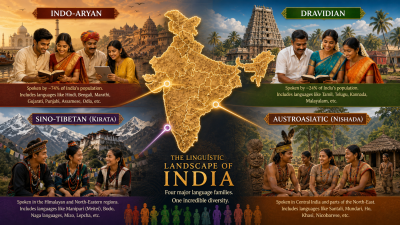
The linguistic landscape of India is categorized into four major families: Indo-Aryan, Dravidian, Sino-Tibetan (Kirata), and Austroasiatic (Nishada). While Indo-Aryan and Dravidian languages account for the majority of the population, the Sino-Tibetan and Austroasiatic families represent the profound ethno-linguistic diversity of the Himalayan, North-Eastern, and Central Indian tribal belts.
The Sino-Tibetan Language Family (Kirata)
The Sino-Tibetan family, referred to in ancient Indian literature as the Kirata group, is primarily concentrated along the Himalayas and the North-Eastern frontier. These languages are characterized by their monosyllabic roots and tonal variations.
Classification of Sino-Tibetan Languages
The family is broadly divided into two main branches within the Indian context:
- Tibeto-Himalayan Branch: This includes languages spoken in the trans-Himalayan belt. Notable examples are Ladakhi, Lahuli, Sherpa, and various dialects of Himachal Pradesh and Uttarakhand.
- Assam-Burmese Branch: This is the most diverse group in India, further subdivided into:
- Bodo Group: Includes Bodo, Kachari, Mech, and Garo.
- Naga Group: Comprising Angami, Ao, Sema, Lotha, and Konayak.
- Kuki-Chin Group: Includes Manipuri (Meitei), Lushai (Mizo), and Thadou.
- Abor-Miri-Dafla Group: Spoken largely in Arunachal Pradesh (e.g., Nyishi, Adi, Apatani).
Key Characteristics and Facts for UPSC
| Feature | Description |
| Speaker Base | Approximately 0.6% of the Indian population. |
| Morphology | Predominantly monosyllabic with a lack of inflection. |
| Tonal Nature | Meaning often changes based on the pitch or tone of the vowel. |
| Meitei (Manipuri) | Included in the 8th Schedule of the Indian Constitution (71st Amendment Act, 1992). |
| Oldest Literature | Newari and Meitei possess significant historical literary traditions. |
Geographical Distribution of Sino-Tibetan Languages
- Ladakh & J&K: Balti, Ladakhi.
- Himachal & Uttarakhand: Kinnauri, Limbu.
- Sikkim: Lepcha, Bhutia.
- Arunachal Pradesh: Aka, Dafla, Abor, Miri, Mishmi.
- Manipur & Mizoram: Meitei, Lushai/Mizo, Kuki.
The Austroasiatic Language Family (Nishada)
The Austroasiatic languages, known as the Nishada group, are considered among the oldest linguistic families in the Indian subcontinent, predating the Indo-Aryan migrations. They are primarily spoken by tribal communities across Central and Eastern India.
Primary Sub-divisions of Austroasiatic Languages
The Austroasiatic family in India is split into two distinct branches:
- Munda Branch: This is the largest sub-group, concentrated in the Chota Nagpur Plateau (Jharkhand, Odisha, Chhattisgarh, and West Bengal).
- Major languages: Santali, Mundari, Ho, Korku, Savara, and Gadaba.
- Mon-Khmer Branch: This branch is geographically isolated from the Munda group, found in the North-East and the Nicobar Islands.
- Major languages: Khasi and Jaintia (Meghalaya) and Nicobarese (Great Nicobar).
Critical Facts and Linguistic Features
- Santali Status: Santali is the only Austroasiatic language included in the 8th Schedule of the Indian Constitution (92nd Amendment Act, 2003). It utilizes the Ol Chiki script, invented by Pandit Raghunath Murmu.
- Prefixes and Infixes: Unlike Indo-Aryan languages which rely heavily on suffixes, Austroasiatic languages frequently use prefixes and infixes to alter word meanings.
- Geographical Discontinuity: The presence of Mon-Khmer languages in Meghalaya (Khasi) suggests a historical link between Central Indian tribes and Southeast Asian populations.
Comparison of Munda and Mon-Khmer Branches
| Feature | Munda Group | Mon-Khmer Group |
| Primary Region | Central and Eastern India (Jharkhand, Odisha). | Meghalaya and Nicobar Islands. |
| Key Tribes | Santhals, Mundas, Hos. | Khasis, Jaintias, Nicobarese. |
| Script Usage | Ol Chiki (Santali); others use Devanagari/Odia. | Primarily Roman script (Khasi). |
| Linguistic Influence | Influenced many Desi words in Indo-Aryan languages. | Closer affinity to languages in Vietnam and Cambodia. |
Historical and Cultural Significance
- Substrate Influence: Austroasiatic languages have significantly influenced the vocabulary of Indo-Aryan languages, particularly in terms of flora, fauna, and agricultural implements (e.g., words for betel leaf, cotton, and brinjal).
- Vedic References: The term “Nishada” appears in later Vedic literature to describe non-Aryan indigenous populations, likely referring to the Austroasiatic speakers.
- Endangered Status: Many languages within these families, particularly the smaller dialects in Arunachal Pradesh and the Nicobar Islands, are classified as “Endangered” or “Critically Endangered” by UNESCO.
- Manuscripts: While most of these languages had oral traditions, the Ahom (Tai-Kadai, often studied alongside NE languages) and Meitei scripts represent rare indigenous written records of the region.
Trivia for Aspirants
- The Munda-Santhal Link: The Munda rebellion (Ulgulan) led by Birsa Munda and the Santhal Hool were led by speakers of the Austroasiatic family.
- The Austroasiatic-Austronesian Distinction: Austroasiatic (Munda/Khasi) is distinct from Austronesian (spoken in Indonesia/Philippines), though they share ancient roots in Southeast Asia.
- Language Isolates: While Nihali (Maharashtra/MP) was traditionally grouped with Munda, many linguists now consider it a “Language Isolate,” though it retains a high percentage of Korku (Austroasiatic) vocabulary.