
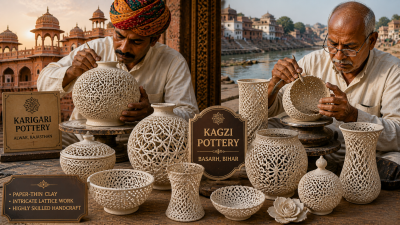
Karigari and Kagzi pottery represent two of the most delicate and technically sophisticated traditions within the Indian pottery landscape. Primarily centered in Alwar (Rajasthan) and Basarh (Bihar), these styles are distinguished not by their bulk or utility, but by their “paper-thin” walls and intricate lattice work. The term “Kagzi” is derived from the Urdu/Persian word Kagaz, meaning paper, directly referencing the extreme thinness of the clay body.
Technical Specifications and Material Science
The production of Kagzi pottery requires a specific grade of clay and a mastery of the potter’s wheel that exceeds standard terracotta production.
- Clay Composition: Artisans use a highly plastic, fine-grained alluvial clay sourced from local pond beds. This clay is filtered multiple times to remove even the smallest grit, allowing it to be stretched thin without collapsing.
- Throwing Technique: The potter throws the vessel on a fast-spinning wheel, using immense pressure and precise finger movements to thin the walls to a thickness often less than 2mm.
- The “Double-Walled” Technique (Karigari): A distinctive feature of this craft is the creation of double-walled vessels. The inner layer holds the liquid, while the outer layer is intricately carved with “Jali” (lattice) work.
- Incised Ornamentation: Before the clay reaches the “leather-hard” stage, artisans use fine needles or small blades to carve geometric and floral patterns.
Distinctive Features of the Two Styles
While often grouped together due to their delicacy, there are subtle regional variations in their execution:
| Feature | Kagzi Pottery (Alwar Style) | Karigari Pottery (Basarh/General Style) |
| Primary Aesthetic | Focus on the thinness of the vessel walls. | Focus on the “Jali” (lattice) and decorative carving. |
| Color | Natural terracotta (pale red to tan). | Often features slips or light washes to highlight carvings. |
| Structural Design | Single-walled, extremely lightweight. | Often double-walled for structural integrity. |
| Common Motifs | Minimalist, focusing on the elegance of the form. | Dense floral patterns, creepers, and geometric grids. |
Functional and Decorative Utility
Due to their fragile nature, these pottery styles are rarely used for heavy-duty kitchen tasks. Instead, they serve specific functional and aesthetic purposes:
- Evaporative Cooling: The extreme thinness and porosity of Kagzi pottery allow for rapid evaporation, making them excellent for cooling water in arid climates like Rajasthan.
- Aromatic Diffusion: In some traditions, these vessels were used to store scented waters or oils, as the porous walls allowed the fragrance to permeate the surrounding air.
- Architectural Miniatures: Karigari techniques are often used to create decorative lamps (Diya) and incense burners where the lattice work creates a play of light and shadow.
Comparative Analysis with Other Pottery Traditions
| Parameter | Kagzi/Karigari Pottery | Blue Pottery (Jaipur) | Black Pottery (Nizamabad) |
| Wall Thickness | Paper-thin (1-2mm) | Thick/Heavy | Moderate |
| Material | Refined Alluvial Clay | Non-clay (Quartz/Glass) | Clay with Manganese |
| Defining Skill | Throwing and Carving | Glazing and Painting | Smoke-firing and Polishing |
| Fragility | Very High | High (Brittle) | Moderate |
Socio-Economic Status and Geographical Indication
The craft is currently preserved by a dwindling number of master artisans, primarily in the Alwar district of Rajasthan.
- Conservation Status: It is classified as an endangered craft due to the high breakage rate during firing and the intensive labor required compared to the market price.
- GI Recognition: Efforts are ongoing to secure specific Geographical Indication tags for Alwar’s Kagzi work to distinguish it from machine-made terracotta imitations.
- Artisan Welfare: Organizations like the Rajasthan Small Industries Corporation (RAJSICO) provide platforms for these artisans at international trade fairs to sustain the craft.
Key Factoids for UPSC Prelims
- Basarh Connection: Basarh in Bihar is archaeologically significant for finding ancient fragments of thin-walled pottery, suggesting a long historical continuity of the “Karigari” style in the Gangetic plains.
- The “Jali” Work: The term “Karigari” literally translates to “craftsmanship” or “workmanship,” emphasizing the skill required to carve the clay without breaking the thin walls.
- Firing Challenges: Kagzi pottery has one of the highest “wastage” rates in traditional kilns because the thin walls are prone to warping or cracking under uneven heat.
- Thermodynamics: The “Kagzi” water pot is scientifically recognized as one of the most efficient natural cooling systems due to its high surface-area-to-thickness ratio.
- Double-Walled Mystery: In double-walled Karigari pottery, the outer wall is carved while the inner wall remains intact to hold water, a technique that requires the potter to join two separate vessels while they are still wet.
Current Challenges and Modern Adaptations
The primary challenge for Kagzi and Karigari pottery is logistics; the fragility of the items makes them difficult to transport for export. Modern artisans are adapting by creating smaller decorative items—such as tea-light holders and miniature vases—which are easier to pack and ship, ensuring the survival of the “paper-thin” technique in a globalized market.
Last Modified: May 5, 2026