

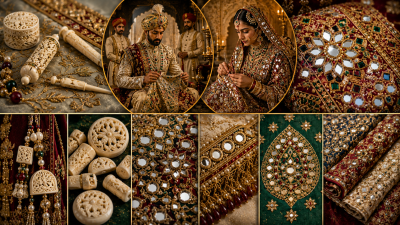
The integration of glass and ivory into Indian textiles represents the pinnacle of luxury and ornamentation in the Indian subcontinent. Historically, these materials served as markers of social status, utilized extensively by the royalty of the Mughal, Rajput, and Maratha empires. While ivory provided a creamy, matte elegance used in structural textile accessories, glass introduced the “Shisha” (mirror) element, symbolizing light and protection against the evil eye in folk traditions.
Glass Craft in Textiles: The Shisha (Mirror) Tradition
Glass-work in textiles, primarily known as Shisha or Abhala Bharat embroidery, involves attaching small pieces of mirrors to fabric using decorative stitches. This tradition originated in 17th-century Persia and flourished in the arid regions of Western India.
Major Regional Varieties
- Kutch and Kathiawar (Gujarat): The Rabari and Ahir communities use mirrors of various shapes (circular, square, triangular) held by “chain stitch” or “herringbone stitch.”
- Rajasthan: Widely used in Lehenga-Cholis and Torans (door hangings), often combined with Gota Patti (metallic lace) work.
- Lambani (Karnataka): The Banjara tribes incorporate glass pieces with vibrant threads and cowrie shells, creating a distinct, heavy geometric aesthetic.
Evolution of Glass in Textiles
- Mica (Abhrak): Before the availability of glass, naturally occurring mica flakes were used.
- Hand-Blown Glass: Large spheres of glass were blown, and the interior was coated with silver or antimony. These were then broken into small, curved shards for embroidery.
- Machine-Cut Glass: Modern Shisha work uses flat, silvered glass discs with rounded edges to prevent fabric tearing.
Ivory Craft in Textile Traditions
Ivory, derived from elephant tusks, was historically integrated into the textile ecosystem through two primary channels: as an ornamental embellishment on royal garments and as high-precision tools for weaving and embroidery.
Ivory as Textile Embellishment
- Bead-work: Microscopic ivory beads were stitched onto fine muslins and silks for the nobility of Awadh and Bengal.
- Ivory Buttons and Clasps: Traditional Angarkhas and Sherwanis often featured intricately carved ivory buttons (Ghundi) depicting floral or faunal motifs.
- Zardosi Integration: In heavy gold embroidery (Zardosi), ivory chips were sometimes used as centers for floral patterns to provide a 3D relief effect.
Ivory Tools in Weaving and Craftsmanship
Ivory’s smooth texture and durability made it the preferred material for high-end weaving implements:
- Ivory Combs (Phani): Used in the weaving of fine Jamdani and Dacca Muslin to align delicate threads without snagging.
- Ivory Netting Needles: Used for Jali (lace) work and fine crochet.
- Ivory Spindles: Used for spinning ultra-fine counts of cotton yarn, where the weight and smoothness of ivory ensured consistent tension.
Technical Comparison: Glass vs. Ivory in Textiles
| Feature | Glass (Shisha) | Ivory (Dant) |
| Primary Function | Light reflection and ornamentation. | Structural tools and luxury accents. |
| Common Stitches | Buttonhole, Chain, and Cross-stitch. | Inlay, Appliqué, and Bead-stitch. |
| Geographic Hubs | Gujarat, Rajasthan, Haryana. | Murshidabad (WB), Jaipur, Thiruvananthapuram. |
| Symbolism | Warding off evil; festive vibrancy. | Purity, longevity, and royal lineage. |
Related Crafts: Beads and Sequins
- Moti Bharat: The art of bead embroidery (often using glass beads) prevalent in Gujarat, where the entire surface of the fabric is covered in a mesh of glass beads.
- Zari-Zardosi: Glass “Pote” (tiny beads) and “Sitara” (metal or glass sequins) are essential components of North Indian heavy embroidery.
Fact Sheet for UPSC Aspirants
- Legal Status: The use of ivory is strictly prohibited under the Wildlife Protection Act, 1972. Modern “Ivory” textiles now use bone-dust resin, celluloid, or vegetable ivory (Tagua nut) as sustainable alternatives.
- Etymology: The word Shisha is derived from the Persian word for glass.
- Murshidabad School: Historically, Murshidabad was the premier center for ivory carving, where artisans worked closely with silk weavers to create royal ceremonial robes.
- Banjara Embroidery: Recognized for its “Sandwich” technique where glass is held between layers of fabric and secured with elaborate thread-work.
Modern Conservation and Sustainable Alternatives
Due to environmental and ethical concerns, the industry has transitioned to:
- Plastic/Acrylic Mirrors: Lightweight and unbreakable alternatives to glass used in contemporary export garments.
- Wood and Resin: Carved to mimic the aesthetic of ivory for buttons and loom accessories.
- Eco-Glass: Recycled glass beads are now popular in the “Sustainable Fashion” sector of Indian exports, particularly in the clusters around Firozabad and Purdilpur.