
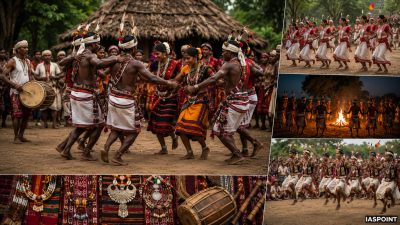
Tribal dances in India are fundamentally distinct from classical dances as they are spontaneous, communal, and lack rigid formal training or a spectator-performer divide. Within the “Tribal and Folk Cultures” unit of Indian Heritage, these dances are viewed as “Total Theatre”—integrating music, costume, ritual, and physical movement to celebrate life-cycle events, harvest cycles, and religious appeasement.
Classification and Regional Distribution
The diversity of tribal dance is best understood through its geographical and ethnic distribution across the five major tribal clusters of India.
Central Indian Cluster (MP, Chhattisgarh, Jharkhand, Odisha)
This region contains the highest density of tribal dance forms, often centered around the “Sacred Grove” (Sarna) and the youth dormitory system.
- Karma Dance: Performed by the Gond, Baiga, Oraon, and Munda tribes during the Karam festival. It involves dancing around a freshly cut branch of the Karam tree, symbolizing fertility and prosperity.
- Saila Dance: A stick dance performed by the Gonds of Chhattisgarh after the harvest. It involves complex footwork and rhythmic striking of sticks.
- Gaur Maria Dance: A spectacular ritual dance of the Bison-horn Maria tribes of Bastar. Dancers wear headdresses made of bison horns and cowrie shells, mimicking the movements of a bison.
- Paika Dance: A martial folk dance of the Munda and Oraon tribes of Jharkhand, where dancers carry shields and swords, representing the military character of the community.
- Buiya Dance: Performed by the Juang tribe of Odisha, mimicking the movements of birds and animals of the forest.
North-Eastern Cluster (Assam, Nagaland, Arunachal, Mizoram)
Dances here are characterized by high-energy movements, synchronization, and the use of bamboo and indigenous weapons.
- Bihu (Tribal variations): While a state festival, the Mising Bihu and Deori Bihu are specific tribal variations in Assam performed with traditional drums and flutes.
- Cheraw (Bamboo Dance): The most famous dance of Mizoram, where men tap bamboo poles on the ground in a rhythmic pattern while women step in and out of the moving bamboos.
- Hojagiri: Performed by the Reang (Bru) tribe of Tripura. It involves balancing pots and lamps on the head while performing complex rhythmic movements with the lower body.
- War Dances of Nagaland: Tribes like the Konyak and Ao perform dances that simulate headhunting raids, characterized by war cries and the brandishing of Daos (machetes).
- Ponung: A community dance of the Adi tribe in Arunachal Pradesh, usually performed by women to pray for a good harvest.
Western Indian Cluster (Rajasthan, Gujarat, Maharashtra)
- Ghoomar (Bhil version): Originally a tribal dance of the Bhil community in Rajasthan, characterized by the pirouetting movements of women in flared skirts.
- Tarpa Dance: Iconic to the Warli tribe of Maharashtra. Dancers circle a Tarpa (a wind instrument made of dried gourd) player, moving in a spiral that symbolizes the “Circle of Life.”
- Tipanni Dance: Performed by the tribal women of the Chorwad region of Gujarat, using sticks (Tippanis) used for thumping the floor.
- Dangi Dance: Performed by the tribes of the Dang region in Gujarat during Holi, involving the formation of complex human pyramids.
Southern and Island Cluster
- Puli Kali: A “Tiger Dance” performed by tribes in Kerala during Onam, where dancers paint their bodies to look like tigers.
- Dhimsa: A chain dance performed by the Porja and Gadaba tribes in the Araku Valley of Andhra Pradesh.
- Nicobarese Dance: A circular dance of the Nicobarese tribe performed during the “Ossuary Feast,” where dancers move in slow, rhythmic steps around the village pillar.
Comparative Table of Iconic Tribal Dances
| State | Dance Form | Primary Tribe | Occasion/Significance |
| Jharkhand | Sarhul | Munda, Oraon | Flowering of Sal trees; New Year |
| Chhattisgarh | Panthi | Satnami community | Birth anniversary of Guru Ghasidas |
| Odisha | Dhemsa | Gadaba, Paroja | Communal harmony and relaxation |
| Rajasthan | Kalbelia | Kalbelia (Snake charmers) | Sensual movements mimicking snakes |
| Nagaland | Chang Lo | Chang Naga | Celebrating victory over enemies |
| Arunachal | Chalo | Nocte Tribe | Harvest festival (Loku) |
| Madhya Pradesh | Bhagoria | Bhil | Spring festival/Matchmaking |
Functional Themes in Tribal Dance
Tribal dances are never performed without a specific socio-religious context, which can be categorized into four functional themes:
- Hunting and Martial Valor: Imitating the hunt or preparing for war (e.g., Naga War Dance, Paika).
- Agricultural Rhythms: Celebrating sowing, weeding, or harvesting (e.g., Karma, Bihu).
- Mimetic/Zoomorphic: Imitating the movements of animals or birds (e.g., Bison-horn Maria, Peacock dance of the Khonds).
- Socialization and Courtship: Opportunities for young men and women to interact (e.g., Bhagoria, Ghotul dances).
Costumes, Ornaments, and Accoutrements
The visual identity of tribal dance is defined by “Found Objects” from the forest and hand-woven textiles.
- Headdresses: Use of feathers (Hornbill, Peacock), animal horns (Bison, Buffalo), and wild seeds.
- Body Paint: Use of rice paste, vermillion, and charcoal to create geometric patterns on the skin.
- Jewelry: Heavy silver, nickel, or brass ornaments; necklaces made of coins or tiger claws (in older traditions).
- Musical Synergy: The dance is almost always accompanied by the Madal (drum), Bansuri (flute), or tribal string instruments like the Kendra.
Essential Facts for UPSC Prelims
- UNESCO Recognition: The Kalbelia dance of Rajasthan and the Chhau dance (which has strong tribal roots in the Mayurbhanj, Seraikella, and Purulia styles) are included in the UNESCO Representative List of Intangible Cultural Heritage.
- The Tarpa Instrument: The Tarpa used in Warli dance must be made from a specific variety of dried gourd and is treated as a sacred object that can only be played during certain seasons.
- Matrilineal Influence: In dances like those of the Khasi or Garo, the positioning and roles of dancers often reflect their matrilineal social structure.
- The Bhagoria Haat: Among the Bhils, the dance during the Bhagoria festival was historically a venue for young couples to elope with social sanction.
- Zeliang Dance: Known for the “Butterfly Dance” of the Zeliang Naga tribe, which is unique for its graceful, fluttering hand movements compared to the usually vigorous Naga war dances.
- GI Tags and Dance: While dances don’t get GI tags, the specific costumes (like the Mizo Puan or Naga Shawls worn during dances) are often GI protected.