
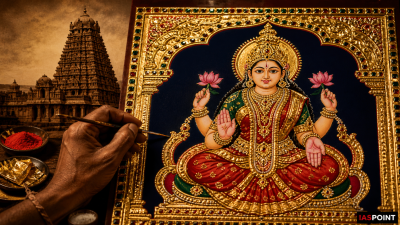
Tanjore (Thanjavur) painting is a classical South Indian art form that originated in the town of Thanjavur in Tamil Nadu. While its roots can be traced back to the 16th-century Vijayanagara Empire, it evolved into its distinct, opulent form during the late 18th century under the patronage of the Maratha rulers of Thanjavur, particularly King Serfoji II.
The 360° Material and Technical Process
Tanjore paintings are unique because they are “panel paintings” rather than works on paper or canvas. The process is labor-intensive and involves several specialized layers:
- The Base (Palagai Padam): The painting is usually done on a solid wood plank, traditionally from the Jackfruit or Teak tree.
- Surface Preparation: The wood is covered with a layer of cloth and a paste made of lime (Chunam) and a binding agent (Gundumani). This creates a smooth, white surface.
- Sketching and Embossing: After the initial sketch, the artist uses a paste of lime and glue (Sukka) to create a three-dimensional embossed effect on ornaments, drapery, and architectural elements.
- Gilding and Inlaying: This is the most distinctive feature. Thin gold leaves (22-carat gold) are pasted over the embossed areas. Semi-precious stones, colored glass pieces, or Jaipur stones are inlaid to mimic jewelry and temple structures.
- Final Coloring: The remaining flat areas are painted using vibrant natural colors, though modern artists may use synthetic ones.
Distinctive Stylistic Features
Tanjore paintings are characterized by their iconic aesthetic markers which distinguish them from Mysore or other South Indian traditions:
- Physicality of Figures: Deities are often depicted as chubby, round-faced, and large-eyed (lotus-shaped). The central figure is always significantly larger than the surrounding figures to show hierarchy.
- The “Dark” Background: Deep greens, blues, and reds are used to make the gold leaf and inlaid stones pop visually.
- Architectural Framing: Most paintings feature a heavy, ornate arch or canopy (Prabhavali) that frames the central deity, mimicking the sanctum sanctorum of South Indian temples.
Primary Themes and Subject Matter
The subject matter is almost exclusively religious, drawing from the Puranas and Epics.
- Krishna Leela: “Bal Krishna” (Child Krishna) eating butter is the most popular motif in the Tanjore tradition.
- Shaivite and Vaishnavite Deities: Common depictions include Rama Pattabhishekam (coronation), Ganesha, Lakshmi, and various forms of Shiva and Parvati.
- Saintly Portraits: Later works occasionally included portraits of local Maratha rulers, saints, and devotees.
- Tirupati Balaji: A major theme involving the detailed representation of the Venkateswara idol with intricate jewelry.
Comparison: Tanjore vs. Mysore Painting
Though both share a Vijayanagara lineage, they differ in execution and material.
| Feature | Tanjore Painting | Mysore Painting |
| Relief Work | High Relief (Thick embossing) | Low Relief (Thin, subtle embossing) |
| Use of Gold | Heavy gold leaf; opaque | Thin gold foil; delicate |
| Embellishments | Uses glass beads and semi-precious stones | Does not typically use stones |
| Medium | Mostly on wooden planks | Mostly on paper or cloth |
| Visual Feel | Grand, opulent, and heavy | Soft, detailed, and delicate |
Geographical Indication (GI) and Recognition
Tanjore Painting was granted the Geographical Indication (GI) Tag in 2007-08 by the Government of India. This legal protection ensures that only paintings made in the Thanjavur region following traditional methods can carry the label, preserving the integrity of the craft against mass-produced replicas.
Fact Sheet for UPSC Prelims
- Maratha Patronage: The school reached its pinnacle under the Maratha Bhonsle dynasty (Raja Sarabhoji and Raja Shivaji).
- Material Science: Traditionally, artists used natural dyes. For example, lampblack for black, saffron/turmeric for yellow, and indigo for blue.
- The “Mukkoni” Technique: A specific method used for sketching figures to maintain traditional proportions.
- Traditional Artists: The craft was historically practiced by the ‘Raju’ community of Tanjore and Tiruchirappalli and the ‘Naidu’ community.
- Modern Variations: While traditional Tanjore paintings used water-based natural colors, modern versions may use acrylics and plywood, though the use of genuine 22-carat gold leaf remains the standard for high-quality pieces.
Trivia for Art Aspirants
- Longevity: Due to the use of solid wood and thick gold leaf, authentic Tanjore paintings are incredibly durable and can last for over 100 years without losing their luster.
- Temple Murals: The style of Tanjore paintings is heavily influenced by the 11th-century Chola murals found in the Brihadisvara Temple, specifically in the treatment of eyes and facial expressions.