
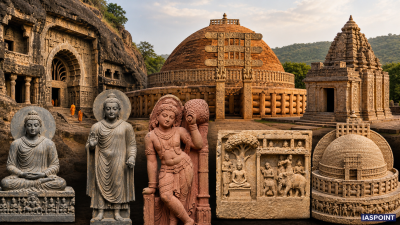
Following the decline of the Mauryan Empire in the 2nd century BCE, the Indian subcontinent saw the rise of various regional powers such as the Shungas, Kanvas, Kushanas, and Satavahanas. This period (c. 200 BCE – 300 CE) is characterized by the shift from imperial court art to more diversified religious architecture, the introduction of the Gandhara and Mathura schools of art, and the perfection of rock-cut cave architecture.
Evolution of Stupa Architecture
During the Post-Mauryan period, existing Mauryan stupas were enlarged and embellished with stone, replacing older wooden or brick structures.
Structural Enhancements
- Toranas (Gateways): The most significant addition was the elaborate stone gateways carved with Jataka tales and scenes from the Buddha’s life.
- Vedica (Railings): The wooden railings were replaced by stone railings carved with intricate reliefs and medallions.
- Sculptural Details: High-relief sculptures depicting Yakshas, Yakshinis, and floral motifs became common.
Major Stupa Sites
- Sanchi Stupa (Madhya Pradesh): The Shungas added the stone railings and the Satavahanas commissioned the four magnificent Toranas.
- Bharhut Stupa (Madhya Pradesh): Known for its “Shunga Art,” these railings are famous for their narrative reliefs, including the first anthropomorphic representations of the Buddha through symbols.
- Amaravati Stupa (Andhra Pradesh): Developed under the Satavahanas and Ikshvakus, it is known for its use of distinctive white marble-like limestone and the “Deep Relief” style of carving.
Development of Rock-Cut Architecture
The Post-Mauryan period saw the proliferation of rock-cut caves, primarily along the Western Ghats (Sahyadri ranges), serving as centers for Buddhist worship and monastic life.
Chaityas and Viharas
- Chaitya (Prayer Hall): A rectangular hall with a semicircular rear end, containing a small stupa at the far end. It featured a vaulted roof and a horseshoe-shaped “Chaitya window” (Gavaksha).
- Vihara (Monastery): Residential quarters for monks consisting of a central hall with small cells opening into it.
Notable Cave Complexes
- Karle Caves (Maharashtra): Features the largest and best-preserved Hinayana Chaitya in India, known for its massive sun window and lion-topped pillars.
- Kanheri Caves (Maharashtra): Located within Sanjay Gandhi National Park, showcasing a continuous architectural evolution from the 1st century BCE to the 10th century CE.
- Bhaja and Bedsa Caves: Early Hinayana examples characterized by simple wooden-imitation architecture and absence of Buddha figures.
Secular and Brahmanical Caves
- Udayagiri and Khandagiri Caves (Odisha): Commissioned by King Kharavela of the Mahameghavahana dynasty for Jain monks. The Hathigumpha inscription provides a biographical account of Kharavela. The Ranigumpha (Queen’s Cave) is the most elaborate two-storied structure here.
Emergence of Major Schools of Sculpture
The Kushana period witnessed the birth of three distinct schools of art that defined the visual language of Indian deities.
| Feature | Gandhara School | Mathura School | Amaravati School |
| Regional Influence | Greco-Roman (Hellenistic) | Indigenous | Indigenous |
| Material Used | Blue-Grey Schist / Stucco | Spotted Red Sandstone | White Marble/Limestone |
| Religious Affiliation | Mainly Buddhist | Buddhist, Jain, and Hindu | Mainly Buddhist |
| Buddha’s Appearance | “Apollo-like,” wavy hair, muscular, wearing heavy robes (Roman Toga). | Pot-bellied, shaved head, thin muslin robes, energetic expression. | Focused on “Narrative Art” (Jataka stories), slender and graceful figures. |
| Patronage | Kushanas | Kushanas | Satavahanas and Ikshvakus |
Early Temple Architecture Beginnings
While full-fledged Hindu temples emerged during the Gupta period, the seeds were sown in the Post-Mauryan era.
- Heliodorus Pillar (Besnagar): A stone column erected by a Greek ambassador who converted to Bhagavatism; it is the earliest archaeological evidence of Vaishnavism in India.
- Early Brahmanical Shrines: Small rectangular shrines with flat roofs began to appear, representing the transition from open-air altars to permanent enclosures.
Architectural Facts and Trivia for Prelims
- Kharavela’s Contribution: The Udayagiri caves are unique as they were primarily intended for Jainism, whereas most Western Ghats caves were Buddhist.
- Satavahana Inscriptions: Many caves in the Nasik and Karle regions contain inscriptions mentioning donations by Satavahana kings and wealthy merchants (Gahapatis).
- Symbolism to Iconography: This period marks the transition from representing Buddha through symbols (Footprints, Bodhi Tree, Wheel) in the Hinayana phase to human figures in the Mahayana phase.
- The Silk Road Link: The Gandhara school flourished because of its location on the trade routes connecting India to Central Asia and the Roman Empire.
Gandhara vs. Mathura: Technical Distinctions
- The Halo: In Gandhara art, the halo is usually plain, whereas, in the Mathura school, the halo (Prabhamandala) is profusely decorated with geometric and floral patterns.
- Drapery: Gandhara sculptures show thick, heavy folds in the clothing, while Mathura sculptures show transparent, clingy drapery.