
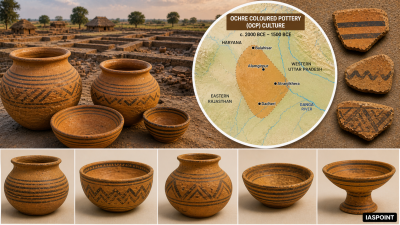
The Ochre Coloured Pottery (OCP) culture represents a significant transitional phase in the proto-history of the Indo-Gangetic divide and the Upper Ganga Valley. Flourishing roughly between 2000 BCE and 1500 BCE, this culture is named after its characteristic ceramic type, which leaves an ochreous (yellowish-orange) color on the fingers when touched. It is geographically situated primarily in Western Uttar Pradesh, Haryana, and Eastern Rajasthan.
Ceramic Characteristics and Manufacturing
The OCP culture is identified by specific physical properties and firing techniques that distinguish it from the preceding Harappan and succeeding Black and Red Ware (BRW) traditions.
- Fabric and Texture: The pottery is generally ill-fired and porous. The clay used is often fine, but the lack of controlled high-temperature firing results in a fragile structure.
- The “Ochre” Effect: The pottery features a red-to-orange slip. Due to long-term water logging or weathering in the humid Gangetic plains, the surface has become powdery, leaving an ochre residue upon handling.
- Technique: While primarily wheel-made, the vessels often exhibit irregular thickness. The shapes include jars, bowls, basins, and small flasks.
- Decoration: Decorations are minimal, usually consisting of incised designs like wavy lines, zig-zags, or simple horizontal bands. Occasionally, black painted motifs are found, though they are often faded.
Geographical Distribution and Key Sites
The OCP culture is concentrated in the fertile plains of the Ganga-Yamuna Doab. Its distribution suggests a community well-adapted to riverine ecosystems.
| Region | Significant OCP Sites |
| Uttar Pradesh | Hastinapur, Ahichchhatra, Saipai, Atranjikhera, Lal Qila |
| Haryana | Siswal, Mitathal |
| Rajasthan | Ganeshwar, Jodhpura |
The OCP and Copper Hoard Association
One of the most debated and critical aspects of this culture for UPSC Prelims is its relationship with the Copper Hoards of Northern India.
- Archaeological Evidence: At sites like Saipai (UP), OCP pottery was found in direct stratigraphic association with copper tools.
- Tool Typology: The copper artifacts include “Anthropomorphs” (human-shaped figures), harpoons, antennae swords, and celts (axes).
- Ganeshwar-Jodhpura Link: The Ganeshwar site in Rajasthan is a major center for copper production. It is believed that the OCP inhabitants of the Doab received their copper supply from the Ganeshwar-Jodhpura complex, indicating an early trade network.
Socio-Economic and Settlement Patterns
The OCP culture signifies a shift toward settled rural life in the post-Harappan era.
- Agriculture: Inhabitants practiced subsistence farming. Archaeobotanical remains at Atranjikhera indicate the cultivation of rice, barley, wheat, and legumes (gram and khesari).
- Animal Husbandry: Evidence of domesticated cattle, sheep, and pigs suggests a mixed pastoral-agricultural economy.
- Housing: Settlements were generally small. Houses were made of wattle-and-daub (mud plastered over reed mats), as evidenced by the discovery of mud-clots with reed impressions.
- Temporal Overlap: In some regions, OCP sites show a transition into the Late Harappan phase, while in the Doab, they are succeeded by the Black and Red Ware (BRW) and Painted Grey Ware (PGW) cultures.
Scientific and Archaeological Challenges
The study of OCP is marked by specific challenges related to the preservation of artifacts in the Gangetic environment.
- The “Flood” Theory: Early archaeologists like B.B. Lal suggested that the weathered nature of OCP was due to a massive, long-standing flood in the Ganga valley. This theory explains the powdery surface and the lack of distinct habitation layers in many sites.
- Thermoluminescence (TL) Dating: TL dating has helped place OCP in the early 2nd millennium BCE, confirming it as a contemporary of the Late Harappan and early Chalcolithic cultures.
Facts and Trivia for UPSC Aspirants
- First Discovery: OCP was first identified by B.B. Lal in 1951 at Budaun and Bisauri in Uttar Pradesh.
- Nomenclature: The term “Ochre Coloured” is technically a description of its current weathered state rather than its original intended appearance, which was likely a sturdy Red Ware.
- Lal Qila Site: Located in Bulandshahr, this is one of the few sites where OCP was found in a relatively well-preserved state with intact floor levels and paintings.
- Transition Marker: OCP is considered the “Indo-Gangetic” response to the decline of the Harappan urban system, representing a move back to rural, copper-using localized communities.
- Link to Vedic Culture: Some scholars have attempted to link the OCP-Copper Hoard people with the early Aryans, though this remains a subject of intense academic debate and lacks conclusive linguistic evidence.