
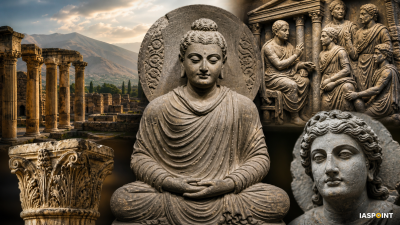
The Gandhara School of Art (1st Century BCE to 5th Century CE) represents a unique synthesis of Indian Buddhist themes and Greco-Roman artistic styles. Flourishing primarily in the northwestern frontiers of ancient India—encompassing modern-day Peshawar, Taxila, and the Swat Valley—it is often referred to as the Greco-Buddhist School. This school played a pivotal role in transitioning Buddhist art from symbolic representation to the anthropomorphic depiction of the Buddha.
Historical Context and Patronage
The Gandhara School emerged following the conquests of Alexander the Great and the subsequent establishment of Indo-Greek kingdoms. It reached its zenith under the Kushana Dynasty, particularly during the reign of Emperor Kanishka, who was a fervent patron of Mahayana Buddhism.
- Geographic Influence: Centered in the Gandhara region, which served as a gateway for the Silk Road, facilitating the exchange of Hellenistic, Persian, and Indian artistic traditions.
- Patronage: While primarily supported by the Kushanas, the school also received patronage from local elites and mercantile classes who benefited from the transcontinental trade.
Salient Features of Gandhara Sculpture
Gandhara art is distinguished by its heavy reliance on Hellenistic realism applied to Buddhist iconography. The sculptures are characterized by a focus on physical perfection and anatomical precision.
- Material Evolution: The early phase (1st–2nd Century CE) utilized Bluish-Grey Schist stone. The later phase (3rd–5th Century CE) saw an increasing use of Stucco (plaster) and terracotta, allowing for more expressive and fluid modeling.
- Anatomical Realism: Unlike the indigenous Mathura school, Gandhara focused on the muscularity of the human body, depicting the Buddha with defined physiques and realistic proportions.
- Drapery: The garments are inspired by the Roman Toga. The drapery is heavy, opaque, and features complex, deep-cut folds arranged in a logical, rhythmic pattern.
- Physiognomy: The Buddha is often depicted with Greco-Roman facial features, including a sharp, straight nose, thin lips, and curly or wavy hair tied in a top-knot known as the Ushnisha.
- The Halo: The Prabhamandala (halo) in Gandhara art is typically plain and undecorated, serving as a backdrop to the head, unlike the ornate halos of the Gupta period.
Iconography and Symbolic Gestures
The Gandhara School was instrumental in standardizing the visual representation of the Buddha and Bodhisattvas.
- Buddha’s Appearance: He is frequently depicted with a mustache (resembling a Greek philosopher) and elongated ears signifying his past life as a prince.
- Bodhisattvas: Elaborate sculptures of Bodhisattvas like Maitreya (the future Buddha) and Avalokiteshvara are common, characterized by heavy jewelry and complex hairstyles.
- Mudras (Gestures):
- Abhaya Mudra: Gesture of fearlessness.
- Dhyana Mudra: Gesture of meditation.
- Dharmachakra Mudra: Gesture of turning the wheel of law.
Major Centers and Notable Examples
The Gandhara region hosted several significant workshops that produced thousands of stone and stucco images.
- Taxila (Sirkap): A major educational and artistic hub where numerous Greco-Buddhist artifacts have been unearthed.
- Bimaran Casket: An early gold reliquary found in Afghanistan, depicting the Buddha flanked by Brahma and Indra, showing early Gandharan stylistic traits.
- The Fasting Siddhartha: A famous masterpiece from Sikri (Pakistan) depicting the Buddha in an emaciated state during his extreme ascetic phase, showcasing intense anatomical detail and emotional depth.
- Bamiyan Buddhas: Once the largest standing Buddha statues in the world, carved into the cliffs of Afghanistan, representing the westward expansion of Gandharan influence.
Comparison: Gandhara vs. Mathura School of Art
| Feature | Gandhara School | Mathura School |
| Origin | Indo-Greek / Hellenistic Influence | Entirely Indigenous |
| Primary Material | Grey Schist, Stucco | Spotted Red Sandstone |
| Religious Focus | Exclusively Buddhist (Mahayana) | Buddhist, Jain, and Brahmanical |
| Buddha’s Hair | Wavy, curly, Hellenistic style | Shaven or “Snail-shell” curls |
| Body Type | Lean, muscular, realistic | Fleshy, robust, smiling |
| Drapery | Heavy, thick folds (Roman style) | Transparent, thin, clinging to body |
Fact Sheet and Trivia for UPSC Prelims
- Syncretism: Gandhara art includes non-Buddhist figures such as Herakles (depicted as Vajrapani) and the goddess Tyche (depicted as Hariti).
- The Mahayana Shift: The school flourished alongside the rise of Mahayana Buddhism, which emphasized the worship of the Buddha in human form rather than through symbols like the Bodhi tree or footprints.
- Chronological End: The school declined significantly following the Huna invasions in the 5th Century CE, though its influence traveled via the Silk Road to China and Japan.
- Stucco Transition: The shift from stone to stucco in the late Gandhara period allowed for the mass production of sculptures and a softer, more emotional portrayal of Buddhist deities.
- The “Apollo” Connection: Early scholars often described the Gandhara Buddha as “an Indian heart in a Greek body” due to the facial resemblance to the Greek god Apollo.