
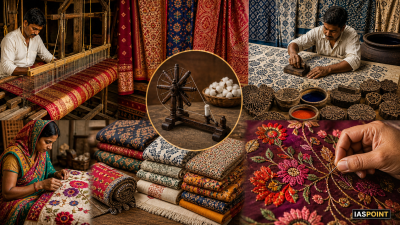
Indian textile handicrafts represent a diverse spectrum of weaving, dyeing, and embroidery traditions that have evolved over five millennia. As a vital segment of the Indian Art, Culture, and Heritage unit, these crafts are categorized by their production techniques—weaving, printing, and needlework—each reflecting specific regional ecosystems and historical patronage.
Handloom Weaving Traditions
Handloom weaving is the foundational pillar of the textile sector, often involving complex techniques like “extra weft” insertion or “interlocking” of threads.
- Banarasi Silk (Uttar Pradesh): Known for Zari (gold/silver thread) work and Butidar patterns. It traditionally uses the Naksha (drawloom) technique.
- Kanjeevaram Silk (Tamil Nadu): Distinguished by the Temple Borders and the Korvai technique, where the border and body are woven separately and joined.
- Chanderi and Maheshwari (Madhya Pradesh): Famous for their lightweight texture, traditionally using a blend of silk and cotton with intricate borders.
- Pashmina (Jammu & Kashmir): Derived from the undercoat of the Changthangi goat; known for its extreme fineness and warmth.
- Muga Silk (Assam): A rare, naturally golden silk produced by the Antheraea assamensis silkworm, endemic to the Brahmaputra valley.
Resist Dyeing and Printing Techniques
These techniques involve the application of patterns through mechanical or chemical resistance before dyeing.
| Technique | Region | Methodology |
| Patola | Gujarat | Double-Ikat technique where both warp and weft are dyed. |
| Bandhani | Rajasthan/Gujarat | Tie-and-dye method involving small, intricate knots. |
| Kalamkari | Andhra Pradesh | Hand-painted (Srikalahasti) or block-printed (Machilipatnam) using natural dyes. |
| Ajrakh | Gujarat/Sindh | Complex block printing using geometric patterns and indigo/madder dyes. |
| Dabu Printing | Rajasthan | Mud-resist hand-block printing technique. |
| Leheriya | Rajasthan | Diagonal striping created through a unique tie-dye process representing waves. |
Traditional Embroidery of India
Embroidery serves as a cultural signifier, with motifs often inspired by local flora, fauna, and folklore.
- Chikankari (Lucknow, UP): A delicate shadow-work embroidery originally done on white muslin with white thread. It involves 36 different types of stitches.
- Phulkari (Punjab): Literally “flower work”; it utilizes the damask stitch on the wrong side of coarse cotton cloth (Khaddar).
- Kantha (West Bengal/Odisha): A “running stitch” technique traditionally used to repurpose old sarees into quilts.
- Kasuti (Karnataka): Handwork involving four specific stitches (Gavanti, Murgi, Negi, and Menthi) that cannot be replicated by machines.
- Zardozi: Elaborate metal embroidery using gold or silver threads, historically patronized by the Mughal royalty.
- Toda Embroidery (Tamil Nadu): Done by the Toda tribe; it features red and black threads on a white background, resembling woven fabric.
Geographical Indications (GI) and Protection
The GI tag ensures that only those registered as authorized users are allowed to use the popular product name. This protects the intellectual property of the artisan communities.
- Kullu Shawl (Himachal Pradesh): Known for geometric patterns and floral designs.
- Pochampally Ikat (Telangana): The first textile to receive a GI tag in India; uses the “tie and dye” of yarn.
- Bhagalpuri Silk (Bihar): Also known as “Tussar silk,” famous for its resilient texture and yellowish-gold tint.
- Kota Doria (Rajasthan): Recognized for its ‘Khat’ (square) patterns and feather-light weight.
Technical Trivia for Prelims
- Sujini Embroidery: A traditional craft from Bihar, similar to Kantha but used specifically for narrating social themes and stories.
- Applique Work (Pipli, Odisha): Involves sewing smaller pieces of cloth onto a larger base to create vibrant patterns, often used for umbrellas in the Puri Rath Yatra.
- The “Flying Shuttle”: A pivotal invention in handloom history that increased weaving speed, though many traditional Indian looms still use the “Throw Shuttle” for higher precision in complex designs.
- Natural Dyes: Traditionally, Indian textiles used Indigo (blue), Madder (red), Pomegranate peel (yellow), and Iron filings (black).
Government Institutional Framework
The development and preservation of textile handicrafts are managed through several specialized bodies:
- Office of the Development Commissioner (Handlooms/Handicrafts): The nodal agency for policy formulation and implementation.
- National Handicraft Development Programme (NHDP): Focuses on Ambedkar Hastshilp Vikas Yojana (cluster development) and marketing support.
- Handloom Mark and Silk Mark: Quality assurance labels to protect consumers from powerloom imitations and impure silk.
- National Institute of Fashion Technology (NIFT): Plays a crucial role in design intervention and modernization of traditional textile crafts.