
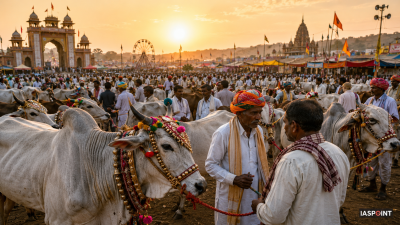
Cattle fairs, historically known as Pashu Melas, are an integral part of India’s intangible cultural heritage, bridging the gap between agrarian economy and religious tradition. These fairs typically coincide with auspicious astronomical dates, such as Purnima (Full Moon), and serve as massive hubs for the trade of livestock, including camels, horses, elephants, and various indigenous cattle breeds.
Sonepur Mela: The Largest Cattle Fair in Asia
Located at the confluence of the rivers Ganga and Gandak in Bihar, the Sonepur Mela is historically significant and is held on Kartik Purnima (November).
- Historical Context: Legend traces its origins to the “Gajendra Moksha” episode of Hindu mythology. Historically, it was a major site for Chandragupta Maurya to purchase elephants and horses for his army.
- Unique Features: It is the only fair in India where a large number of elephants are traditionally brought for display and ritual sale, although strict wildlife laws now regulate these transactions.
- Cultural Element: The fair is also known as Harihar Kshetra Mela, dedicated to the deity Hariharnath (a synthesis of Vishnu and Shiva).
Pushkar Camel Fair: The Rajasthan Icon
The Pushkar Fair is perhaps the most globally recognized cattle fair, held in the Ajmer district of Rajasthan during the month of Kartik.
- Livestock Trade: It is primarily world-famous for the trade of camels (Camelus dromedarius), alongside Marwari horses and various breeds of sheep.
- Religious Significance: It coincides with the religious pilgrimage to the Brahma Temple and a ritual dip in the Pushkar Lake.
- Artistic Expression: The fair features “Camel Decoration” competitions and “Gorbandh” (traditional camel neck jewelry) displays.
Major Cattle Fairs of Northern and Western India
These fairs are crucial for the preservation of indigenous breeds and the pastoral economy of the arid and semi-arid zones.
| Fair Name | Location | Primary Livestock | Key Fact for Prelims |
| Nagaur Fair | Rajasthan | Nagauri Bull / Horses | Known as the second-largest cattle fair in India; famous for the trade of the sturdy Nagauri breed of cattle. |
| Bateshwar Mela | Uttar Pradesh | Camels and Cattle | Held at the banks of the Yamuna near Agra; it is a complex of 108 temples dedicated to Lord Shiva. |
| Vautha Mela | Gujarat | Donkeys and Camels | Held at the confluence of seven rivers (Saptasangam); it is the largest donkey trade fair in India. |
| Kolayat Fair | Rajasthan | Buffaloes and Camels | Known as the “Kapil Muni Fair”; includes a ritual of “Deep Dan” in the Kolayat Lake. |
| Chandrabhaga | Rajasthan | Gir Cattle / Camels | Held in Jhalawar; focuses on the trade of Malvi and Gir breeds of cattle. |
Cattle Fairs of Central and Southern India
The fairs in the southern peninsula often focus on draught breeds and are linked to the temple festival traditions of the region.
Nagoba Jatara (Telangana)
While primarily a tribal festival of the Mesram clan of Gonds, it involves a significant cattle trade element. It is the second-largest tribal congregation in India after Medaram Jatara.
Jallikattu and Cattle Fairs (Tamil Nadu)
In Tamil Nadu, fairs like the Uppidamangalam Cattle Fair are prominent. These are often linked to the Pongal season, where specific “Pulikulam” or “Kangayam” breeds are traded for both agriculture and traditional sports like Jallikattu.
The Socio-Economic and Ecological Role of Pashu Melas
- Breed Preservation: These fairs are vital for the conservation of indigenous “Desi” breeds like the Ongole, Gir, Sahiwal, and Tharparkar.
- Trade Nexus: They provide a decentralized market for farmers to exchange livestock without intermediaries, supporting the rural dairy and draught economy.
- Cultural Syncretism: The fairs host folk performances like Nautanki, Kalbelia dance, and traditional wrestling (Dangal), preserving regional oral traditions.
Important Facts and Trivia for Aspirants
- Vautha Mela Geography: The fair occurs where the Sabarmati, Hathmati, Meshwo, Khari, Majham, Vatrak, and Shedhi rivers meet.
- The Horse Trade: The Sarangkheda Chetak Festival in Maharashtra is one of the oldest and largest horse fairs in India, specializing in the Marwari, Kathiawari, and Nila breeds.
- The Camel as State Animal: Since the camel was declared the State Animal of Rajasthan (2014), the Pushkar and Nagaur fairs have gained added importance for conservation-linked tourism.
- Socio-Legal Perspective: Recent years have seen increased regulation of these fairs under the Prevention of Cruelty to Animals Act, impacting the traditional display of elephants and certain cattle sports.
Regional Distribution of Key Livestock Fairs
- Madhya Pradesh: The Gwalior Trade Fair has a massive cattle section, historically initiated by the Scindia rulers.
- Haryana: The Jhajjar Cattle Fair is one of the largest in the NCR region, primarily focusing on Murrah buffaloes, often referred to as “Black Gold.”
- Punjab: The Maghi Mela at Muktsar includes a large-scale livestock market along with the commemoration of the Forty Immortals (Chali Mukte).