

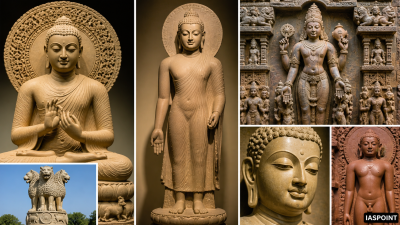
The Gupta period (4th to 6th century CE) is hailed as the “Golden Age” of Indian sculpture. It represents the culmination of centuries of artistic evolution, where the robust sensuality of the Kushana period merged with the spiritual idealism of the new era. This period moved away from the foreign influences of the Gandhara school, establishing a purely indigenous “Classical” idiom characterized by balance, harmony, and meditative serenity.
Core Schools of Gupta Sculpture
During this period, three major centers of excellence emerged, each contributing distinct stylistic nuances to the pan-Indian aesthetic.
- Sarnath School: This is the most refined school of Gupta art. It is characterized by the use of Chunar Sandstone and an emphasis on simplicity. The sculptures lack the heavy ornamentation of earlier periods, focusing instead on the “inner calm” and the spiritual glow of the face.
- Mathura School: A continuation of the Kushana tradition but with significant refinements. The “Spotted Red Sandstone” remained the primary medium, but the figures became more slender, the drapery more sophisticated, and the facial expressions more contemplative.
- Pataliputra School: Noted for its excellence in both stone and metal casting, this school served as the administrative and artistic heart of the empire.
Key Stylistic Characteristics of Gupta Art
The Gupta sculptor achieved a perfect synthesis between the physical form and spiritual essence.
- Wet Drapery Technique: Unlike the heavy folds of Gandhara, Gupta robes are transparent and cling to the body like “wet silk.” In Sarnath, the robes are often entirely smooth with only the hem indicated.
- Aura and Halos: The Prabhamandala (halo) became an elaborate work of art, featuring intricate floral patterns, creepers, and concentric circles, contrasting with the plain halos of the Gandhara period.
- The Meditative Gaze: Eyes are often depicted as half-closed or “lotus-shaped” (Padmapalasha), directed inward in a state of Samadhi (deep meditation).
- Curly Hair: The Buddha is almost universally depicted with small, clockwise “snail-shell” curls, replacing the wavy hair of the Greco-Buddhist style.
- Ornate Backrests: Statues were often set against richly carved thrones featuring Makaras (mythical sea creatures) and Shardulas (leogryphs).
Iconic Masterpieces of the Gupta Era
- Sarnath Seated Buddha: Carved in Chunar sandstone, this represents the Dharmachakra Pravartana (turning the wheel of law). It is the quintessential example of Gupta serenity, featuring a highly ornate halo and a peaceful facial expression.
- Sultanganj Buddha: A monumental 7.5-foot tall copper statue found in Bihar (now in Birmingham Museum). It demonstrates the advanced metallurgical skills of the Gupta craftsmen.
- Standing Buddha of Mathura: Shows the transition from Kushana to Gupta styles; the figure is robust yet graceful, wearing a diaphanous robe with delicate string-like folds.
- Varaha Avatar (Udayagiri Caves): A massive rock-cut relief depicting Vishnu as the Boar rescuing Goddess Earth. It symbolizes the political power and protective nature of the Gupta monarchs.
Religious Diversity in Gupta Sculpture
While Buddhist art reached its zenith, the Gupta period also saw the standardization of Hindu and Jain iconography.
| Religion | Key Sculptural Developments | Notable Examples |
| Brahmanism | Standardization of the Dashavatara (ten incarnations of Vishnu); emergence of the Ganga and Yamuna motifs at temple entrances. | Vishnu in Anantashayana (Deogarh); Dashavatara Temple reliefs. |
| Buddhism | Culmination of the Mahayana iconographic tradition; focus on various Mudras and Bodhisattvas. | Sarnath Buddha; Sultanganj Copper Buddha. |
| Jainism | Tirthankaras depicted with the Srivatsa mark on the chest; seated in Dhyana or standing in Kayotsarga pose. | Tirthankara images from Akota and Mathura. |
Metallurgy and Decorative Arts
The Gupta period was famous for its proficiency in casting large metal statues using the Lost Wax (Cire Perdue) process.
- Iron Pillar of Mehrauli: Though technically an architectural element, its casting and rust-resistant properties reflect the high caliber of Gupta metalwork.
- Numismatic Art: Gupta gold coins (Dinars) are themselves miniature sculptures. They feature highly realistic portraits of kings playing the Veena, hunting lions, or performing sacrifices, showcasing a high degree of individualized detail.
Fact Sheet for UPSC Prelims
- Materials: Predominantly Sarnath Sandstone, Red Sandstone, and Copper/Bronze.
- Deogarh Temple: The Dashavatara Temple at Deogarh is the finest example of Gupta stone relief carving, particularly the panels showing Vishnu reclining on the serpent Shesha.
- The “Gupta Smile”: A specific term used by art historians to describe the gentle, compassionate, and slightly detached smile seen on the faces of Gupta deities.
- Standardization: The Gupta period established the Chitra (fully in the round), Ardhachitra (high relief), and Chitrabhasa (painting) classifications of art.
- Legacy: The aesthetic standards set by the Guptas traveled to Southeast Asia, influencing the art of the Dvaravati (Thailand) and Sailendra (Indonesia) dynasties.
Comparison: Kushana vs. Gupta Sculpture
- Spirituality: Kushana art is more worldly and robust; Gupta art is spiritual and ethereal.
- Ornamentation: Kushana figures (especially Mathura) are heavily ornamented; Gupta figures (especially Sarnath) rely on the beauty of the physical form with minimal jewelry.
- Drapery: Kushana drapery is either heavy (Gandhara) or stringy (Mathura); Gupta drapery is thin, transparent, and seamless.
- Halos: Kushana halos were simple; Gupta halos are extravagantly decorated with floral and geometric motifs.