
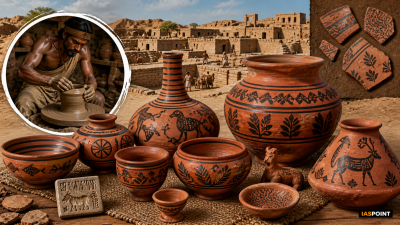
The pottery of the Indus Valley Civilization (IVC), dating primarily from the Mature Harappan phase (2600 BCE – 1900 BCE), represents the zenith of proto-historic ceramic technology and aesthetic tradition. Unlike the preceding Neolithic era, Harappan pottery was characterized by the widespread use of the potter’s wheel, resulting in sophisticated shapes and a standardized “Black-on-Red” painting style. These ceramics were not merely utilitarian but served as a canvas for the socio-religious and ecological expressions of the Harappan people.
Technical Classification of IVC Pottery
Harappan pottery is broadly classified into two categories, with the painted variety being the most significant for the study of Indian art history.
- Plain Pottery: The most common variety, usually made of red clay with or without a fine slip. It includes storage jars, offering stands, and S-shaped jars.
- Painted Pottery: Known as Red and Black Ware, where the pottery was coated with a red slip (iron oxide) and designs were executed using black pigment (manganese).
- Polychrome Pottery: Rare and found primarily at specific sites; it utilized multiple colors like red, black, green, and occasionally white and yellow.
- Incised Ware: Decorative patterns were cut into the clay before firing, though this is less common than painted decorations.
The Black-on-Red Painting Tradition
The hallmark of Indus Valley painting is the contrast between the deep red background and the jet-black motifs.
- Pigment Sourcing: Red slips were derived from ochre/hematite, while the black paint was typically made from manganese dioxide or charcoal.
- Firing Technique: Pottery was fired in high-temperature kilns, ensuring the pigments fused permanently with the clay body, which accounts for the remarkable preservation of these designs after 4,000 years.
- Surface Treatment: Before painting, the vessel was polished or burnished to create a smooth, slightly lustrous finish.
Iconography and Motifs: A 360° View
The painted motifs on IVC pottery can be categorized into geometric, floral, and faunistic themes, reflecting a deep connection with the natural environment.
Geometric Patterns
- Horizontal Bands: Most vessels feature parallel lines of varying thickness near the rim or base.
- Interlocking Circles: A signature Harappan motif consisting of overlapping circles that create a repetitive, sophisticated grid.
- Checkered Patterns: Squares and triangles arranged in alternating colors or textures.
- Chevrons and Spirals: Used to fill gaps between larger thematic elements.
Floral and Naturalistic Motifs
- Pipal Leaf (Ficus religiosa): The most sacred and recurring motif, indicating early roots of tree worship.
- Palm and Acacia: Depictions of local flora common to the Indus basin.
- Sun and Stars: Stylized celestial symbols often interspersed with floral patterns.
Faunal (Animal) Motifs
- Humped Bulls: Represented with great anatomical detail and vigor.
- Birds: Including peacocks, ducks, and cranes, often shown in motion.
- Fish and Aquatic Life: Fish-scale patterns were frequently used as “filler” designs on larger jars.
- Complexity of Narrative: Unlike simple isolated figures, some pottery (like that from Lothal) depicts complex scenes interpreted as folk tales.
Key Sites and Unique Findings
| Site | Unique Pottery Feature |
| Mohenjo-daro | High-quality large storage jars with intricate interlocking circle designs. |
| Harappa | Detailed “Black-on-Red” jars featuring the Pipal leaf and stylized bulls. |
| Lothal | The “Cunning Fox” jar: A painting depicting a bird on a tree holding a fish and a fox-like animal below, often linked to the Panchatantra stories. |
| Kalibangan | Discovery of pre-Harappan (Fabric A to F) pottery which was more utilitarian and less decorated. |
| Surkotada | Coarse red-brown pottery with simple horizontal lines, typical of the later phases. |
| Chanhu-daro | Evidence of a pottery workshop, showing mass production of painted ware. |
Functional Diversity of Painted Vessels
The Harappans applied their painting traditions to a wide variety of ceramic forms, each serving a specific social or domestic purpose.
- S-Shaped Jars: Tall, graceful jars decorated with elaborate floral and geometric scrolls.
- Perforated Jars: Large cylinders with holes, potentially used for straining liquids or as braziers; these were rarely painted but are a unique Harappan hallmark.
- Dish-on-Stand: Ritualistic or high-status serving vessels often decorated on the inner surface of the dish.
- Goblets and Beakers: Small, pointed-base “disposable” cups, usually plain, but occasionally featuring simple bands.
Trivia and Fact-File for UPSC Prelims
- Standardization: The uniformity in pottery shapes and painting styles across vast distances (from Gujarat to Punjab) suggests a highly organized guild system or centralized production.
- The “Lothal Narrative”: The pottery found at Lothal is considered the earliest evidence of pictorial storytelling in India.
- Graffiti Marks: Some pottery shards bear small signs or symbols (Potter’s marks) that resemble the Indus Script, though they remain undeciphered.
- Ochre Coloured Pottery (OCP): Aspirants should distinguish Harappan Black-on-Red ware from the later OCP culture, which was contemporary to the late-Harappan/Post-Harappan transition and had inferior firing quality.
- Glazed Pottery: The Harappans were among the earliest in the world to produce a form of glazed pottery (Faience), though this was used for beads and small amulets rather than large vessels.
Significance in Indian Art History
Indus Valley pottery painting is the foundational stage of the Indian aesthetic tradition. It established the use of nature-based symbolism (like the Pipal leaf) and mathematical symmetry (interlocking circles) that continued to influence Indian folk art, textile patterns, and temple decorations for millennia. The transition from the “Naturalism” of the Mesolithic to the “Stylized Perfection” of the Harappan pottery marks the birth of urban artistic sensibilities in the Indian subcontinent.
Last Modified: May 4, 2026