
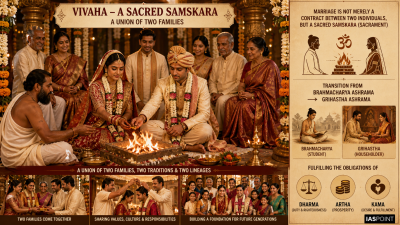
In the Indian social structure, marriage (Vivaha) is traditionally viewed not merely as a contract between two individuals, but as a sacred Samskara (sacrament) and a union between two families. It is the transition from the Brahmacharya (student) ashrama to the Grihastha (householder) ashrama, fulfilling the social and religious obligations of Dharma, Artha, and Kama.
Types of Marriages in Ancient India
The Dharmashastras and Manusmriti categorize marriage into eight distinct types, reflecting the social and moral landscape of ancient India.
- Brahma Vivaha: The father gifts his daughter, adorned with jewels, to a man learned in the Vedas. This is considered the most evolved and virtuous form.
- Daiva Vivaha: The daughter is married to a priest who performs a sacrifice (Yajna) properly.
- Arsha Vivaha: The groom gives a cow and a bull to the bride’s father, signaling a symbolic exchange rather than a bride-price.
- Prajapatya Vivaha: Similar to Brahma Vivaha, but with the specific instruction that the couple performs their civic and religious duties together.
- Gandharva Vivaha: A voluntary union based on mutual love and consent without the participation of the family (modern-day equivalent of love marriage).
- Asura Vivaha: The groom acquires the bride through the payment of a bride-price (Shulka).
- Rakshasa Vivaha: Marriage by abduction or force, common among warring factions in ancient times.
- Paishacha Vivaha: The lowest form, involving the seduction of a woman when she is unconscious or intoxicated; strongly condemned by all scriptures.
Key Marriage Customs and Rituals across Religions
India’s pluralistic heritage is reflected in the diverse marriage ceremonies practiced across different faiths, each governed by specific personal laws and traditions.
Hindu Marriage Traditions
Hindu weddings are characterized by Vedic rituals that have remained largely unchanged for centuries.
- Kanyadaan: The ritual of the father “gifting” the daughter to the groom.
- Panigrahana: The groom holds the bride’s hand, symbolizing his acceptance of responsibility.
- Saptapadi: The couple takes seven steps around the sacred fire (Agni). Each step represents a vow—nourishment, strength, prosperity, happiness, progeny, seasonal harmony, and lifelong friendship.
- Sindoor and Mangalsutra: Physical symbols of a woman’s married status in many Hindu communities.
Muslim Marriage Traditions (Nikah)
In Islam, marriage is a civil contract rather than a religious sacrament.
- Nikah-nama: The written contract signed by both parties.
- Mahr: A mandatory gift or dower paid by the groom to the bride at the time of marriage, which remains her personal property.
- Ijab-e-Qubul: The formal proposal (Ijab) and acceptance (Qubul) in the presence of witnesses.
- Walima: The marriage feast hosted by the groom’s family to announce the union to the community.
Sikh and Christian Traditions
- Anand Karaj: The Sikh marriage ceremony, performed in the presence of the Guru Granth Sahib. The couple circumambulates the holy book four times (Laavan).
- Christian Weddings: Governed by the Indian Christian Marriage Act, 1872; characterized by the exchange of rings, wedding vows, and the signing of the church register.
Rules of Marriage: Exogamy and Endogamy
Indian social customs dictate specific boundaries for choosing a spouse to maintain social order and lineage purity.
| Term | Definition | Context/Example |
| Endogamy | Marrying within one’s own social group/caste. | The most prevalent feature of the Jati system. |
| Exogamy | Marrying outside a specific group. | Gotra Exogamy: Prohibition of marriage within the same clan. |
| Hypergamy (Anuloma) | A woman marrying a man of higher social status. | Traditionally favored to maintain or raise family prestige. |
| Hypogamy (Pratiloma) | A woman marrying a man of lower social status. | Historically discouraged and socially penalized. |
| Cousin Marriage | Marriage between first cousins. | Common in South Indian Hindu traditions and Muslim communities; prohibited in North Indian Hindu customs. |
Regional and Tribal Variations
- Matrilineal Marriage: Among the Khasis of Meghalaya and Nayars of Kerala (traditionally), the groom often moves to the bride’s house or maintains a visiting relationship, with inheritance passing through the female line.
- Fraternal Polyandry: Historically practiced among certain Himalayan tribes (like the Toda of Nilgiris or communities in Jaunsar-Bawar), where brothers share a common wife to prevent the fragmentation of agricultural land.
- Maternal Uncle’s Role: In South Indian weddings (e.g., Tamil and Telugu), the maternal uncle (Mama) holds high ritualistic importance, often escorting the bride to the Mandap.
Legal Framework and Social Reforms
Post-independence India introduced several laws to regulate marriage and protect individual rights, overriding certain traditional customs.
- Special Marriage Act, 1954: Provides a legal avenue for inter-faith and inter-caste marriages without requiring religious conversion.
- Hindu Marriage Act, 1955: Codified laws for Hindus (including Buddhists, Jains, and Sikhs), prohibiting polygamy and establishing a legal age for marriage.
- Dowry Prohibition Act, 1961: Outlaws the practice of demanding or giving dowry, aiming to curb social exploitation.
- Prohibition of Child Marriage Act, 2006: Set the minimum age of marriage (18 for women, 21 for men) to protect children from early marriage.
Important Facts and Trivia for UPSC Prelims
- Swayamvara: An ancient practice where a woman of noble birth chose her husband from a group of assembled suitors after they performed a feat of skill.
- Vivaha Samskara: One of the 16 Shodasha Samskaras (major life transitions) in Hinduism.
- Meher vs. Dowry: Unlike dowry (which goes to the groom’s family), Mahr is the exclusive right of the Muslim bride, providing her financial security in case of divorce or death.
- The Concept of ‘Kulinism’: A historical practice in Bengal where high-caste Brahmin men married multiple women from lower sub-castes to “elevate” those families, often leading to social issues.
- Article 44: The Directive Principle of State Policy that suggests a Uniform Civil Code, which would standardize marriage and divorce laws across all religions in India.