
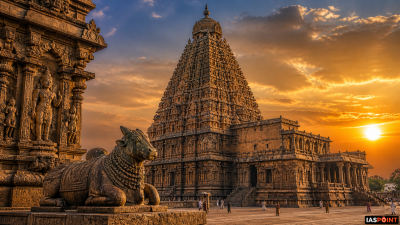
The Chola dynasty (9th to 13th century CE) represents the “Golden Age” of South Indian art and architecture. Under the patronage of monarchs like Rajaraja I and Rajendra I, Chola artists achieved technical perfection in both stone carving and bronze casting. While they inherited the foundational styles of the Pallavas, the Cholas introduced greater refinement, naturalism, and grandiosity, transitioning from the rock-cut tradition to massive structural temples decorated with intricate iconographic programs.
Characteristics of Chola Stone Sculpture
Chola stone sculptures are primarily integrated into the architectural framework of temples, serving as “Koshta-devatas” (niche deities) on the exterior walls of the Vimana.
- Refinement of Form: Unlike the slender Pallava figures, Chola sculptures exhibit a more balanced and rhythmic anatomy. The figures are characterized by rounded faces, slightly fuller bodies, and highly detailed ornamentation.
- Iconographic Standardization: The Cholas standardized the placement of deities. For instance, Dakshinamurti is consistently placed in the south niche, Vishnu or Ardhanarishvara in the west, and Brahma in the north.
- Narrative Friezes: The basements (Adhisthana) of Chola temples often feature long friezes depicting scenes from the Puranas, the Periyapuranam, and the epics (Ramayana and Mahabharata).
- Technical Precision: Sculptors used hard granite, yet managed to achieve a level of detail in jewelry, drapery, and hair that rivaled work in softer stones.
The Pinnacle of Bronze Casting: The Lost-Wax Process
The Cholas are world-renowned for their “Cire Perdue” (Lost-Wax) bronze sculptures. These were created as Utsava Murtis (processional deities) to be carried outside the temple during festivals.
- The Nataraja: The most iconic Chola bronze, depicting Shiva in the Ananda Tandava (Dance of Bliss).
- Right hand (Abhaya Mudra): Symbolizes protection and reassurance.
- Upper right hand: Holds the Damaru (drum), symbolizing the sound of creation.
- Upper left hand: Holds Agni (fire), symbolizing destruction.
- Lower left hand: Points to the raised foot, symbolizing liberation (Moksha).
- Right foot: Tramples the dwarf Apasmara, representing the crushing of ignorance and ego.
- Prabha Mandala: The flaming halo surrounding the deity represents the cosmos.
- Humanism in Divinity: Chola bronzes are noted for their “S-curve” or Tribhanga posture, lending a sense of fluid movement and grace to the metal.
Masterpieces of Chola Sculpture
| Temple/Site | Significant Sculptural Features |
| Brihadisvara Temple, Thanjavur | Massive monolithic Nandi; colossal Dwarapalas (gatekeepers); 108 Karana poses of Bharatanatyam carved in stone. |
| Gangaikonda Cholapuram | Exquisite panel of Chandesa Anugraha Murti (Shiva crowning the devotee Chandesa); complex Saraswati and Ganesha icons. |
| Airavatesvara Temple, Darasuram | Known as a “sculptor’s dream”; features “miniature” carvings of the 63 Nayanmars (Saiva saints) and revolving stone pillars. |
| Nageswaraswamy Temple, Kumbakonam | Contains life-size, highly realistic stone portraits of royal donors and court ladies. |
Major Themes and Iconography
Chola art was predominantly Saivite, but it remained inclusive of Vaishnava and Buddhist/Jain themes.
- Shaiva Themes: Various forms of Shiva including Bhikshatana (the supreme mendicant), Kalantaka (conqueror of death), and Lingodbhava (emergence from the pillar of light).
- Vaishnava Themes: Notable depictions of Varaha, Narasimha, and the “Kaliya-mardan” Krishna.
- Portrait Sculpture: The Cholas pioneered the creation of realistic portrait sculptures of kings and queens, often depicted in a state of perpetual worship (Anjali Mudra).
- Animal Statuary: The Chola Nandi (sacred bull) reached massive proportions, usually carved from a single block of stone and placed in a dedicated pavilion (Nandi Mandapa).
Technical Facts for UPSC Prelims
- Patronage of Queens: Queen Sembiyan Mahadevi was a prolific patron who reconstructed many brick temples into stone and commissioned some of the finest Chola bronzes.
- The Great Living Chola Temples: This UNESCO World Heritage site includes the temples at Thanjavur, Gangaikonda Cholapuram, and Darasuram, all of which house prime examples of Chola sculpture.
- Transition in Material: The Cholas moved entirely away from the soft sandstone used by some early dynasties to hard Granite, which required advanced iron tools and superior craftsmanship.
- Shilpa Shastras: Chola sculptors strictly followed the canons of the Agamas and Shilpa Shastras, ensuring that every proportion (Tala measure) of the deity was mathematically precise.
Trivia and Distinctive Marks
- The “Chola Smile”: A distinctive feature of Chola bronzes is the serene, ethereal smile on the faces of the deities, conveying a sense of inner detached calm.
- Stone Chains: At certain Chola sites, sculptors demonstrated their skill by carving functional, interlocking chains out of a single piece of stone.
- Global Recognition: The Chola Nataraja is considered by modern physicists (like Fritjof Capra) as a metaphor for the “cosmic dance” of subatomic particles, leading to a statue of the Nataraja being installed at CERN, Geneva.
- Processional Holes: Most Chola bronzes have rectangular holes in their bases, designed to fit wooden poles so the heavy statues could be carried on the shoulders of devotees.