
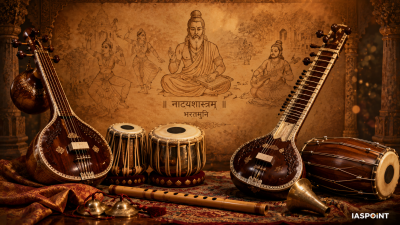
The classification of musical instruments in India is traditionally based on the Natyashastra compiled by Bharat Muni (c. 200 BC – 200 AD). He categorized instruments into four distinct groups based on the source of sound vibration, a system later adopted by Western musicologists as the Hornbostel-Sachs system.
Tata Vadya (Chordophones/String Instruments)
These instruments produce sound through the vibration of strings. They are further divided into three sub-categories based on the method of playing.
Plucked Instruments
- Veena: The oldest string instrument. Variants include the Rudra Veena (used in Dhrupad), Saraswati Veena (Carnatic music), and Vichitra Veena.
- Sitar: Traditionally attributed to Amir Khusrau; it features sympathetic strings (Tarabs).
- Sarod: Derived from the Afghan Rabab; it has a fretless metal fingerboard allowing for smooth glides (Meend).
- Tanpura: A four or five-stringed instrument used exclusively as a drone to provide the reference pitch.
Bowed Instruments
- Sarangi: Known as the instrument most resembling the human voice; traditionally carved from a single block of wood.
- Dilruba and Esraj: Cross-breeds between the Sitar and Sarangi, popular in Shantiniketan and Sikh devotional music.
- Violin: Introduced to Carnatic music in the 18th century by Balaswami Dikshitar.
Struck String Instruments
- Santoor: A trapezoid-shaped hammered dulcimer from Kashmir, traditionally called Shata-tantri Veena (instrument with 100 strings).
Sushira Vadya (Aerophones/Wind Instruments)
Sound is produced by the vibration of air columns.
- Bansuri: A transverse flute made of bamboo. Key exponents include Pt. Hariprasad Chaurasia.
- Shehnai: A double-reed instrument traditionally associated with auspicious occasions. Ustad Bismillah Khan brought it to the classical stage.
- Nadaswaram: A larger, more powerful version of the Shehnai used in South Indian temples and weddings.
- Shankh (Conch): One of the oldest wind instruments, primarily used in religious rituals.
Avanaddha Vadya (Membranophones/Percussion Instruments)
These are “covered” instruments where sound is produced by striking a stretched skin or membrane.
- Tabla: A pair of drums (Dayan and Bayan). It is the primary percussion for Khayal and light classical music.
- Pakhawaj: A two-headed barrel drum used primarily for Dhrupad and Odissi dance.
- Mridangam: The primary rhythmic accompaniment in Carnatic music. Unlike the Pakhawaj, it is made of clay or wood with specialized paste (Sadam) on the right head.
- Ghatam: An earthenware pot used in Carnatic music, played with fingers and palms.
- Kanjira: A small frame drum (similar to a tambourine) used in South India.
Ghana Vadya (Idiophones/Solid Instruments)
These instruments are made of metal or wood and do not require tuning. They produce sound through the resonance of the body itself.
- Manjira: Small brass cymbals used in Bhajans and dance.
- Kartal: Wooden clappers with metal discs, commonly used in folk and devotional music.
- Jaltarang: A series of porcelain bowls filled with water to specific levels, struck with wooden sticks to produce melodic notes.
- Morsing: A “Jew’s Harp” used in Carnatic music, placed between the teeth and plucked.
Comparative Overview of Major Instruments
| Category | Typical Materials | Key Instruments | Primary Musical Context |
| Tata | Wood, Silk/Steel strings, Gourd | Sitar, Sarod, Veena | Solo Melodic Elaboration |
| Sushira | Bamboo, Wood, Metal | Bansuri, Shehnai | Melody/Auspicious rituals |
| Avanaddha | Wood, Clay, Animal Skin | Tabla, Mridangam | Rhythmic Cycles (Tala) |
| Ghana | Metal, Glass, Clay | Manjira, Jaltarang | Rhythm and Time-keeping |
Regional and Folk Musical Instruments
- Ektara: A single-stringed instrument used by Baul singers in Bengal and Sufi saints.
- Kamaicha: A bowed instrument of the Manganiyar community in Rajasthan, featuring a large circular skin-covered resonator.
- Pepa: A horn-pipe instrument made of buffalo horn, used during Bihu celebrations in Assam.
- Pungi/Been: A reed instrument traditionally used by snake charmers, made from a dried gourd.
- Chenda: A loud, cylindrical percussion instrument essential to Kathakali and festivals in Kerala.
Technical Facts and Trivia for UPSC
- The Drone: The Tanpura is the only instrument in Indian music that does not play a melody but is considered the most essential as it provides the Adhara Shadja (base note).
- The Black Spot (Siyahi): Found on the Tabla and Mridangam, this is a paste made of iron filings and flour that allows the instrument to produce specific harmonic overtones.
- Sympathetic Strings: Many Indian instruments like the Sitar and Sarangi have a second layer of strings that vibrate “in sympathy” with the main strings, creating the characteristic “reverb” of Indian music.
- Kshudra Ghantika: Small bells (Ghungroo) worn by dancers; these are classified as Ghana Vadya.
- Historical Evolution: The Sitar evolved from the Persian ‘Sehtar’ (three strings), while the Sarod was adapted from the Rabab to suit the continuous melodic glides required in Indian Ragas.