
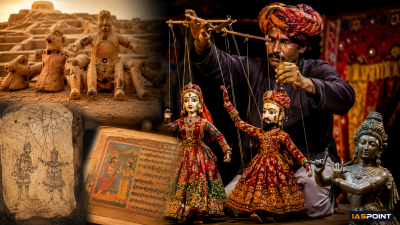
The art of puppetry in India, known as Puttalika or Marionette, traces its roots back to the Harappan civilization. Archaeological excavations at Mohenjo-daro and Harappa have unearthed terracotta figurines with detachable limbs and holes for strings, suggesting that mechanical toys or primitive puppets existed as early as 2500 BCE. Historically, puppetry is considered one of the oldest forms of entertainment and education in India. In the classical Sanskrit text Natya Shastra, the stage manager is referred to as the Sutradhara (the holder of strings), implying that puppetry might have predated or deeply influenced classical Indian theater. The Silappadikaram, a 2nd-century CE Tamil epic, also contains explicit references to “marionettes moved by strings.”
Regional Classifications and Techniques
Indian puppetry is broadly categorized into four distinct styles based on the method of manipulation and the materials used. Each region has evolved its own unique aesthetic, often drawing themes from the Ramayana, Mahabharata, and local folklore.
String Puppets (Marionettes)
String puppets are carved from wood and manipulated using strings attached to different body parts. These are prevalent in Rajasthan, Odisha, Karnataka, and Tamil Nadu.
- Kathputli (Rajasthan): Characterized by large eyes and oval faces, these puppets have no legs but are covered by long trailing skirts (ghagra). They are operated by a single string looped around the puppeteer’s fingers.
- Kundhei (Odisha): These puppets are made of light wood and have multiple joints, providing more flexibility. They are dressed in costumes reminiscent of the Jatra traditional theater.
- Gombeyatta (Karnataka): These are styled after the characters of Yakshagana, the traditional theater form of the region. They are highly stylized and often require multiple puppeteers for a single figure.
- Bommalattam (Tamil Nadu): Unique for combining features of both string and rod puppets. The strings are attached to a cloth-covered iron ring, which the puppeteer wears on their head like a crown.
Shadow Puppets
Shadow puppets are flat figures cut out of leather, which has been treated to make it translucent. They are pressed against a white screen with a strong light source behind them.
- Togalu Gombeyatta (Karnataka): These puppets vary in size depending on the social status of the character; for instance, kings are larger than commoners.
- Tholu Bommalata (Andhra Pradesh): Known for being life-sized and intricately perforated. They often feature colored shadows, a rare trait in traditional shadow theater.
- Ravanachhaya (Odisha): These are the most primitive shadow puppets, made of deerskin and possessing no joints. They cast bold, opaque shadows rather than colored ones.
Rod Puppets
Rod puppets are an extension of glove puppets but are much larger and supported by rods from below.
- Putul Nautch (West Bengal): These puppets are usually human-sized and carved from wood. The puppeteer stands behind a head-high curtain and manipulates the rods tucked into their waist.
- Yampuri (Bihar): Traditional rod puppetry where puppets are made of wood. Unlike others, these are not jointed, making the manipulation simpler but the storytelling more narrative-heavy.
Glove Puppets
Also known as sleeve or hand puppets, these are manipulated using the thumb and fingers.
- Pavakoothu (Kerala): Deeply influenced by Kathakali, these puppets feature the same elaborate headgears and facial colors. The themes are predominantly based on the Ramayana and Mahabharata.
Comparative Analysis of Major Puppetry Forms
| Form | Region | Type | Material | Distinctive Feature |
| Kathputli | Rajasthan | String | Wood & Cloth | No legs; stylized oval faces. |
| Tholu Bommalata | Andhra Pradesh | Shadow | Leather | Large, translucent, and colored. |
| Putul Nautch | West Bengal | Rod | Wood | Large size; waist-pole manipulation. |
| Pavakoothu | Kerala | Glove | Wood & Cloth | Mirroring Kathakali dance costumes. |
| Bommalattam | Tamil Nadu | String/Rod | Wood | Heaviest puppets in India; head-ring control. |
Cultural and Socio-Political Significance
Puppetry in India has never been purely for entertainment. It served as a vital tool for:
- Social Reform: During the Indian independence movement, puppetry was used to spread nationalist messages and awareness about social evils like dowry and illiteracy.
- Religious Education: Puppeteers, often belonging to nomadic communities like the Bhats of Rajasthan, acted as carriers of oral traditions, ensuring the survival of epic narratives across generations.
- Mythological Preservation: The portrayal of deities and demons through puppets helped maintain the iconographic standards of Indian art and sculpture.
Trivia and Key Facts for Aspirants
- Sutradhara: Literally means “holder of strings.” This term in classical Sanskrit drama proves the foundational role of puppetry in Indian performing arts.
- UNESCO Recognition: Various initiatives by Sangeet Natak Akademi aim to preserve “dying” forms like Ravanachhaya, which are considered endangered cultural heritage.
- Leather Sources: Traditional shadow puppets were made from goat or deer skin, treated with indigenous oils to achieve a parchment-like transparency.
- Absence of Legs: In Rajasthani Kathputli, the absence of legs is a stylistic choice, emphasizing the fluid, sweeping movements of the traditional Rajasthani dance forms.