
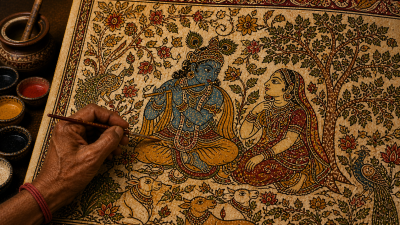
Kalamkari is a traditional Indian art form of hand-painting or block-printing on cotton textile, derived from the Persian words Kalam (pen) and Kari (craftsmanship). While its roots can be traced back to the ancient healing patterns found in the sites of Mohenjo-daro, it flourished during the medieval period under the patronage of the Golconda Sultanate and later the Vijayanagara Empire. Historically, it served as a “visual aid” for wandering singers and painters known as Chitrakattis, who illustrated accounts of Hindu mythology to village audiences.
The Two Main Schools of Kalamkari
Indian Kalamkari is broadly divided into two distinct styles, each defined by its geographical origin, patronage, and technical execution.
| Feature | Srikalahasti Style | Machilipatnam Style |
| Location | Tirupati district, Andhra Pradesh | Krishna district, Andhra Pradesh |
| Technique | Entirely hand-drawn using a bamboo pen (Kalam). | Combination of hand-carved wooden blocks and pen-work. |
| Patronage | Temple-oriented; flourished under Vijayanagara kings. | Trade-oriented; influenced by Persian motifs and Golconda Sultanate. |
| Thematic Focus | Primarily Hindu mythology (Ramayana, Mahabharata, Puranas). | Floral patterns, creepers, and Persian designs (Tree of Life). |
| Visual Style | Narrative scrolls with text descriptions. | Geometric and repetitive decorative patterns. |
Process and Technical Specifications
The production of a single piece of Kalamkari involves a rigorous 23-step process that can take up to 40 days to complete. It relies heavily on “slow-processing” and natural alchemy.
- Treatment of Cloth: The cotton fabric (usually Gada) is treated with a mixture of buffalo milk and Myrobalan (Karakkaya). The milk prevents the dyes from spreading, while the Myrobalan acts as a natural mordant.
- The Kalam (Pen): A sharp-pointed bamboo or date palm stick is used. A bundle of fine hair or a piece of cloth is tied near the tip to serve as a reservoir for the dye.
- Charcoal Sketching: Initial outlines are drawn using burnt tamarind twigs.
- Color Chemistry:
- Black (Kasim): Prepared by fermenting iron filings with jaggery and water.
- Red: Obtained from the roots of the Madder plant or Alizarin.
- Yellow: Sourced from pomegranate rinds or Myrobalan flowers.
- Blue: Extracted from the Indigo plant.
- The Washing Ritual: The fabric is washed multiple times in running river water (traditionally the Swarnamukhi River for Srikalahasti) to remove excess dye and set the colors.
Iconography and Narrative Elements
The Srikalahasti style is particularly famous for its narrative panels. These often include:
- Deities: Elaborate depictions of Lord Shiva, Vishnu, and the Goddess in various avatars.
- Borders: Heavy borders featuring lotus motifs, swans (Hamsas), or stylized peacocks.
- Textual Labels: Descriptions of the scenes written in Telugu script often accompany the paintings to help viewers identify the mythological episode.
Geographical Indication (GI) and Recognition
Both major styles of Kalamkari have been granted Geographical Indication tags, ensuring the protection of the traditional knowledge associated with the craft.
- Srikalahasti Kalamkari: GI Tagged under the Handicrafts category for Andhra Pradesh.
- Machilipatnam Kalamkari: Also GI Tagged, recognizing its unique block-printing heritage.
- Karuppur Kalamkari: A lesser-known but significant third style from Tamil Nadu (Thanjavur region), which involves intricate pen-work on gold-brocaded fabric, primarily used for royal attire and temple umbrellas.
Fact Sheet for UPSC Prelims
- Mordant Painting: Kalamkari is technically a “mordant-dyeing” process where the dye only sticks to the areas treated with specific minerals.
- Influence on Global Trade: During the 17th and 18th centuries, Kalamkari (known as Chintz in Europe) was a major Indian export, significantly influencing the textile industries of Britain and France.
- Environmental Impact: The art is completely eco-friendly; it uses no synthetic chemicals, and the waste products (like used milk or vegetable matter) are biodegradable.
- Pedda Ganjam: A historical hub near Machilipatnam once famous for producing high-quality Kalamkari for Southeast Asian markets.
- The “Tree of Life” Motif: A signature element of the Machilipatnam style, symbolizing the connection between the earth, the sky, and the underworld, heavily influenced by Safavid Persian art.
- Role of Buffalo Milk: It provides a protein coating to the cellulose fibers of the cotton, which is essential for the natural dyes to bond permanently.